Samsung Galaxy S25+ Appears on Geekbench Featuring Snapdragon 8 Elite for Galaxy

The Samsung Galaxy S25+ is gearing up for its anticipated launch in January 2025, alongside the standard Galaxy S25 and the premium Galaxy S25 Ultra. This new lineup will serve as the successor to the Galaxy S24 series, which debuted earlier in January 2024. Recent leaks have revealed key details about the Galaxy S25+, following a Geekbench listing that offers insights into its hardware specifications, including its chipset, RAM capacity, and software.

A device believed to be the Galaxy S25+ was spotted on Geekbench with the model number SM-S936U, where the “U” is indicative of the US variant. According to the listing, the smartphone achieved an impressive 3,160 points in single-core testing and 9,941 points in multi-core testing. The benchmarks further revealed that the device is powered by an octa-core processor with a peak clock speed of 4.47 GHz, showcasing its potential for high performance.

Under the hood, the Samsung Galaxy S25+ is expected to feature the Snapdragon 8 Elite for Galaxy chipset. This custom-tuned processor, exclusive to Samsung’s Galaxy series, is likely designed to deliver enhanced performance and efficiency compared to its predecessors. Accompanying the powerful SoC is 12GB of RAM, which will ensure smooth multitasking and a seamless user experience. The device is also anticipated to run Android 15, layered with Samsung’s upcoming One UI 7.0, offering the latest software features and design refinements.

As part of the Galaxy S25 series, the Galaxy S25+ is positioned to appeal to users seeking a balanced combination of premium features and performance without venturing into the ultra-premium price range. With cutting-edge hardware, advanced software, and Samsung’s trusted design philosophy, the Galaxy S25+ is shaping up to be a strong contender in the flagship smartphone market for 2025. More details are likely to emerge as the official launch date approaches, fueling anticipation for Samsung’s next-generation devices.

Brazilian Flowers Use Pollen Catapults to Gain Edge in Pollination Competition

Brazilian Flowers Use Pollen Catapults to Outcompete Rivals in Pollination
In a fascinating study of plant-pollinator interactions, researchers have discovered that flowers of Hypenia macrantha, a species native to Brazil, employ an innovative strategy to increase their reproductive success. These flowers use a unique pollen “catapult” mechanism to boost their chances of successful pollination by effectively displacing competing pollen from visiting hummingbirds. This remarkable adaptation ensures that their pollen is more likely to be transferred to other flowers, thus outcompeting other species in the pollination process.

How the Pollen Catapult Works
The flowers of Hypenia macrantha exhibit a clever strategy for both male and female reproductive stages, alternately switching roles to prevent self-pollination. During their male phase, the flowers produce and store pollen in compartments hidden beneath their petals. When a hummingbird approaches the flower to feed on nectar, the bird’s probing activates a trigger mechanism, launching the stored pollen in a burst. This sudden release of pollen aims to displace any competing pollen already present on the bird’s beak, improving the flower’s chances of fertilization.

Experimenting with Hummingbird Skull Simulations
To observe this mechanism in action, researchers conducted experiments using hummingbird skulls coated with fluorescent particles to simulate natural conditions. High-speed footage captured the remarkable effect of the pollen launch, showing that the flower’s burst of pollen successfully displaced rival particles from the bird’s beak. The research demonstrated that when flowers were still in their male phase, the pollen launch was much more effective at removing competing pollen, further solidifying the plant’s advantage in the pollination process.

Implications for Pollination and Plant Evolution
The findings of this study offer new insights into how plants have evolved specialized strategies to ensure reproductive success in competitive environments. The use of a pollen catapult by Hypenia macrantha is a prime example of how plants can outcompete one another through sophisticated mechanisms that take advantage of animal behavior. This research not only advances our understanding of plant-pollinator dynamics but also highlights the remarkable ways in which nature adapts to ensure survival and reproduction.

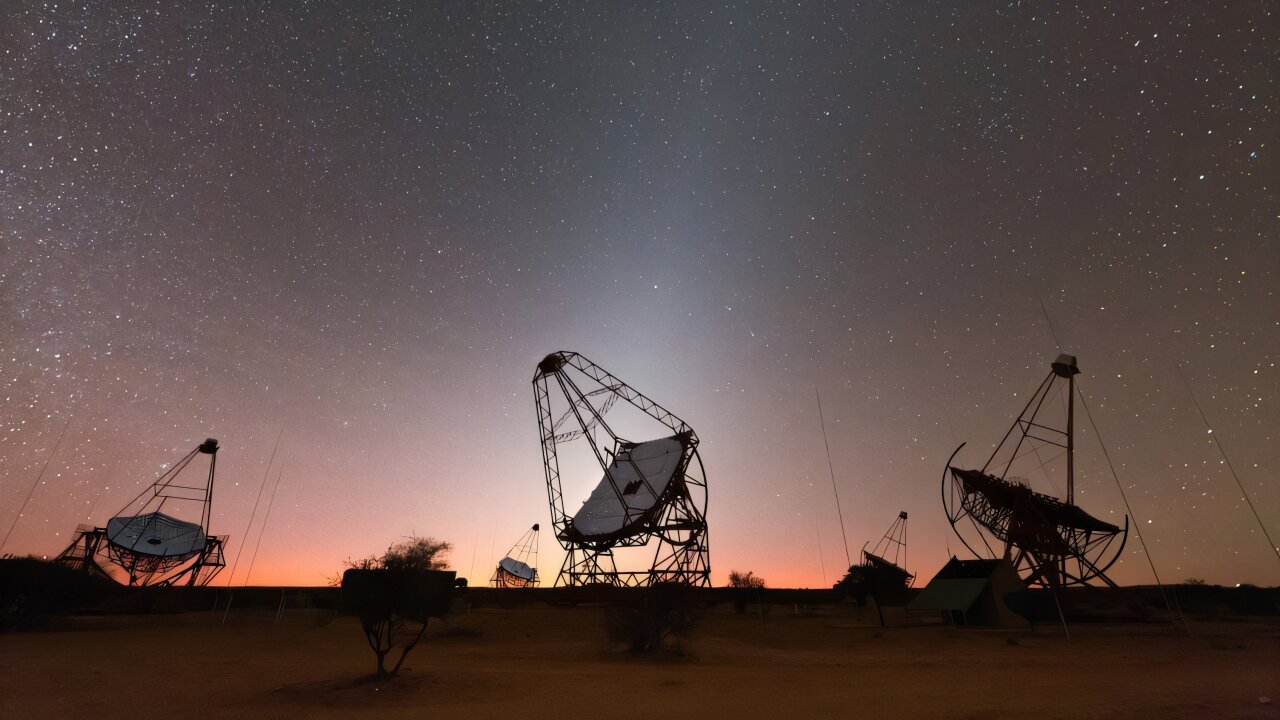
Namibian Observatory Detects Highest Energy Cosmic Electrons, Enhancing Understanding of Cosmic Rays

Namibian Observatory Records Highest-Energy Cosmic Electrons, Unlocking Cosmic Ray Mysteries
After more than a decade of research, the H.E.S.S. (High-Energy Stereoscopic System) Observatory in Namibia has made a groundbreaking discovery by detecting the most energetic cosmic ray electrons ever observed. These high-energy particles, which include both electrons and positrons, are believed to originate from some of the universe’s most extreme and powerful phenomena, such as supernova explosions, neutron stars, and black holes. The discovery provides new insights into the sources of these particles, which are suspected to lie within a few hundred light-years of the solar system.

Understanding Extreme Cosmic Processes
The detection of these particles marks a significant advancement in our understanding of the universe’s most energetic processes. Dr. Mathieu de Naurois, Deputy Director of the H.E.S.S. collaboration and researcher at the French National Centre for Scientific Research, emphasized the importance of these findings in revealing the nature of the universe’s biggest particle accelerators. These cosmic accelerators are often linked to the most violent and high-energy phenomena in space, and by studying them, scientists can better understand the mechanics behind these extreme events.

Challenges in Detecting High-Energy Electrons
Detecting these high-energy cosmic rays presents unique challenges due to their rarity and the difficulty in distinguishing them from other cosmic particles. The H.E.S.S. Observatory overcame these obstacles by employing an innovative method using an array of large telescopes designed to detect Cherenkov radiation. This phenomenon occurs when high-energy particles collide with Earth’s atmosphere, producing a faint flash of light. The observatory’s telescopes are capable of capturing this light, allowing scientists to identify and study these particles with energy levels far exceeding those generated by Earth-based accelerators.

Advancing the Study of Cosmic Rays
The successful detection of cosmic electrons with energies surpassing several teraelectronvolts (TeV) marks a new frontier in astrophysical research. This breakthrough provides a clearer picture of the dynamic and violent environments where these particles are produced, offering clues about the physical conditions near black holes and other extreme objects. As the H.E.S.S. Observatory continues its research, it is poised to further unravel the mysteries of cosmic rays and the powerful forces shaping the universe. This discovery not only enhances our understanding of high-energy particles but also paves the way for future research into the most energetic and distant phenomena in space.