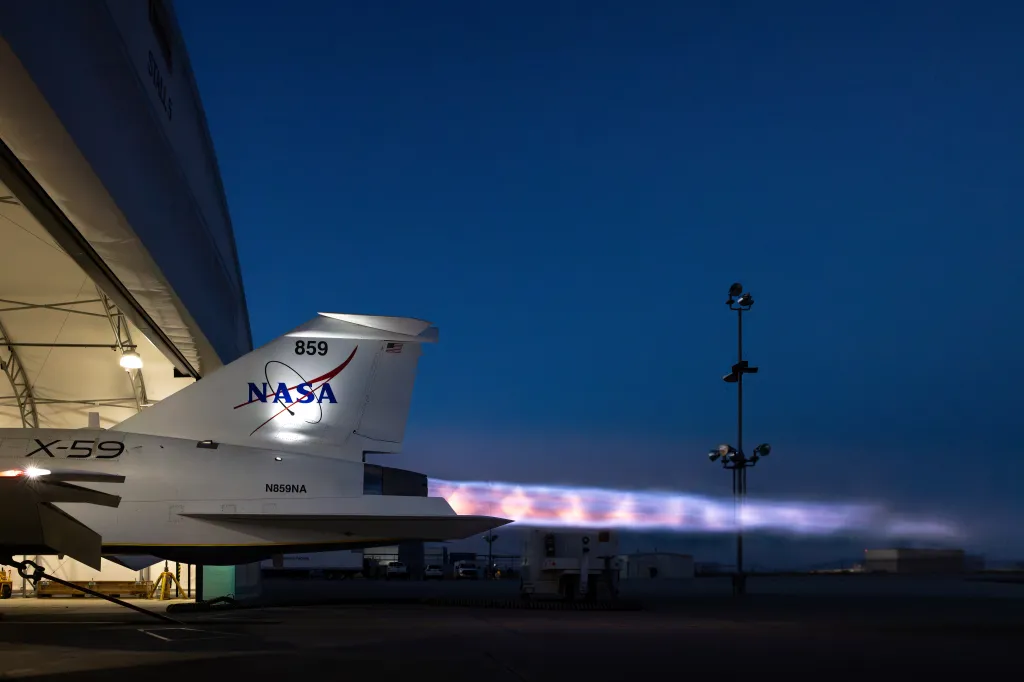
NASA’s X-59 Jet Undergoes Afterburner Test Ahead of Supersonic Flight Trials

NASA’s X-59 supersonic jet, developed in collaboration with Lockheed Martin, has achieved a major milestone with the successful completion of afterburner engine tests. This aircraft is a key component of NASA’s Quesst program, which aims to revolutionize supersonic travel by significantly reducing the disruptive sonic booms that have long restricted such flights over populated areas. Conducted at Lockheed Martin’s Skunk Works facility in Palmdale, California, the tests showcased the X-59’s ability to meet supersonic performance benchmarks, bringing it closer to its first flight.

Performance Evaluation of Engine Systems

The X-59 is powered by the General Electric F414-GE-100 jet engine, a modified version of the one used in Boeing’s F/A-18 Super Hornet. NASA subjected the engine to rigorous afterburner trials to evaluate its performance under supersonic conditions. These tests assessed whether the engine could operate within safe temperature limits while maintaining sufficient airflow to sustain high-speed travel. Lockheed Martin shared images on X (formerly Twitter) highlighting the afterburner tests, which involved injecting fuel into the exhaust system to increase thrust. The trials also ensured compatibility between the engine and other onboard subsystems.

Flight Testing and Public Reaction Studies

With successful engine tests completed, the next phase for the X-59 involves ground testing and final flight preparations. Once ready, NASA will conduct a series of flight tests, during which F-15 aircraft equipped with specialized probes will analyze the shockwaves produced during supersonic travel. This data will be critical in validating the X-59’s quiet supersonic technology. Unlike traditional supersonic jets that produce loud sonic booms, the X-59 is designed to create a much softer “sonic thump.”

A Step Toward Commercial Supersonic Travel

NASA’s long-term goal is to use the X-59 to gather public response data by flying over select residential areas in the United States. Researchers will measure how people perceive the aircraft’s reduced sonic impact, providing crucial insights for regulatory agencies. If successful, this program could pave the way for future commercial supersonic flights over land, ultimately transforming air travel by significantly cutting flight times without the disruptive noise that has hindered supersonic aviation in the past.

ISRO Marks 100th Launch with Successful Deployment of NVS-02 NavIC Satellite via GSLV-F15

The Indian Space Research Organisation (ISRO) marked a historic achievement on Wednesday with the successful deployment of the NVS-02 navigation satellite using the GSLV-F15 rocket. The launch took place at 6:23 am from the Satish Dhawan Space Centre in Sriharikota and was ISRO’s 100th mission, highlighting the agency’s continued advancements in space technology. The satellite was precisely placed into the Geosynchronous Transfer Orbit (GTO), further strengthening India’s Navigation with Indian Constellation (NavIC) system. Notably, this was the first major launch overseen by ISRO Chairman V Narayanan since he took office on January 16, 2025.

Mission Details and NavIC Expansion

ISRO confirmed the successful launch in a post on X (formerly Twitter), noting that the 50.9-meter GSLV-F15 rocket lifted off smoothly after a 27.30-hour countdown. This mission featured an indigenous cryogenic upper stage, a key technological milestone for India’s space program. The NVS-02 satellite is the second in the second-generation NavIC series, designed to enhance India’s positioning, navigation, and timing services, covering both domestic regions and a 1,500 km range beyond national borders. The first satellite in this series, NVS-01, was launched in May 2023, paving the way for more robust and precise navigation capabilities.

Developed at the U R Rao Satellite Centre in Bengaluru, NVS-02 weighs approximately 2,250 kg and carries advanced payloads operating in the L1, L5, and S bands. It is equipped with a tri-band antenna and an indigenous Rubidium Atomic Frequency Standard, a critical technology that significantly improves the accuracy of navigation signals. This marks a major step in India’s efforts to reduce dependency on foreign positioning systems and further develop its own satellite-based navigation infrastructure.

With the successful deployment of NVS-02, ISRO continues to expand the capabilities of NavIC, ensuring better coverage and precision for civilian and military applications. This mission underscores India’s growing expertise in satellite navigation technology and reinforces its position as a key player in the global space industry. As ISRO gears up for future launches, including ambitious interplanetary missions, this achievement serves as another milestone in India’s journey toward space self-reliance.

Hugging Face Works on Fully Open-Source Alternative to DeepSeek-R1 AI

Hugging Face has launched a new initiative to develop Open-R1, a fully open-source replication of the DeepSeek-R1 AI model. This move comes in response to last week’s release of DeepSeek-R1 by the Chinese AI firm DeepSeek, which made headlines for its advanced capabilities and potential to rival OpenAI’s cutting-edge models. While DeepSeek-R1 was made publicly available, it was not truly open-source, as crucial components like the training code and dataset were withheld. Hugging Face aims to bridge this gap by reconstructing these missing elements, ensuring a fully transparent and accessible alternative for the AI community.

Why Is Hugging Face Building Open-R1?

In a blog post, Hugging Face researchers outlined their motivation for replicating DeepSeek-R1. While the model’s architecture and weights were shared, key training assets were not disclosed, making it a “black-box” release. This means users can run the model locally, but they lack the necessary data and methods to recreate or modify it. By developing Open-R1, Hugging Face hopes to empower researchers and developers with a fully open framework, promoting transparency and collaborative AI advancements.

One of the critical missing pieces in DeepSeek-R1’s release is the dataset used for training, particularly in reasoning-specific tasks. Additionally, the training code that defines hyperparameters—essential for fine-tuning the model’s ability to process complex queries—remains undisclosed. Hugging Face’s initiative aims to reconstruct these elements, ensuring that developers can understand and improve upon the model rather than simply using it as a locked-down tool.

By working on Open-R1, Hugging Face is reinforcing its commitment to truly open AI development, countering the growing trend of AI models being released with limited transparency. If successful, this project could set a new standard for open-source AI, allowing researchers to study, improve, and build upon state-of-the-art models without restrictions. As AI development continues to accelerate, efforts like Open-R1 will be crucial in maintaining a balance between innovation and accessibility.