Fossil Discovery Reveals Plant Survival After the End-Permian Mass Extinction in China

New Fossil Findings Suggest Plants Survived the End-Permian Mass Extinction in China

Fossil evidence uncovered in China indicates that not all life perished during the catastrophic End-Permian mass extinction, which occurred nearly 252 million years ago. This event, often referred to as the “Great Dying,” led to the extinction of approximately 80% of life on Earth. While the mass extinction was largely driven by intense volcanic eruptions in the Siberian Traps, causing massive carbon dioxide emissions, global warming, and ocean acidification, new findings show that some plant species managed to survive the upheaval. Fossilized remains of gymnosperm forests and ferns have been discovered in present-day northeastern China, suggesting that certain regions of terrestrial life endured the planet’s harshest extinction event.

Insights from Ancient Rock Layers in Xinjiang

The research, published in Science Advances, focused on rock layers in Xinjiang, China, that date back to the time of the End-Permian extinction. Lead researcher Wan Yang, a professor of geology and geophysics at Missouri University of Science and Technology, pointed out that these rock formations showed no signs of mass plant extinction in the region. Rather than a rapid die-off followed by regrowth, the fossils of spores and pollen found in the layers revealed a more gradual shift in plant species. This discovery challenges the long-held belief that land-based ecosystems experienced the same near-total collapse as marine environments during this period.

The Role of Climate and Geography in Plant Survival

The findings also suggest that geography and climate played a significant role in plant survival during this difficult period. The study proposes that areas with humid climates and proximity to water bodies, such as rivers and lakes, acted as refuges for vegetation. This pattern mirrors what has been observed in other parts of the world, such as South America and Africa, where higher-latitude locations seemed to offer more stable conditions for plant life. Paleobotanist Josefina Bodnar, from the National University of La Plata in Argentina, commented that plants’ survival mechanisms, including deep-rooted structures and durable seeds, likely helped them endure the extreme environmental conditions of the time.

Implications for Understanding Mass Extinctions

These new fossil discoveries offer valuable insights into how life on land responded to one of Earth’s most severe extinction events. They challenge previous assumptions about the total collapse of terrestrial ecosystems during the End-Permian event, revealing a more complex survival strategy among plants. As scientists continue to study the resilience of life during such catastrophic periods, these findings help improve our understanding of mass extinctions and the environmental factors that shape the survival of species. The research underscores the importance of regional differences and survival adaptations in shaping the course of life on Earth through times of global environmental upheaval.
ISRO SpaDeX Achieves Successful Undocking, Paving the Way for Chandrayaan-4 and Gaganyaan Missions

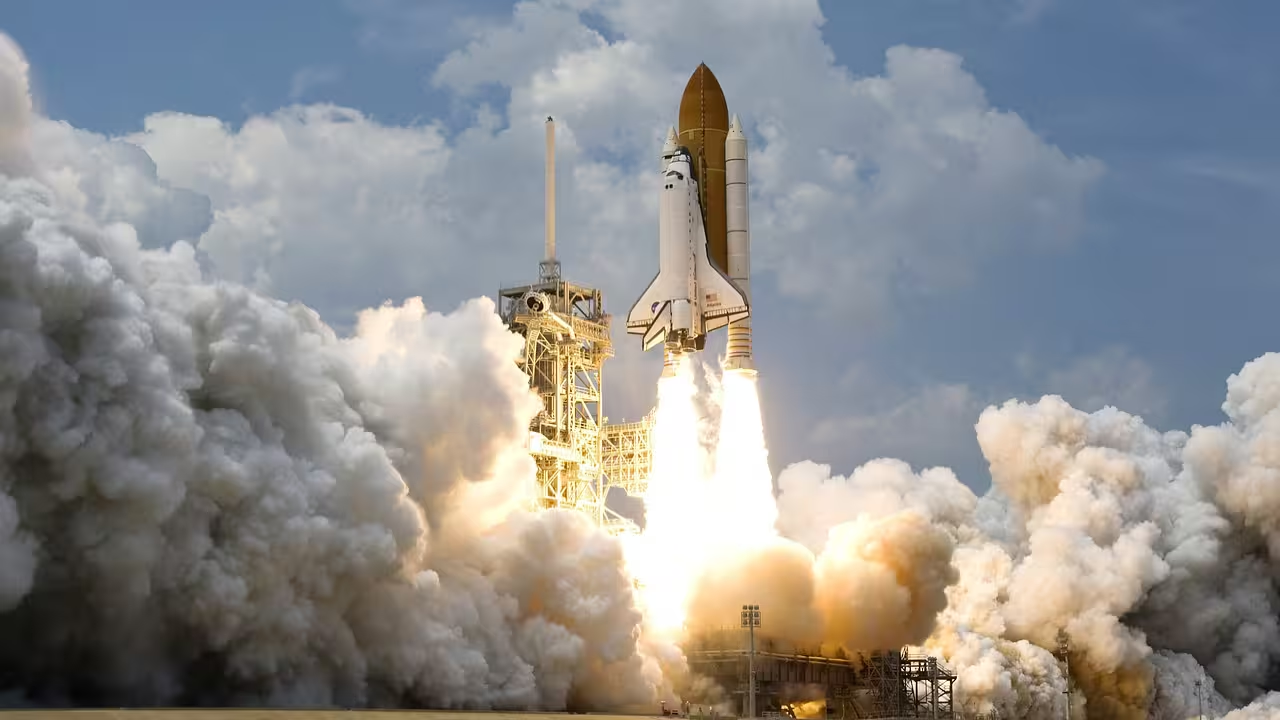
The Indian Space Research Organisation (ISRO) has successfully completed a pivotal milestone with the undocking of its Space Docking Experiment (SpaDeX). This marks a significant advancement for India’s space program, especially in relation to future missions such as Chandrayaan-4 and Gaganyaan. The successful undocking, which took place earlier today, involved the precise separation of two spacecraft, showcasing ISRO’s growing capabilities in space docking technologies. With this success, India joins an exclusive group of countries— the United States, Russia, and China— that have achieved this critical space feat. This accomplishment is set to lay the groundwork for more ambitious missions, including the planned Bharatiya Antriksha Station, which aims to further enhance India’s presence in space.

The undocking process was an intricate procedure, carefully planned and executed by ISRO. According to reports from the agency, the operation began with the extension of the SDX-2, followed by the precise release of capture lever 3. This series of steps ensured the successful disengagement of the docking mechanism. The de-capture command was then issued, allowing the satellites to separate as planned. Every step in the sequence was meticulously monitored to ensure the stability of both spacecraft after separation, highlighting ISRO’s growing expertise in handling complex space operations.

Union Minister of Science and Technology, Dr. Jitendra Singh, took to social media to congratulate ISRO on this breakthrough, emphasizing that the success of the SpaDeX undocking not only strengthens India’s space capabilities but also enhances its readiness for future ambitious missions. He credited the ongoing support from the government, particularly under the leadership of Prime Minister Narendra Modi, as a critical factor in enabling these technological advancements. This success underscores the importance of continued government backing in pushing India toward becoming a global leader in space exploration.

Looking ahead, this achievement is expected to play a key role in India’s long-term space strategy. As ISRO continues to refine its docking technology, future projects such as the Chandrayaan-4 lunar mission and the Gaganyaan human spaceflight program will benefit from these advancements. The SpaDeX undocking not only marks a moment of pride for India but also strengthens its position in the competitive arena of global space exploration.

Starliner Crew-9 Astronauts Sunita Williams and Barry Wilmore Successfully Return to Earth

NASA astronauts Barry Wilmore and Sunita Williams, along with NASA’s Nick Hague and Russian cosmonaut Aleksandr Gorbunov, began their journey back to Earth on March 18, 2025, aboard the SpaceX Crew Dragon capsule, Freedom. Their departure from the International Space Station (ISS) marked the start of a journey that would take them home after an unexpectedly extended stay. Originally scheduled for a short-term mission, the tenure of Wilmore and Williams stretched into an extraordinary nine months, due to technical concerns with the Boeing Starliner spacecraft that had initially ferried them to space. Their return marks a significant milestone in human spaceflight, completing one of the longest space missions by astronauts launched aboard Boeing’s Starliner.

Descent and Splashdown Operations

The descent operations for the returning crew were slated to begin at 4:45 p.m. EDT, with the SpaceX capsule Freedom set to perform a deorbit burn at 5:11 p.m. EDT. This crucial maneuver would initiate the process of re-entry into Earth’s atmosphere. Splashdown, where the capsule would land in the Gulf of Mexico off the coast of Florida, was expected to occur about 46 minutes later. NASA had prepared recovery teams near the designated landing zone, ensuring that the astronauts would be promptly retrieved after landing. This marks the conclusion of an unplanned but productive mission, demonstrating both the resilience of the astronauts and the adaptability of the mission’s logistics.

Reflecting on the Extended Stay

Throughout the mission, the crew, led by Commander Nick Hague, expressed deep gratitude for the unique opportunity to live and work aboard the ISS. Hague emphasized the international collaboration that made the mission successful, praising the contributions from space agencies across the globe. Both Sunita Williams and Barry Wilmore reflected on the unexpected duration of their stay, acknowledging that despite the challenges, their time in space provided them with the chance to contribute to significant scientific research and further operations on the ISS. The delay in their return due to the Starliner spacecraft’s technical concerns had not only extended their mission but also led to a deeper exploration of their scientific objectives.

The Future of Space Travel

As the crew made their way back to Earth, NASA broadcasted the re-entry and splashdown procedures live, offering the public a chance to witness the culmination of the mission. Recovery operations were conducted immediately upon landing, ensuring that the astronauts received the necessary medical assessments and debriefings. Their safe return also marked a critical step in NASA’s ongoing evaluations of commercial spacecraft, particularly regarding the performance of SpaceX’s Crew Dragon and Boeing’s Starliner. This mission and its results will help shape the future of long-duration space travel, informing future missions, spacecraft design, and strategies for human exploration beyond Earth.