A Planet Doomed to Destroy Its Star: The Story of HIP 67522 b
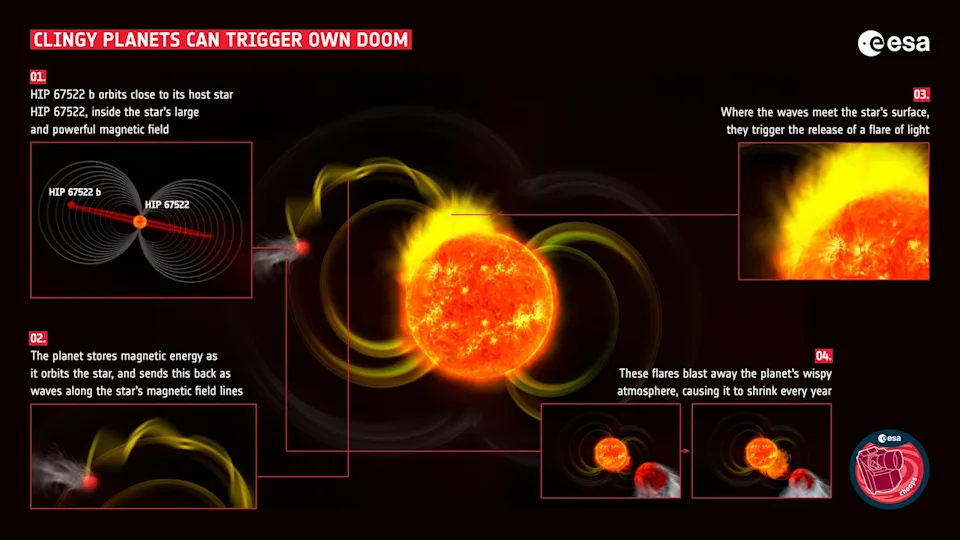
Scientists have recently discovered a planet that appears to have a “death wish,” orbiting extremely close to its star at an astonishing speed. This alien world, named HIP 67522 b, is roughly the size of Jupiter and completes a full orbit in just seven days. Its rapid orbit is causing significant disturbances in the magnetic field of its host star, triggering massive explosive eruptions. These powerful blasts push back against the planet and even cause its surface to wrinkle. This remarkable interaction between a planet and its star is unprecedented, as detailed in a study published on July 2, 2025, in the journal Nature.
According to NASA and lead researcher Ekaterina Ilin from the Netherlands Institute for Radio Astronomy, HIP 67522 b is directly linked to the energetic flares observed on its star. Scientists have long speculated that planets with close orbits might interfere with their star’s magnetic fields, but this is the first time such a relationship has been confirmed. The planet’s magnetic influence appears to set off waves that trigger the star’s explosive flares. Understanding this dynamic sheds light on the intricate magnetic dance between stars and their planets, especially for those orbiting very near their suns.
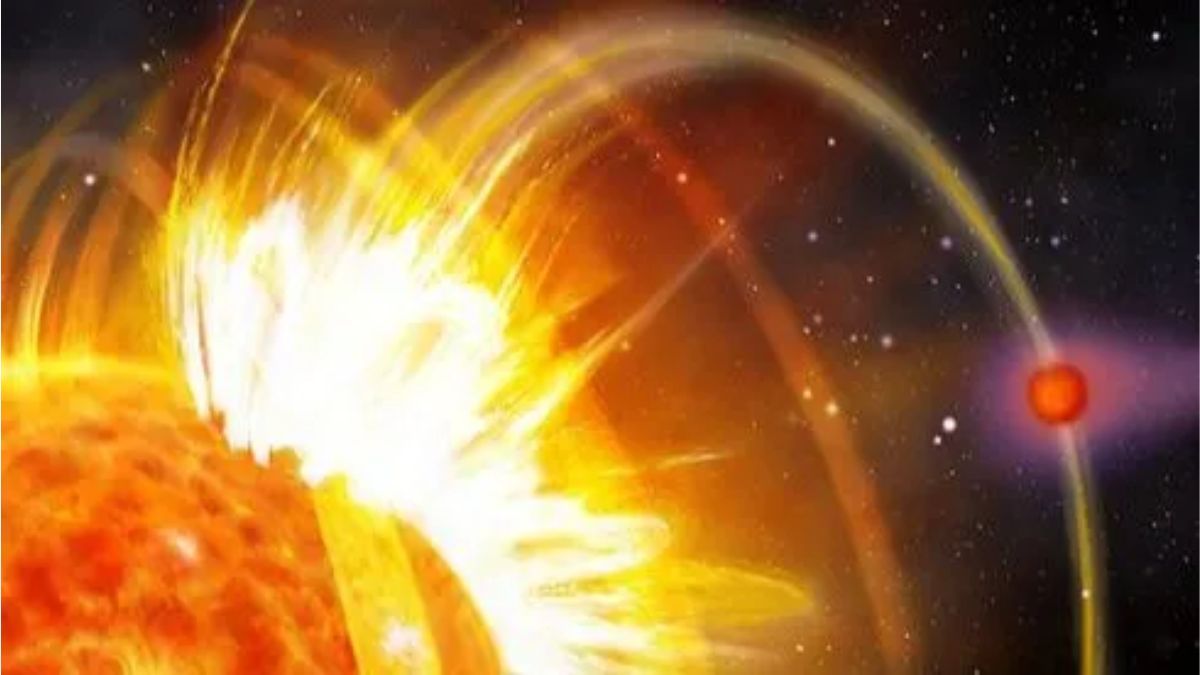
This discovery ushers in a new era of studying star-planet relationships. When a planet with a strong magnetic field orbits a star possessing a more delicate magnetic field, intense interactions occur. These interactions can bombard the planet with solar radiation, impacting the planet’s atmosphere and magnetic environment. Studying such systems helps scientists better understand the evolution of planetary atmospheres and magnetic fields, as well as the long-term stability of star-planet systems.
Stars themselves are massive balls of burning plasma, composed of charged particles called ions that move across their surfaces. These movements generate powerful magnetic fields. Occasionally, these magnetic fields become tangled and suddenly snap, releasing vast amounts of energy in the form of solar flares and coronal mass ejections—huge bursts of plasma emitted from the star’s surface. The discovery of HIP 67522 b reveals that planetary companions can play an active role in triggering such explosive stellar events, adding a new layer to our understanding of cosmic magnetic phenomena.