NASA Finds Titan Violating a Core Principle of Chemistry
Saturn’s largest moon, Titan, continues to challenge our understanding of chemistry and the potential for life beyond Earth. In a groundbreaking study, researchers from Chalmers University of Technology in Sweden, working with NASA, have uncovered evidence that Titan’s extreme cold allows chemicals to interact in ways long thought impossible. The study reveals that in Titan’s frigid environment—where temperatures plunge to nearly -179°C—substances that normally resist mixing can in fact combine. This remarkable behavior overturns one of chemistry’s most fundamental ideas: the rule that “like dissolves like.”
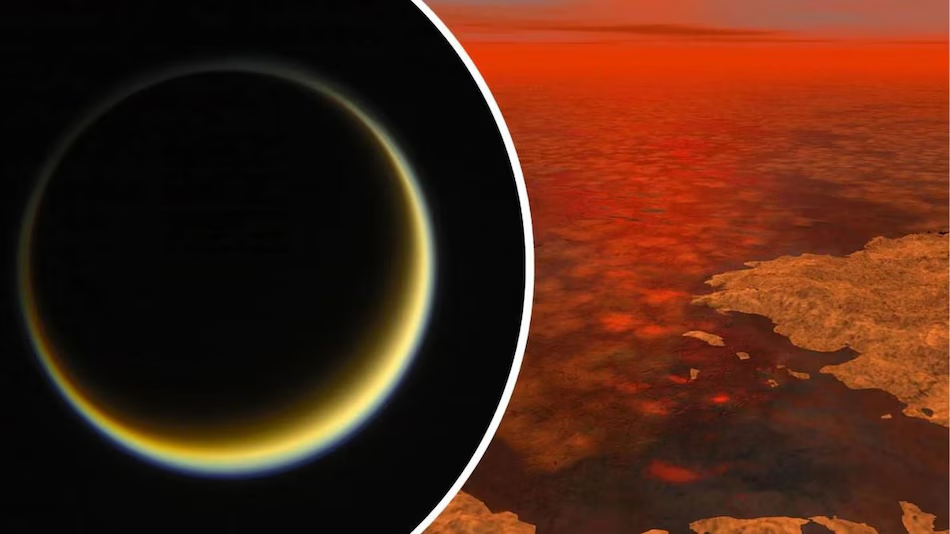
According to the team’s findings, Titan’s frozen landscape hosts a unique blend of organic molecules such as methane, ethane, and hydrogen cyanide. These compounds, common both on the moon’s surface and in its dense, orange-hued atmosphere, appear capable of forming stable crystalline structures despite their chemical differences. This challenges traditional distinctions between polar and nonpolar molecules, suggesting that under extreme cold, chemical bonding may follow entirely new pathways. The discovery, published in PNAS, highlights Titan as a natural laboratory for testing the limits of molecular interaction.
To explore this phenomenon, scientists at NASA’s Jet Propulsion Laboratory (JPL) conducted a series of experiments at 77 Kelvin, replicating Titan-like conditions. Using laser spectroscopy, they analyzed mixtures of hydrogen cyanide with methane and ethane. The results astonished researchers: hydrocarbons were found to infiltrate hydrogen cyanide’s crystal lattice, forming new, stable compounds previously thought unattainable. These findings provide concrete evidence that Titan’s surface chemistry may be far more dynamic than once believed.
Beyond its chemical novelty, this discovery has profound implications for astrobiology. If such unexpected interactions can occur on Titan, similar processes may have taken place on early Earth—or might still occur on icy moons and exoplanets elsewhere in the universe. By breaking one of chemistry’s oldest rules, Titan not only redefines our understanding of molecular behavior under extreme conditions but also opens new avenues for studying how life’s building blocks could emerge in the coldest corners of space.