
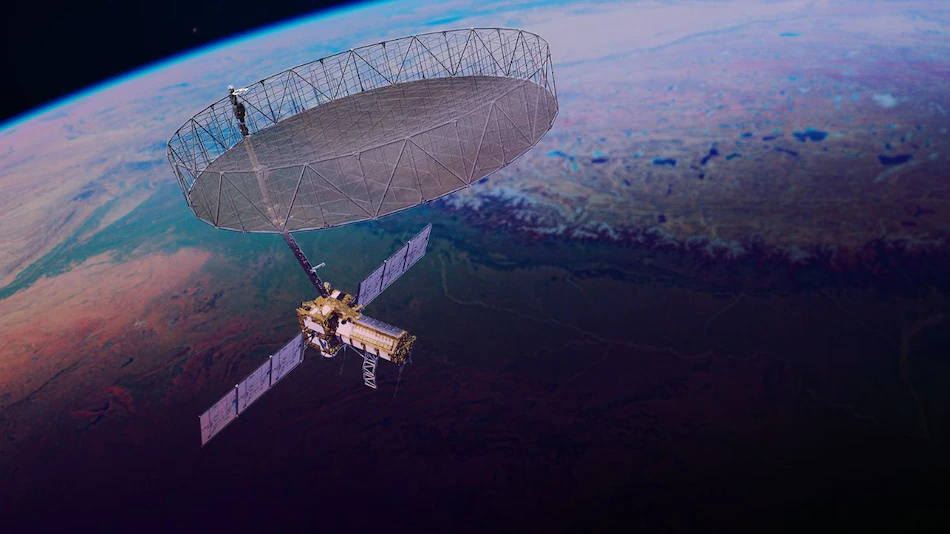
NISAR Satellite Successfully Unfolds Its 12-Meter Radar Reflector in Space
The NISAR (NASA-ISRO Synthetic Aperture Radar) satellite has successfully deployed its massive 12-meter (39-foot) wide drum-shaped antenna reflector in space, marking a critical milestone for the joint Earth observation mission. Folded like an umbrella during launch, the reflector gradually extended to its full configuration, approximately 30 feet (9 meters) away, and is now positioned to receive signals from Earth. Launched by ISRO on July 30 from the Satish Dhawan Space Centre, NISAR is designed to provide detailed information on glaciers, ice sheets, earthquakes, volcanoes, and wetlands, including forests. Its data is expected to benefit agriculture, disaster response, and infrastructure planning worldwide.
This deployment represents a major scientific milestone for Earth observation. According to NASA’s Earth Science Division, NISAR’s data will help scientists and policymakers monitor environmental changes and optimize resource management. By capturing precise and continuous measurements, the mission will contribute to global understanding of phenomena ranging from natural disasters to long-term ecological shifts. Its insights are expected to influence a wide range of sectors, including urban planning, food security, and climate research.
A defining feature of NISAR is its dual radar system. The satellite carries both L-band and S-band synthetic aperture radars (SAR). The L-band penetrates clouds and dense forest canopies, while the S-band is highly sensitive to vegetation and snow moisture. Working together, the two radar systems provide complementary data that allows scientists to capture high-resolution images under a variety of environmental conditions, making NISAR a uniquely powerful tool for Earth observation.
The antenna reflector is a key component for the performance of both radar systems, and its successful deployment ensures that NISAR can operate at full capability. This achievement underscores the technical sophistication of the mission and highlights the collaborative efforts between NASA and ISRO. With its advanced sensors and global coverage, NISAR is set to become a cornerstone of next-generation Earth monitoring, offering actionable insights for science, policy, and sustainable development.