
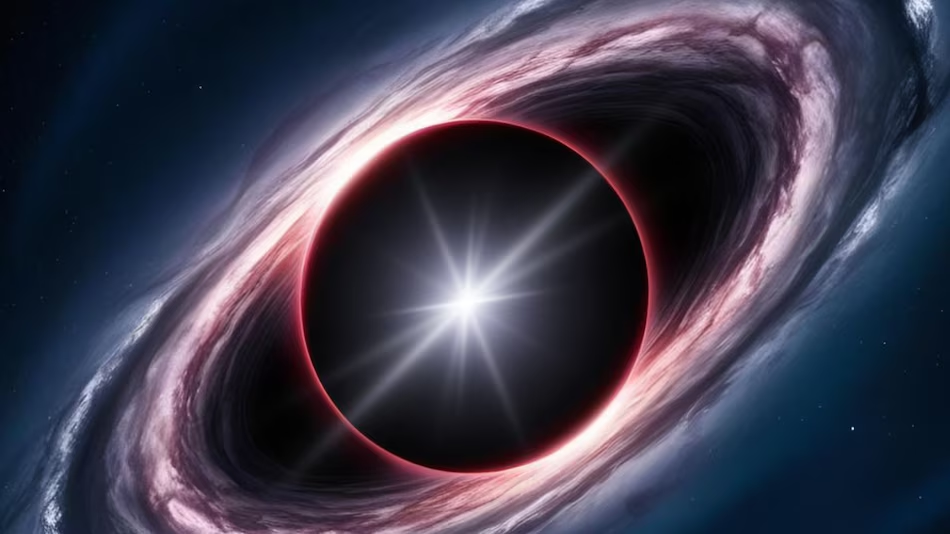
Researchers propose that tiny “black hole morsels” could provide insights into quantum gravity and may be observable with current telescopes.
Advanced theoretical research suggests that tiny black holes, formed from violent cosmic collisions, could offer a unique window into the quantum nature of space and time. These compact objects, termed “black hole morsels,” may emit bursts of high-energy radiation, a phenomenon first predicted by Stephen Hawking in the 1970s. If observed, they could serve as natural laboratories for probing physics at energy scales far beyond the capabilities of current particle accelerators.
According to a study published in Nuclear Physics B, the concept builds on Hawking’s insight that black holes emit faint radiation due to quantum effects near their event horizons. Smaller black holes radiate more intensely, and morsels formed during massive black hole mergers could be asteroid-sized yet extremely hot. This elevated temperature would cause them to evaporate quickly, releasing gamma rays and neutrinos that existing detectors such as HESS, HAWC, LHAASO, and the Fermi Gamma-ray Space Telescope could potentially detect.
The study involved researchers from the University of Southern Denmark, CNRS in France, and Institut de Physique des Deux Infinis de Lyon, who modeled how these morsels might form when instabilities during black hole mergers pinch off small fragments from the parent black hole. The evaporation process could produce a unique, delayed, and isotropic release of fast particles, distinguishable from conventional directed gamma-ray bursts.
While this theory opens exciting possibilities, earlier research has already begun setting observational limits. Current telescope data can help constrain how and where these black hole morsels might appear, bringing scientists closer to potentially detecting these elusive remnants and testing predictions of quantum gravity in the cosmos.