Yazılar

Supercomputer Frontier Models the Universe with Unprecedented Detail

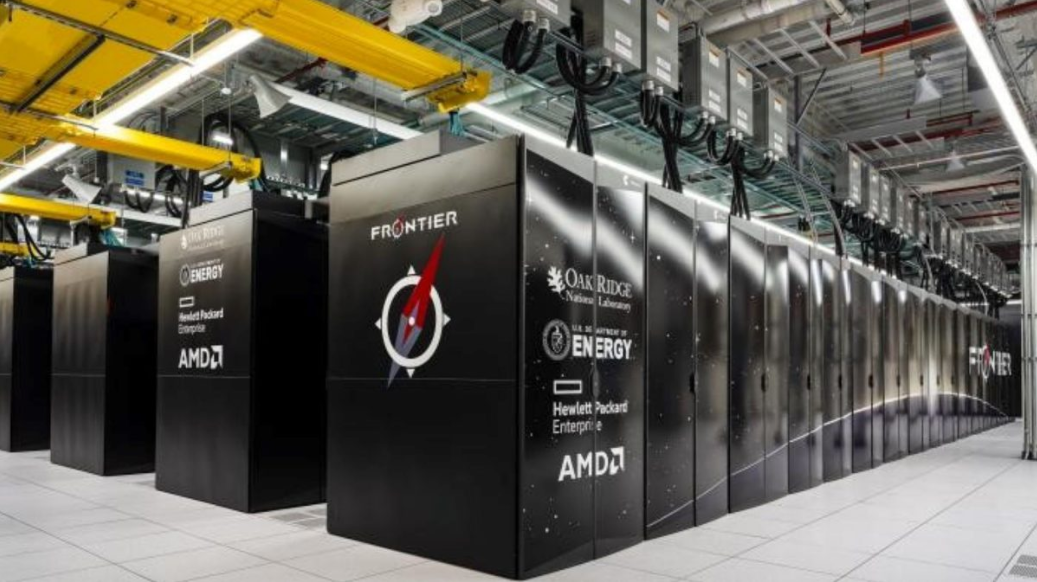
A groundbreaking cosmic simulation has been achieved using the Frontier supercomputer, one of the most advanced computing systems in the world. This simulation offers an unprecedented level of detail in modeling the observable universe, incorporating not only gravitational forces but also complex interactions involving dark matter, gas, and plasma. The ability to simulate such intricate cosmic phenomena represents a major leap forward in our understanding of the universe’s large-scale structures and evolutionary processes.

The simulation was conducted as part of the U.S. Department of Energy’s Exascale Computing Project, which aims to push the boundaries of computational science. Using the Hardware/Hybrid Accelerated Cosmology Code (HACC), the research team at Oak Ridge National Laboratory (ORNL) leveraged Frontier’s immense processing power to run calculations at speeds nearly 300 times faster than previous cosmological models. This breakthrough showcases the potential of exascale computing in tackling some of the most complex problems in astrophysics.

A key component of this research was the application of hydrodynamic cosmology, which integrates dark matter and energy with traditional gravitational interactions. Previous simulations primarily focused on gravity’s role in shaping the cosmos, but the new model provides a more holistic view by incorporating additional physical factors. To achieve this, the researchers utilized 9,000 computing nodes, each equipped with AMD Instinct MI250X graphics processors, allowing for higher-resolution simulations than ever before.

The success of this simulation underscores the transformative impact of supercomputing on scientific discovery. By replicating the universe’s intricate processes with unparalleled accuracy, researchers can refine existing theories of cosmic evolution and gain deeper insights into fundamental astrophysical questions. As computational power continues to advance, future simulations may unlock even more mysteries about the formation and behavior of the universe on the grandest scales.

Surprising Insights into the Universe’s Evolution Uncovered by New Cosmic Surveys

Recent cosmic surveys have provided unexpected insights into the evolution of the universe, suggesting that its development may be more intricate than previously believed. A research team led by Joshua Kim and Mathew Madhavacheril from the University of Pennsylvania, in collaboration with scientists from Lawrence Berkeley National Laboratory, analyzed data from the Atacama Cosmology Telescope (ACT) and the Dark Energy Spectroscopic Instrument (DESI). Their findings point to a slight discrepancy in the expected distribution of cosmic structures over the past four billion years, potentially challenging established models of cosmic evolution.

The study, published in the Journal of Cosmology and Astroparticle Physics and available on the preprint server arXiv, utilized a combination of ACT’s cosmic microwave background (CMB) lensing data and DESI’s luminous red galaxy (LRG) distribution. The ACT data captures faint light from roughly 380,000 years after the Big Bang, offering a glimpse into the early universe. Meanwhile, DESI’s observations map millions of galaxies in three dimensions, providing crucial insights into the large-scale structure of the universe in more recent times. By integrating these datasets, researchers were able to construct a more detailed picture of how cosmic structures have evolved.

One of the key findings of the study revolves around the measurement of Sigma 8 (σ8), a parameter that quantifies the clumpiness of matter in the universe. The analysis suggests that the observed σ8 values are slightly lower than expected, indicating that cosmic structures may not have formed exactly as predicted by standard cosmological models. This discrepancy, while small, could hint at previously unknown physical processes influencing the universe’s large-scale evolution.

If confirmed by further studies, these findings could have significant implications for our understanding of fundamental cosmic forces, including dark matter and dark energy. While the standard ΛCDM model has been highly successful in describing the universe’s evolution, even minor inconsistencies like this could point to new physics beyond our current theories. Future observations from next-generation telescopes and surveys may help clarify whether these anomalies are statistical fluctuations or signs of deeper, unresolved mysteries in cosmology.

3D Galaxy Maps Uncover Hidden Clues About the Mysterious Dark Universe

Scientists have uncovered new clues about the “dark universe”—the enigmatic realm consisting of dark matter and dark energy—through an innovative method of analyzing 3D galaxy maps. Using sophisticated computational techniques, researchers have been able to study the positions and distributions of galaxies in unprecedented detail. This new approach has revealed previously hidden patterns that may either reinforce or challenge existing cosmological theories. Unlike traditional methods, which often compress spatial data into simplified models, this technique preserves the three-dimensional structure of the universe, offering fresh insights into its evolution.

A research team led by astronomer Minh Nguyen of the University of Tokyo has pioneered this new technique by employing advanced field-level inference (FLI) methods. This approach, which incorporates complex algorithms to model galaxy formation and dark matter halos, significantly improves upon past galaxy surveys that relied primarily on two-dimensional measurements. By incorporating redshift data, which provides depth information, scientists have been able to construct a more accurate 3D representation of the cosmos. This allows them to study the large-scale distribution of galaxies and how dark matter may be shaping their motion.

In previous studies, astronomers often relied on statistical tools such as “n-point correlation functions” to describe galaxy clustering. However, while efficient, these methods tended to obscure finer details about the structure of the universe. The FLI technique works directly with unprocessed 3D data, enabling a more detailed analysis of galaxy positioning and movement. As Nguyen explained in an interview with Space.com, this method exposes hidden information about how galaxies interact with dark matter, potentially identifying discrepancies that could lead to revisions in our understanding of fundamental physics.

This breakthrough has major implications for cosmology, as it provides a new way to test and refine the standard model of the universe. If the observed patterns deviate from theoretical predictions, it could suggest the need for new physics to explain the influence of dark matter and dark energy. With future telescopes expected to generate even more detailed 3D galaxy maps, scientists are hopeful that this method will lead to deeper discoveries about the mysterious forces that govern the cosmos.