Yazılar

Google Meet Rolls Out New Call Interface and Contact Suggestions for All Users

Google Meet has started rolling out a revamped call interface to all users, bringing updates that were previously limited to enterprise accounts. The new interface features a pill-shaped search bar positioned at the top of the screen, providing users with a more streamlined way to search for contacts. Additionally, users will now receive contact suggestions directly on the call screen, based on their recent interactions, such as frequently contacted people or starred contacts. This is part of Google’s continuous efforts to enhance user experience by making meetings more intuitive and accessible.

The new user interface (UI) update also includes larger, redesigned buttons to create or schedule meetings, making it easier to navigate and initiate calls. Users can now see suggestions for calls in a grid layout, which simplifies the process of finding the right contact, especially for those who regularly interact with large teams. These improvements are designed to offer a more efficient and organized experience, particularly for users who manage multiple meetings or engage with numerous colleagues daily.

In conjunction with the UI updates, Google Meet has also introduced a home screen shortcut that allows users to join meetings via a code. This shortcut, labeled “Code,” enables participants to quickly enter a meeting code without navigating through multiple menus. This feature enhances the speed and ease with which users can connect to scheduled meetings, particularly when time is limited.

The rollout of these new features follows closely on the heels of Google’s introduction of an artificial intelligence (AI) tool for Meet, which generates notes after the conclusion of a meeting. This AI-driven feature further exemplifies Google’s push toward improving both the organization and productivity of virtual meetings, catering to the growing demand for smart, user-friendly video conferencing solutions.

Google Reportedly Developing Reasoning AI in Response to OpenAI’s Advances

Google is reportedly developing artificial intelligence software aimed at emulating human reasoning capabilities, similar to OpenAI’s recent advancements. This marks a new phase in the ongoing competition between the tech titan and the rapidly emerging startup. According to sources familiar with the project, several teams within Alphabet Inc. have been making strides in creating AI reasoning software that excels at tackling complex, multistep problems, particularly in areas like mathematics and computer programming.

The drive towards creating reasoning models is seen as a crucial step forward in AI technology. Both Google and OpenAI are attempting to approximate human reasoning through a technique known as chain-of-thought prompting. This method, which Google originally pioneered, involves the AI pausing for a brief period before responding to a prompt. During this pause, the system evaluates a range of related queries behind the scenes, ultimately summarizing what it determines to be the most effective response. This approach aims to enhance the AI’s ability to provide coherent and logically sound answers to complex questions.

Despite the buzz surrounding this development, Google has chosen not to comment publicly on the ongoing efforts. This lack of information underscores the competitive nature of the AI landscape, where companies are keen to guard their innovations. The tech industry has seen an increasing focus on reasoning models as researchers aim to push the boundaries of what AI can accomplish, signaling a shift towards more sophisticated applications of the technology.

The rivalry between Google and OpenAI has intensified since the launch of ChatGPT, which has raised concerns among investors about the potential implications for Google Search. In response, Google has taken various steps to bolster its position in the AI arena, such as merging its research labs into the Google DeepMind unit and fostering closer collaboration between researchers and product teams. However, Google’s cautious approach to rolling out AI products reflects a broader consideration of ethical concerns, public trust, and the complexities of managing diverse AI initiatives within the organization. As both companies strive to lead the AI revolution, the quest for reasoning capabilities will be a pivotal battleground.

Google for India 2024: Gemini Live Expands with Hindi and Eight Additional Regional Language Support

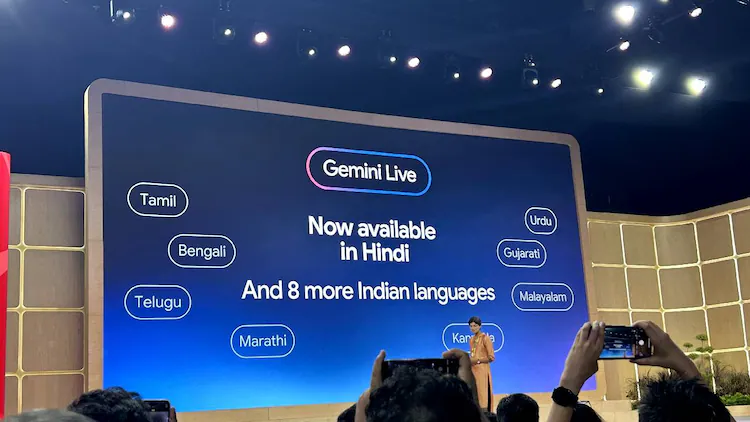
At the Google for India 2024 event in New Delhi, Google unveiled several India-centric features, including significant updates to its AI chatbot, Gemini. The tech giant introduced Gemini Live, a real-time verbal communication feature, last month, and it is now expanding its language capabilities to reach a broader audience. Previously available only in English, Gemini Live now supports Hindi and eight other regional Indian languages, underscoring Google’s commitment to making its technology accessible to India’s diverse linguistic population.

During the event, Hema Budaraju, Senior Director of Product Management at Google, emphasized the importance of this update. The new language support allows users to engage with Gemini Live in their native languages, making the AI experience more intuitive and natural. Users can now ask questions verbally in Hindi, Bengali, Gujarati, Kannada, Malayalam, Marathi, Telugu, Tamil, and Urdu, with the chatbot providing real-time spoken responses. This functionality aims to bridge the digital divide, especially for non-English speakers, offering an inclusive AI-driven interaction for millions of users in India.

Gemini Live was first introduced as part of the Gemini Advanced subscription in August, but Google later extended it to the free tier on Android devices. This move made the feature more accessible to a wider user base, enabling people to experience AI-powered communication without the need for a subscription. Until now, the feature had been limited to English, but with the addition of nine Indian languages, Google is making strides to cater to India’s multilingual user base. The inclusion of these regional languages reflects the growing demand for localized AI services in India, a country known for its linguistic diversity.

With these updates, users in India can now interact with the chatbot more naturally, asking questions and receiving answers in their preferred language. This expansion not only enhances the usability of Google’s AI services but also sets a precedent for more tech companies to adopt a multilingual approach. The rollout of Gemini Live’s language support marks another milestone in Google’s ongoing efforts to integrate AI into everyday experiences for users in India, reinforcing its position as a leader in the country’s digital transformation.