Yazılar

JWST Reveals HH 30’s Protoplanetary Disk, Highlighting Dust Grains and Jets

The James Webb Space Telescope (JWST) has captured a remarkable image of Herbig Haro 30 (HH 30), a young star encircled by a dense disk of dust and gas in the Taurus constellation. The image showcases not only the star’s complex surroundings but also the dynamic interaction between the light from the star and the surrounding material. Bright jets of material are seen extending from the disk, while the star itself remains obscured by the dense dust surrounding it. These powerful jets and the surrounding shockwaves offer scientists a valuable opportunity to study the processes that shape planetary formation, particularly how dust grains move and accumulate within protoplanetary disks.

Recent research, published in The Astrophysical Journal, reveals the discovery of microscopic dust grains within HH 30’s protoplanetary disk. These tiny particles, measuring just one-millionth of a meter, are crucial in the formation of planets. As these dust grains clump together over time, they form larger particles, eventually evolving into the building blocks of planets. According to the European Space Agency (ESA), the dense dust layer surrounding HH 30 plays a vital role in the development of planetary bodies, providing the foundation necessary for the formation of pebbles, which eventually coalesce into full-fledged planets.

In addition to the dust, the research team, led by Ryo Tazaki of the University of Tokyo, also uncovered intricate structures within the disk, combining JWST data with information from the Hubble Space Telescope and the Atacama Large Millimeter/submillimeter Array (ALMA). One of the key findings was the presence of a high-speed jet emerging perpendicular to the disk’s plane. This jet is surrounded by a broader cone-shaped outflow, indicative of significant ongoing activity in the region. The team also observed spiral-like features and a tidal tail, which may be the result of a jet’s oscillations or the influence of a stellar companion or a nearby star that passed through the area around 1,000 years ago.

These findings provide a detailed snapshot of the complex processes at play in the formation of planetary systems. The interplay between dust, gas, and stellar winds within HH 30 offers an unprecedented look at the early stages of planetary formation, highlighting the importance of protoplanetary disks in shaping future planetary bodies. As researchers continue to analyze these structures and jets, the data gathered from JWST and other observatories will deepen our understanding of how planets, including those in our own solar system, come into being.

JWST Discovers Surprisingly Massive Black Holes in the Universe’s Early Days

Massive Black Holes in the Early Universe Challenge Existing Theories

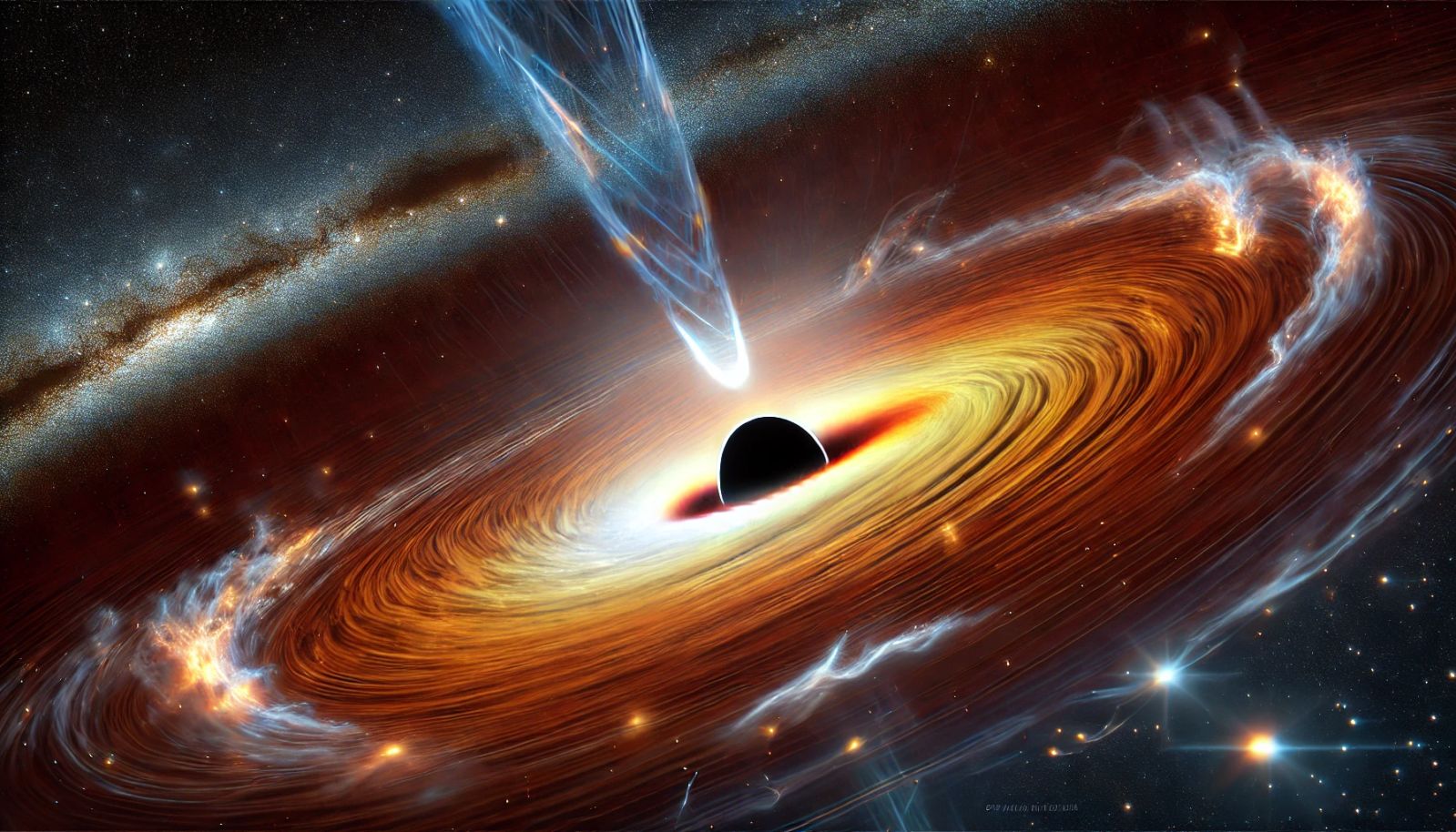
Astronomers using the James Webb Space Telescope (JWST) have discovered supermassive black holes in the early universe that are far larger than expected. These black holes appear to hold nearly 10 percent of their host galaxy’s stellar mass—an astonishing contrast to the 0.01 percent ratio observed in modern galaxies. This unexpected finding raises new questions about how black holes could have grown so rapidly in the universe’s infancy, challenging current models of galaxy and black hole co-evolution.

New Insights from JWST Observations

A research team led by Jorryt Matthee from the Institute of Science and Technology Austria (ISTA) analyzed JWST data, with their findings published on the preprint server arXiv. The study focused on early galaxies, informally named “little red dot” galaxies, which appear to host supermassive black holes with masses nearly 1,000 times greater than previously estimated. These galaxies, observed as they existed around 1.5 billion years after the Big Bang, exhibit an unusual balance between stellar mass and black hole mass. The results challenge existing models that predict a slower growth rate for black holes relative to their host galaxies.

Possible Explanations for Rapid Growth

Researchers speculate that an abundant supply of gas in the early universe could have fueled this accelerated black hole growth. The red hue of these small galaxies suggests the presence of accretion disks—regions of swirling hot gas spiraling into the black hole—indicating intense matter consumption. The study proposes that early black holes may have gained mass at rates previously thought to be impossible, potentially redefining our understanding of black hole formation and growth in the first few billion years of the universe.

Implications for Cosmology and Future Research

These findings open up new avenues for investigating the early universe, particularly the relationship between black holes and galaxy formation. If these results are confirmed by further JWST observations, astronomers may need to revise their theories on the initial growth phases of supermassive black holes. As JWST continues to peer deeper into cosmic history, scientists hope to uncover more clues about how these colossal objects formed and influenced the evolution of their host galaxies.

Astronomers Discover Black Hole Devouring Matter at 40 Times Its Theoretical Limit

Astronomers Detect Record-Breaking Black Hole Consuming Matter at Unprecedented Rate
A team of astronomers, utilizing data from NASA’s James Webb Space Telescope (JWST) and the Chandra X-ray Observatory, has identified a black hole that is consuming matter at an astonishing rate, far exceeding theoretical limits. The black hole, named LID-568, is located in a galaxy formed just 1.5 billion years after the Big Bang, offering a rare glimpse into the early universe. This discovery challenges existing models of black hole growth, suggesting that supermassive black holes may have formed much more rapidly than previously thought.

Revolutionary Observation Technique Offers New Insights
The breakthrough was led by Dr. Hyewon Suh from the International Gemini Observatory at NSF NOIRLab, with the team identifying LID-568 within a cluster of galaxies that emit bright X-rays despite being faint in the visible spectrum. In a departure from traditional observational methods, the researchers employed JWST’s integral field spectrograph in the Near Infrared Spectrograph (NIRSpec) to capture data from every pixel in the target area. This innovative approach allowed for precise positioning of the black hole, revealing significant gas outflows surrounding it.

Intense Feeding and Rapid Growth
The outflows detected around LID-568 suggest that the black hole is likely undergoing periods of rapid, short-lived feeding, contributing to its extraordinary growth rate. Dr. Emanuele Farina, a co-author of the study, emphasized the importance of the new technique, noting that it was essential to capture the faint signals coming from such a distant and early cosmic object. These findings could redefine our understanding of how supermassive black holes form and evolve, providing key insights into their growth in the early universe.

Implications for Understanding Early Universe Phenomena
The discovery of LID-568 challenges existing theories of black hole formation, particularly how these massive objects could grow so quickly in the early stages of the universe. As astronomers continue to study this and other similar galaxies, they may uncover new mechanisms that explain the rapid growth of supermassive black holes. This research not only pushes the boundaries of astrophysics but also sheds light on the processes that shaped the universe as we know it.