
One UI 8.5 Beta Hints at Galaxy S26 Ultra’s Private Display Feature
Samsung’s upcoming Privacy Display reportedly uses Flex Magic Pixel technology from Samsung Display for enhanced screen privacy. Devamını Oku

Samsung’s upcoming Privacy Display reportedly uses Flex Magic Pixel technology from Samsung Display for enhanced screen privacy. Devamını Oku
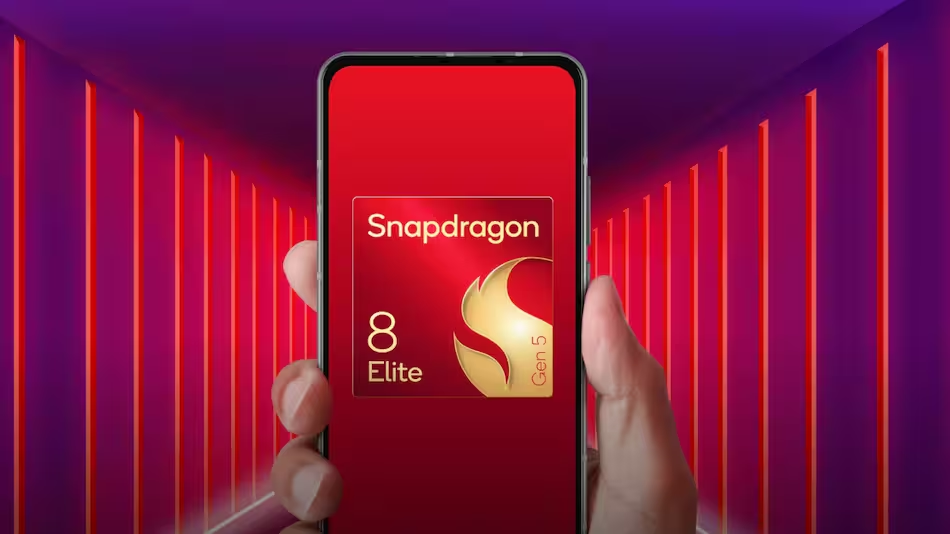
Snapdragon 8 Elite Gen 5 to Power Majority of Samsung Galaxy S26 Lineup, Confirms Qualcomm
Samsung’s Galaxy S26 series is expected to make its debut early next year, and reports indicate that the company will once again adopt a dual-chip strategy for its flagship smartphones. The lineup will reportedly include the Galaxy S26, Galaxy S26+, and Galaxy S26 Ultra, each powered by either Qualcomm’s latest Snapdragon 8 Elite Gen 5 or Samsung’s own Exynos 2600 chipset. However, new statements from Qualcomm’s leadership suggest that the Snapdragon chip will continue to dominate across most global markets, with the Exynos variant reserved for select regions.
Qualcomm President and CEO Cristiano Amon discussed the company’s partnership with Samsung during its Q4 earnings call. Amon revealed that Qualcomm expects to supply chips for roughly 75 percent of all Galaxy S26 devices, maintaining the same ratio seen in recent flagship launches. This reflects a continuation of the close collaboration between the two tech giants, which has strengthened in recent years as Samsung increasingly relies on Qualcomm’s top-tier silicon for its global smartphone lineup.
Amon reportedly highlighted that the Snapdragon 8 Elite Gen 5 will be the primary chipset powering the Galaxy S26 series worldwide. He stated that Qualcomm’s “new baseline” share of Samsung’s premium lineup now sits at about 75 percent, up from the 50-50 split that existed several years ago. “On Galaxy S25, we got 100 percent,” Amon noted, adding that while some regional models may use the Exynos 2600, Qualcomm remains confident in its majority share for the upcoming flagship series.
This development suggests that most Galaxy S26 buyers, particularly in markets like the United States, India, and parts of Europe, can expect their devices to be equipped with the Snapdragon 8 Elite Gen 5. The Exynos 2600, meanwhile, is likely to power only limited regional variants, possibly in Samsung’s home market of South Korea or select European countries. As both chipmakers continue to push advancements in AI, performance, and efficiency, Samsung’s dual-chip approach may offer valuable insights into how the two platforms compare in real-world usage when the Galaxy S26 series officially launches in 2025.
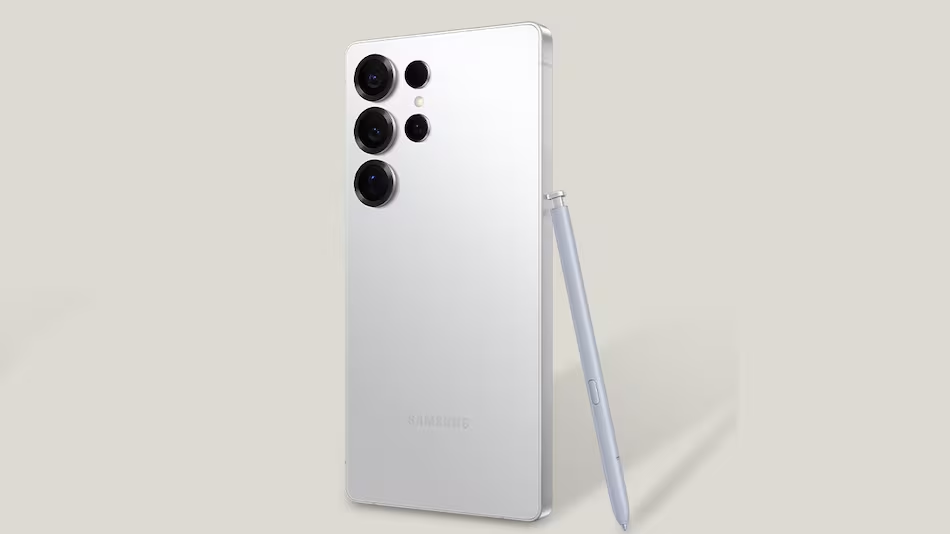
Samsung appears to be refining its flagship smartphone strategy with the Galaxy S26 Ultra rather than reinventing it, as per new leaks. Despite the highly anticipated debut of the Exynos 2600 chipset — which reportedly brings significant leaps in imaging and AI capabilities — the Galaxy S26 Ultra’s camera hardware may remain largely unchanged from its predecessor. This aligns with Samsung’s recent focus on optimizing performance, processing, and software-driven image quality rather than introducing entirely new camera sensors each year.
According to a post on X (formerly Twitter) by tipster @chunvn8888, the upcoming Galaxy S26 Ultra will retain the same 200-megapixel ISOCELL HP2 primary sensor, alongside a 50-megapixel ultrawide ISOCELL JN3 sensor and a 50-megapixel periscope telephoto lens featuring a Sony IMX854 sensor. The biggest reported change is in the 3x telephoto lens, which may get a small upgrade to a 12-megapixel Samsung S5K3LD sensor. For selfies, the phone is expected to sport a 12-megapixel Sony IMX874 front camera.
The Exynos 2600 chipset — expected to debut with the Galaxy S26 and S26+ — is said to feature a next-generation NPU (neural processing unit) designed for AI-enhanced photography and real-time scene optimization. It could handle more complex image segmentation and low-light processing with reduced power consumption. However, with the Galaxy S26 Ultra likely using a Snapdragon 8 Gen 4 chip globally, the Exynos-based AI enhancements may not directly benefit Ultra users, at least outside select regions.
This leak reinforces the idea that Samsung is focusing on refinement rather than reinvention for 2026. While rival brands like Xiaomi and Vivo continue to push boundaries with massive sensor upgrades and custom optics, Samsung seems intent on leveraging AI and computational photography to elevate image quality. If accurate, the Galaxy S26 Ultra may rely on its improved processing, enhanced HDR capabilities, and optimized algorithms to deliver more realistic, detail-rich images — even without a drastic hardware overhaul.