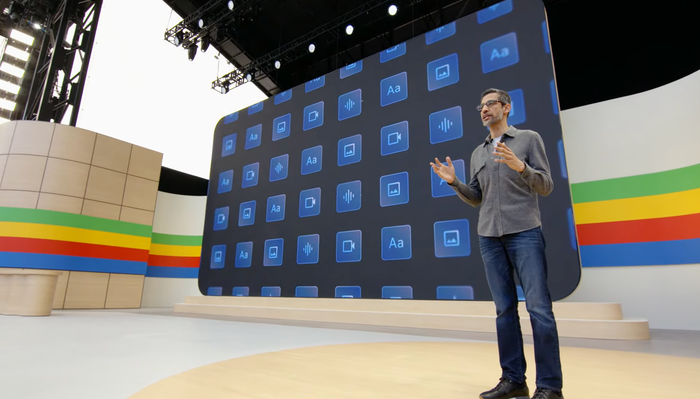
Google CEO Sundar Pichai Claims AI Now Creates Over a Quarter of All New Code

During Alphabet’s quarterly earnings call on Tuesday, CEO Sundar Pichai shared significant insights into how the company is optimizing its artificial intelligence (AI) infrastructure to drive efficiency and reduce costs. One of the key highlights was Pichai’s announcement that Google has now begun generating more than a quarter of all new code using generative AI. This shift has allowed the company to streamline its operations and become more cost-effective, leveraging AI not just for products but also for internal processes.

In a blog post summarizing the earnings call, Google emphasized the role AI is playing in improving operational efficiency. Pichai detailed how the company has overcome challenges in scaling its AI infrastructure, making it more accessible and efficient across all its products and services. Alphabet’s strong Q3 results, which saw a revenue of $88.3 billion (approximately Rs. 7.4 lakh crore), were largely driven by AI-based services that Google began offering earlier this year, marking a significant expansion in the company’s AI-focused business model.

The growth in revenue was not solely attributed to new AI services but also to Google’s careful management of expenditures. Pichai pointed out that part of the increase in revenue was the result of the company’s focus on becoming more agile and lean. By minimizing overhead and deploying smaller, more efficient teams, Google has been able to accelerate development and delivery. Pichai specifically mentioned the creation of Notebook LM, an AI tool developed by a small, dedicated team, as an example of how this new approach has allowed for quicker innovation.

Overall, the earnings call highlighted not only the financial success of Alphabet in the third quarter of 2024 but also the pivotal role AI is playing in reshaping Google’s operations. With generative AI now driving a significant portion of new code generation, the company is positioning itself as a leader in the integration of AI into business operations, aiming to stay competitive while optimizing both its product offerings and internal processes


Huawei’s New Foldable Smartphone with Integrated Case and Rectangular Design Revealed in Patent Filing

Huawei may be developing a new foldable smartphone with a unique design that features an attached protective cover. According to a patent published on the China National Intellectual Property Administration (CNIPA) website, the company is exploring the possibility of integrating a cover directly into the foldable device itself. Images provided in the patent suggest that the phone could be a tri-fold model, with the outermost panel serving as a protective cover when the device is closed. This follows Huawei’s recent release of the Mate XT Ultimate Design, the world’s first commercially available tri-fold phone, further indicating the company’s push to innovate in the foldable market.

The patent outlines a device that could function both as a smartphone and a tablet, incorporating a flexible hinge mechanism that allows the device to unfold and transform into a larger display. The protective cover is designed to wrap around the foldable sections of the device, providing added durability when the device is folded. This solution would help safeguard the fragile display without adding bulk, as the cover is described as being slim and lightweight, reducing the overall size of the phone.

This innovative concept aims to offer both practicality and style, addressing the potential downsides of foldable phones, such as screen damage or durability concerns. By integrating the cover into the design, Huawei could simplify the user experience by eliminating the need for a separate case while providing enhanced protection. The foldable’s hinge and frame design will likely be engineered to ensure smooth operation, with the cover remaining flexible to adapt to the device’s movements.

While still in the patent phase, this foldable phone concept could set the stage for Huawei’s next generation of foldable smartphones, continuing the trend of offering versatile devices with cutting-edge features. The design’s emphasis on reducing the overall footprint while still providing functionality suggests that Huawei is thinking strategically about the future of foldable technology. If the concept moves forward, it could provide a more streamlined and durable option for consumers in the growing foldable phone market.

OpenAI Introduces Chat History Search Feature on ChatGPT Web Platform

OpenAI has unveiled a new feature for its popular AI chatbot, ChatGPT, designed to make navigating past conversations easier. On Tuesday, the company announced that users will now be able to search through their chat history, allowing them to quickly locate relevant information from previous interactions. This new feature aims to address the current inconvenience where users must manually scroll through their chat logs to find specific conversations, saving time and enhancing the overall user experience. Initially, the feature is available only on ChatGPT’s web portal and is being rolled out to paid subscribers of the platform.

The addition of a search function for past chats has been one of the most requested updates from ChatGPT users. Previously, finding a specific piece of information from past interactions could be frustrating and time-consuming, especially as users accumulated more conversations. With the search capability, users now have an efficient way to locate important details without the hassle of endless scrolling.

To use the new feature, users will notice a magnifying glass icon on the side panel of the ChatGPT web interface. This icon is located on the left side of the screen, and by clicking it, users are presented with a text field where they can type keywords to find specific conversations. For those who prefer not to type, the interface also displays recent chats, making it easy to quickly jump to a previous discussion.

This feature marks a significant step forward for OpenAI’s chatbot platform, improving usability and accessibility for users who need to reference past chats. As the tool continues to evolve, features like chat history search are likely to become standard, offering a more seamless and productive experience for those who rely on ChatGPT for both casual and professional purposes.