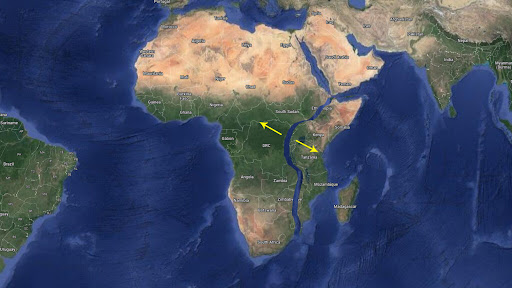
Africa’s Slow Divide May Pave the Way for Earth’s Sixth Ocean

Africa’s landmass is undergoing a slow but significant split, driven by tectonic forces that could eventually lead to the creation of a new ocean. Scientists estimate that in about 50 million years, the ongoing geological activity will have widened the gap enough to allow seawater to flood in, forming what could be Earth’s sixth ocean. This gradual process mirrors the ancient geological shifts that have shaped the planet’s continents, such as the break-up of Pangea around 230 million years ago. Fossil evidence, such as the discovery of Cynognathus, a prehistoric reptile found in both Africa and South America, supports the idea that these continents were once part of a single landmass before splitting apart.

At the heart of this tectonic phenomenon is the East African Rift System (EARS), a vast network of faults running through countries like Kenya, Tanzania, and Ethiopia. The rift, which has been active for millions of years, marks the boundary between two sections of Africa’s tectonic plate—the Nubian plate to the west and the Somalian plate to the east. Over the last 25 million years, this rift has been widening, and the forces driving this split show no signs of slowing. As the land continues to separate, scientists predict that eventually, water will rush in, creating a body of water that could become an ocean.

The scientific community is closely monitoring these geological changes to better understand how the Earth’s crust is evolving. Geologist David Adede notes that the East African Rift has a long history of tectonic and volcanic activity, which continues to reshape the landscape. While the visible movement of the rift may seem slow, deeper shifts within the Earth’s crust are creating weak points that could eventually result in major geological events. However, there is some debate about the specific causes of these developments. Researcher Stephen Hicks suggests that a notable crack observed in Kenya may be more due to recent soil erosion caused by rainfall rather than tectonic forces.

Meanwhile, geologist Lucía Pérez Díaz offers a different perspective, suggesting that the crack may indeed be related to the fault lines in the rift. However, she stresses that further study is needed to confirm the precise mechanism driving this geological activity. Despite the uncertainties, one thing is clear: Africa’s tectonic split is an ongoing process, and its eventual consequences could fundamentally reshape the continent, with the formation of a new ocean standing as one of the most remarkable outcomes of this natural evolution.


Xiaomi 15 and 15 Pro Debut with Snapdragon 8 Elite, Triple Cameras: Specs and Pricing

Xiaomi unveiled its highly anticipated Xiaomi 15 and Xiaomi 15 Pro smartphones in China, marking the next chapter in its flagship lineup. These new models succeed the Xiaomi 14 series, delivering upgrades in performance, display, and camera features. Both devices are powered by the cutting-edge Snapdragon 8 Elite SoC, ensuring top-tier performance for gaming, multitasking, and AI processing. The standard Xiaomi 15 boasts a 6.36-inch 1.5K OLED display with a peak brightness of 3,200 nits, while the Pro model steps up to a 2K resolution display for a more immersive viewing experience.

The Xiaomi 15 series also introduces an upgraded camera setup, with a Leica-tuned triple rear camera module. Leading the array is a 50-megapixel primary sensor, designed to capture detailed and vibrant photos. This camera configuration aims to deliver professional-grade photography capabilities, catering to both casual photographers and those looking to explore advanced imaging options. The series also runs on Xiaomi’s HyperOS 2, bringing a smooth and responsive software experience, alongside several new features designed to enhance user engagement and productivity. Additionally, both devices maintain an IP68 rating, offering water and dust resistance for durability in harsh environments.

In terms of pricing, the Xiaomi 15 comes in several configurations. The base model with 12GB of RAM and 256GB of storage is priced at CNY 4,499 (approximately Rs. 52,000). For users who need more storage, the 12GB RAM + 512GB variant is available for CNY 4,799 (around Rs. 56,000), while the 16GB RAM + 512GB storage version costs CNY 4,999 (roughly Rs. 58,000). The highest-end configuration, offering 16GB of RAM and a massive 1TB of storage, is priced at CNY 5,499 (about Rs. 65,000). The Xiaomi 15 series is available in multiple color options, including Asakusa Green, Bright Silver Edition, Black, Lilac, and White, providing users with a range of stylish choices.

The launch of the Xiaomi 15 series is poised to offer a compelling option for those looking for a powerful smartphone with premium features. With the combination of a high-end Snapdragon chipset, a Leica-optimized camera system, and a variety of storage options, the Xiaomi 15 lineup seems geared to compete strongly in the flagship market. Xiaomi’s continued focus on both performance and user experience positions the 15 series as a strong contender for consumers seeking a top-notch device.

Honor 200 Series in India Gains ‘Circle to Search’ Feature in New Software Update

The Honor 200 series has begun receiving a significant software update in India, introducing the much-anticipated “Circle to Search” feature. This over-the-air (OTA) RM3 update is rolling out for the Honor 200 5G and Honor 200 Pro 5G models, adding new functionality powered by artificial intelligence (AI) to the devices. Alongside this new feature, the update includes the October 2024 Google security patch and several performance improvements to enhance user experience. The Circle to Search feature, which was initially announced for the Honor 200 series earlier this month, had yet to make its debut in India—until now.

The Circle to Search feature allows users to quickly identify objects, locations, and landmarks in photos or live camera views by simply drawing a circle around them on the screen. Originally launched on the Samsung Galaxy S24 series, this visual lookup tool was later expanded to the Pixel 8 series and additional Samsung and Pixel devices. Now, Google is rolling out this visual search capability to more smartphones within the Android ecosystem, broadening its accessibility and functionality across various manufacturers. Honor users in India can now experience this AI-powered feature firsthand, bringing added convenience and utility to the Honor 200 lineup.

Apart from Circle to Search, the RM3 update for the Honor 200 series also focuses on performance and security enhancements. The update introduces the October 2024 Google security patch, addressing critical security vulnerabilities to protect users against potential cybersecurity threats. Honor has also made several system improvements to ensure smoother performance, enhancing the overall stability and reliability of the devices.

Another noteworthy addition in this update is the expanded screen recording capabilities. Users now have the option to record system audio during screen recordings, offering more versatility for content creation or instructional videos. Furthermore, three screen recording resolutions—480p, 720p, and 1080p—have been made available, allowing users to select the resolution that best suits their needs. This update not only strengthens device security and performance but also enriches the user experience with new features that make the Honor 200 series more functional and versatile for everyday use.