Ancient 1,800-Year-Old Silver Amulet Discovered in Germany Raises Questions About Early Christianity

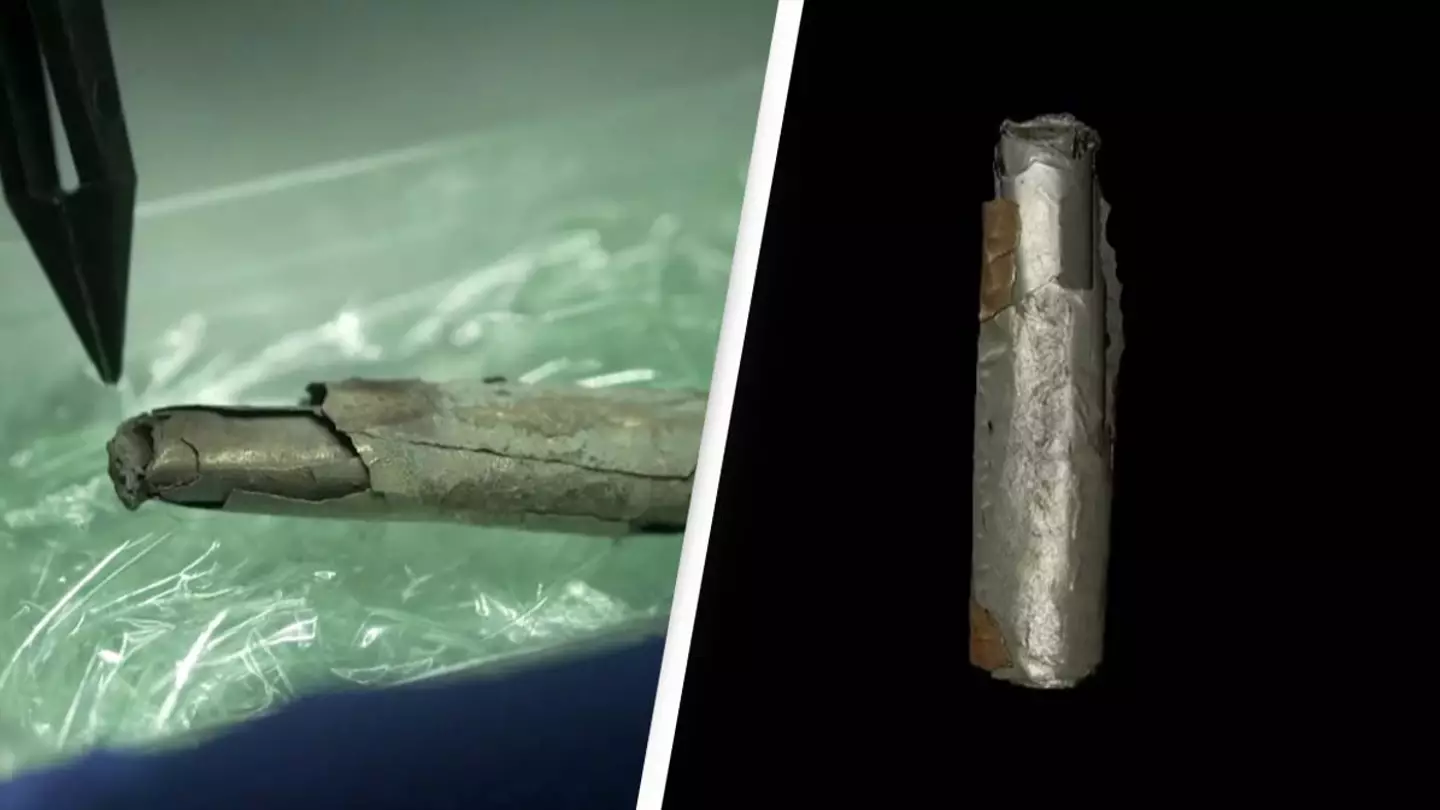
A 1,800-year-old silver amulet unearthed in a Roman-era grave near Frankfurt, Germany, is offering new insights into the spread of Christianity in the Roman Empire. The amulet, dated between AD 230 and 270, contains an 18-line Latin inscription, making it the oldest known Christian artifact found north of the Alps. This discovery, detailed in a December 11 study by the Leibniz Center for Archaeology (LEIZA), challenges previous assumptions about the early reach of Christianity and its presence in the western provinces of the Roman Empire.

The amulet, measuring just 3.5 centimeters, was found in a grave containing the remains of a man buried on the outskirts of Frankfurt. Positioned beneath the man’s chin, the amulet is believed to have been worn as a pendant on a cord around his neck. Researchers used high-resolution CT scanning to analyze the delicate, wafer-thin silver sheet housed inside the amulet, creating a 3D model to reveal its intricate inscription. Markus Scholz, a scholar at the Goethe University Institute of Archaeological Sciences, successfully deciphered the text, shedding light on its Christian significance.

What sets this amulet apart is its exclusively Latin inscription, a rare feature among similar artifacts typically found in the eastern Mediterranean, which often include Greek or Hebrew texts. Dr. Tine Rassalle, a biblical archaeologist, noted that such amulets were commonly used in the eastern parts of the Roman Empire, often as protective charms or expressions of faith. The discovery of this artifact in western Europe suggests that Christian communities may have been more widespread and connected than previously thought, even in regions far from Christianity’s traditional centers.

This find underscores the complexity of early Christian practices and the faith’s expansion during the Roman Empire. The amulet not only provides evidence of Christian belief but also highlights the cultural and linguistic adaptations that occurred as Christianity spread westward. Researchers hope this discovery will prompt further investigations into the development of Christian communities in regions traditionally overlooked in historical studies.


 

USS Zumwalt to Be Equipped with Hypersonic Missiles for Enhanced Long-Range Strike Capability

The USS Zumwalt, one of the United States Navy’s cutting-edge stealth destroyers, is set to receive a major upgrade to accommodate advanced hypersonic missiles as part of the Conventional Prompt Strike (CPS) program. These weapons, capable of traveling at speeds exceeding five times the speed of sound, mark a significant leap forward in non-nuclear strike capabilities. By integrating hypersonic missiles, the USS Zumwalt will enhance its capacity for long-range, high-precision attacks, providing the Navy with a powerful new tool for strategic operations.

Hypersonic missiles are a revolutionary class of weaponry designed for speed, accuracy, and survivability. According to reports, the CPS system employs a hypersonic glide vehicle that can reach speeds of up to Mach 8—about 6,140 miles per hour—far surpassing the capabilities of traditional ballistic missiles. The Zumwalt-class destroyers, known for their stealth and advanced technology, will be equipped with four launch tubes, each capable of housing three of these state-of-the-art missiles. This configuration ensures a formidable offensive capability while maintaining the ship’s stealth profile.

One of the standout features of hypersonic weapons is their high-altitude trajectory, with missiles capable of reaching altitudes of up to 50 miles above sea level. This design minimizes air resistance, allowing the missiles to maintain their incredible speeds while reducing the chances of interception by advanced defense systems. Military analysts highlight this capability as a key advantage, as it enables hypersonic missiles to evade even the most sophisticated missile defense networks, providing a near-unmatched offensive edge.

The integration of hypersonic missiles into the USS Zumwalt represents a pivotal moment in modern naval warfare. By combining the destroyer’s stealthy design with these advanced weapons, the U.S. Navy aims to stay ahead in the race for military innovation. As the CPS program progresses, the Zumwalt-class destroyers are poised to play a critical role in redefining long-range strike capabilities, setting a new standard for the future of naval combat.

Mysterious Dark Spot on Saturn’s Moon Enceladus Leaves Scientists Intrigued

A mysterious dark spot on Saturn’s icy moon Enceladus has baffled scientists, prompting questions about the moon’s geological processes. First spotted in images from NASA’s Cassini spacecraft in 2009, the dark feature, approximately a kilometer in size, appeared to fade significantly by 2012. The discovery was a key topic of discussion at the 2024 American Geophysical Union (AGU) meeting in Washington, D.C., where researchers highlighted the unusual and transient nature of the phenomenon.

Cynthia B. Phillips, a planetary geologist at NASA’s Jet Propulsion Laboratory, provided insights into the discovery, crediting her team member Leah Sacks for identifying the anomaly. Sacks uncovered the dark spot while analyzing data from NASA’s Voyager and Cassini missions, comparing images of the same region over several years. This long-term analysis confirmed the gradual disappearance of the enigmatic feature, adding a layer of intrigue to its already puzzling presence.

Researchers have been working to uncover the origin of this dark spot and have ruled out several initial hypotheses. They determined it was not a shadow or an imaging artefact, as it appeared consistently in photographs taken under various lighting conditions. Further analysis of ultraviolet and visible-light data revealed that the spot had a unique reddish-brown hue, contrasting with the bluish tones often observed in darker regions of Enceladus’s icy surface.

The fading dark spot has raised new questions about the dynamic processes shaping Enceladus’s surface. Whether linked to cryovolcanic activity, shifting subsurface materials, or some other yet-unknown phenomenon, the feature underscores the moon’s status as one of the most geologically active bodies in the solar system. Continuing analysis of Cassini’s data, alongside future missions, may one day shed light on this peculiar and transient feature of Enceladus.