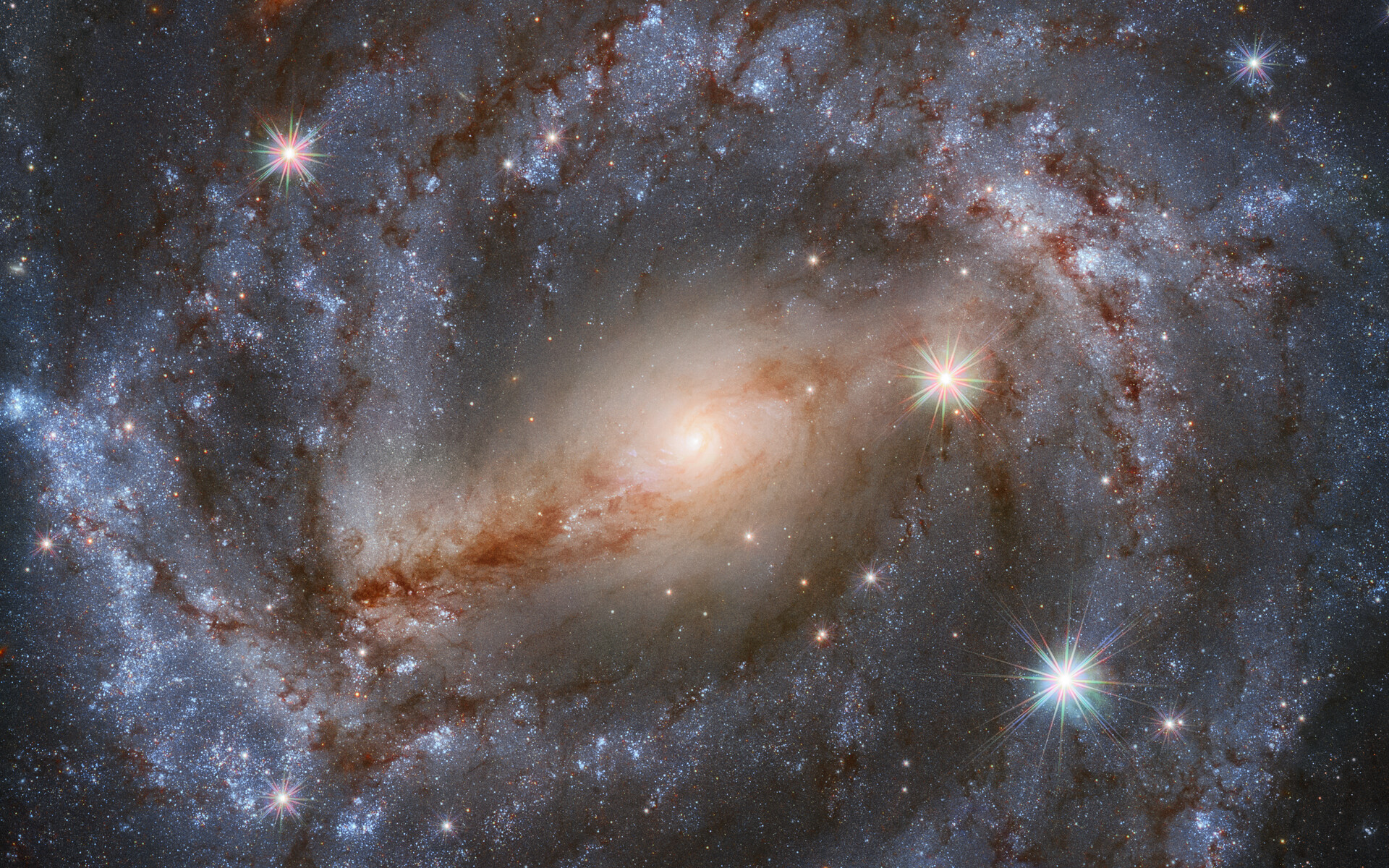
Hubble Unveils NGC 5643’s Stunning Spiral Arms and Hidden Black Hole

The spiral galaxy NGC 5643, located roughly 40 million light-years away in the constellation Lupus, has been vividly captured by the NASA/ESA Hubble Space Telescope. This “grand design spiral” galaxy boasts a symmetrical structure defined by its striking, well-organized spiral arms. These arms are adorned with vibrant, young blue stars interspersed with reddish-brown dust clouds. Within the galactic disc, regions of intense star formation are evident, showcasing pinkish hues that signify the presence of ionized hydrogen gas illuminated by young, massive stars.

While the galaxy’s beauty is readily apparent in visible light, its true nature is revealed in other wavelengths. According to a NASA blog post, ultraviolet and X-ray imaging have uncovered an active galactic nucleus at the heart of NGC 5643, powered by a supermassive black hole. Gas swirling toward the black hole heats up to extreme temperatures within the accretion disk, emitting radiation across the electromagnetic spectrum. This dynamic process, particularly prominent in X-rays, highlights the galaxy’s energetic core.

Surprisingly, the brightest X-ray source in NGC 5643 is not the supermassive black hole itself but a separate, smaller black hole identified as NGC 5643 X-1. Observations from ESA’s XMM-Newton Observatory suggest that this object, with an estimated mass of 30 Suns, is part of a binary system. It pulls gas from its companion star, forming an accretion disk that emits intense X-rays, outshining even the galactic nucleus in this wavelength.

These findings emphasize the complexity and diversity of activity within NGC 5643. From its elegantly structured spiral arms and regions of vibrant star formation to its hidden black holes emitting powerful radiation, this galaxy exemplifies the richness of the universe. Observations like these continue to deepen our understanding of galactic evolution and the interplay between massive celestial objects.


Google Drive Scanner Now Enhances Documents Automatically on Android

Google Drive’s mobile document scanner has received a significant upgrade with the introduction of a new feature called ‘auto enhancements.’ This feature automatically improves the resolution and image quality of digitized documents, making them clearer and easier to read. It addresses common issues like white balance, shadows, lighting, and contrast. Initially announced for Google Workspace users, this enhancement will also be accessible to personal Google account holders, ensuring broader availability.

Over the years, Google has consistently refined its document scanning tool within the Drive app for Android. Notably, the Mountain View-based tech giant introduced machine learning (ML)-powered features like title suggestions, automatic capture, and the ability to import images directly from the camera roll. These updates, alongside a redesigned camera viewfinder and a floating action button (FAB) for quick access to the scanner, showcased Google’s commitment to improving user experience.

More recently, Google enhanced the tool further by adding options to save scanned files as either PDFs or JPEGs, giving users more flexibility in handling their documents. A new black-and-white filter was also introduced to cater to users who prefer simplified, print-friendly scans. These updates collectively made the scanner a versatile tool for personal and professional use.

The newly added auto enhancement feature takes things a step further by leveraging advanced image processing to ensure high-quality scans. According to Google’s official blog post, the feature intelligently corrects issues like poor lighting or shadows, eliminating the need for manual adjustments. By automating these improvements, Google Drive’s scanner is becoming a more efficient and user-friendly tool for both casual and professional users alike.

Winners and Losers in 2024’s Environment Amid Predictions of a Record-Breaking 2025

The National Trust has highlighted the contrasting effects of 2024’s wet and mild climate on wildlife and habitats across the UK. While some species and ecosystems thrived, others faced significant challenges.

Winners

  • Heather Revival: Heather at Dunwich Heath in Suffolk, a crucial habitat for species like nightjar, woodlark, and adders, began recovering from the 60% loss caused by 2022’s drought. Thanks to spring rainfall, drone surveys revealed an 11% regrowth in damaged heathland.
  • Wetland Boost: New wetlands created through river restoration at Holnicote in Somerset supported dense populations of water voles while also benefiting kestrels and barn owls.
  • Grey Seal Success: Suffolk’s Orford Ness saw its first grey seal colony established, indicating the species’ recovery. The remote location’s low disturbance risk attracted seals from other colonies along the coastline.
  • Fungi Flourish: Grassland fungi, aided by a cool, damp autumn free of frost, thrived in several areas.

Losers

  • Butterflies Decline: A wet and cool spring severely impacted insect populations. Butterfly numbers were notably lower than usual across National Trust properties, with some locations reporting record lows.
  • Struggling Bees: Bees faced significant challenges in many areas, though the rare bilberry bumblebee was positively sighted in the Shropshire Hills, benefiting from conservation efforts.
  • Decline in Bats: Bats experienced population drops in some roosts, primarily due to reduced feeding opportunities and low insect numbers caused by the wet, cool weather.
  • Mixed Results for Seabirds: The Farne Islands showed no signs of bird flu, and Arctic tern populations at Long Nanny recovered somewhat compared to 2023. However, European shag populations suffered sharp declines due to extreme weather and storms, while terns recorded substantial losses. Puffin numbers were stable.

2025 Predicted to Be the Hottest Year on Record

Global climate studies revealed the intensifying effects of human-caused climate change in 2024, adding an average of 41 days of dangerous heat. Of 29 extreme weather events analyzed, 26 were worsened by climate change, leading to tens of thousands of deaths and displacing millions.

Scientists warn that 2025 is set to become the hottest year on record. Governments and societies must urgently prepare for rising climate risks to minimize the associated human and ecological tolls.