Morrisons’ Christmas Sales Hit by Cyber Attack on Tech Provider

British supermarket chain Morrisons reported that a cyber attack on its technology provider, Blue Yonder, in November disrupted product availability and negatively impacted its Christmas sales.

Key Details:

  • Warehouse System Shutdown: CEO Rami Baitieh stated that Morrisons had to shut down its warehouse management system, leading to a loss of visibility on fresh produce and stock levels for several days.
  • Impact on Sales: While Morrisons experienced sales growth in the first quarter ending January, Finance Chief Jo Goff noted that growth was lower than the 4.9% recorded in the previous quarter.
  • Cyber Attack Consequences: The disruption affected Morrisons’ ability to manage inventory efficiently during the critical holiday season.

Coma Cluster’s Closer Proximity Than Expected Raises Tension in Hubble Measurement Debate

The Hubble tension, which has long perplexed cosmologists, has recently gained renewed attention due to new findings that challenge the current understanding of the universe’s expansion rate. Researchers, including Dan Scolnic from Duke University and Adam Riess from Johns Hopkins University, have made groundbreaking discoveries that suggest the Coma Cluster of galaxies is 38 million light-years closer to Earth than previously predicted by standard cosmological models. This finding highlights a deeper, ongoing mystery regarding the disparity between how quickly the universe appears to be expanding in the present day compared to what early universe observations would imply. With this new data, the Hubble tension has been described as a potential “crisis” for cosmology, raising profound questions about the very nature of space and time.

The discrepancy in the distance measurements between the Coma Cluster and the predicted value is crucial to understanding the Hubble tension. By using type Ia supernova explosions as “standard candles” in the Coma Cluster, the researchers have calculated a distance of 321 million light-years, much closer than the 359 million light-years predicted by the standard cosmological model. This difference suggests that the models, which rely on the Hubble-Lemaître law and observations of the cosmic microwave background (CMB), might not fully account for the complexities of cosmic expansion. The results, anchored in the precise data gathered by the Hubble Space Telescope, signal a growing need to revisit and possibly revise the models that govern our understanding of the cosmos.

The Hubble constant is the key quantity involved in the tension. This constant is a measure of how fast the universe is expanding at any given moment. Traditionally, two main approaches have been used to determine the value of the Hubble constant: one based on observations of standard candles like supernovae and Cepheid variables, and the other on the analysis of the CMB, which provides a snapshot of the early universe. According to the standard cosmological model, the Hubble constant is approximately 67.4 km/s/Mpc. However, recent measurements that rely on standard candles suggest a higher value, around 73.2 km/s/Mpc, which has sparked further debate over the accuracy of the methods and models used to estimate cosmic expansion.

Efforts to resolve the Hubble tension are ongoing, with instruments like the Dark Energy Spectroscopic Instrument (DESI) playing a crucial role in refining the measurements of the universe’s expansion rate. Despite their potential, however, the results thus far have been inconclusive. The persistent discrepancy has led some scientists to question whether the current understanding of cosmology might need to be rethought entirely. Whether the solution lies in modifying existing models or in uncovering new aspects of physics, the ongoing investigation into the Hubble tension promises to shape the future of our understanding of the cosmos.

Early Supernovas May Have Created Water in the Universe, Supporting Life Formation 100 Million Years After the Big Bang

Supernovas in Early Universe May Have Created Water, Setting the Stage for Life 100 Million Years After the Big Bang

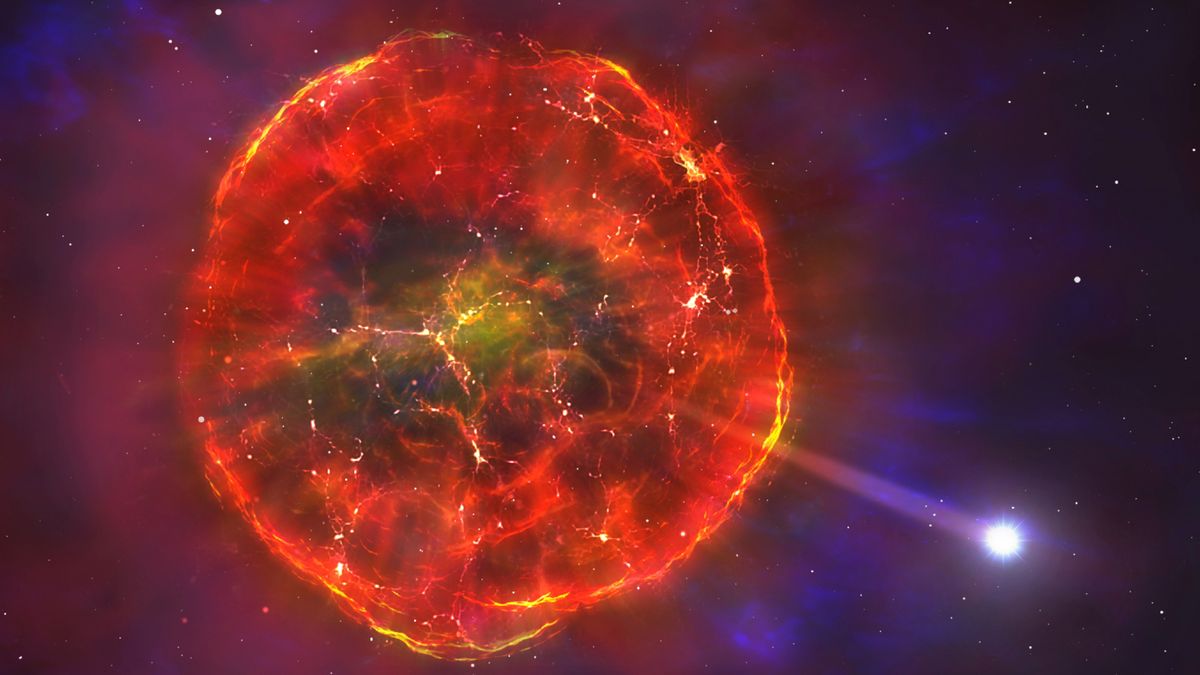
New research suggests that the explosive deaths of the first stars in the universe, known as supernovas, could have been responsible for the creation of water, potentially enabling life to emerge as early as 100 million years after the Big Bang. These findings challenge current theories about the origins of water in the cosmos and highlight the significant role supernovae played in the early universe. The study, based on simulations of short-lived, massive stars, proposes that supernovae triggered the formation of water in dense clouds of hydrogen and oxygen left behind by these stellar explosions.

Water Formation in Early Stellar Explosions

The study, which was uploaded to arXiv on January 9, focused on the first generation of stars, known as population III stars. These stars were much more massive than those seen in the present universe, with masses estimated to be around 200 times that of the Sun. The researchers found that the dense material expelled during these supernovas could have created conditions ripe for water molecules to form. The process likely occurred in the aftermath of the explosion, where hydrogen and oxygen, elements essential for water, were abundant.

High Concentrations of Water in Early Universe

According to the simulations, the concentrations of water formed in the aftermath of early supernovas could have been up to 30 times higher than those observed in the interstellar gas clouds of our own Milky Way galaxy. This significant presence of water in the early universe could have provided essential conditions for the formation of galaxies, stars, and potentially even life. The research opens up new possibilities regarding the timeline and conditions under which life-supporting water could have existed, significantly altering our understanding of the universe’s early history.

Implications for the Origins of Life and Galaxy Formation

The discovery has profound implications for our understanding of both the origins of water and the formation of life in the universe. If water existed so early in the universe’s history, it could have acted as a crucial ingredient for the formation of complex molecules, setting the stage for the emergence of life. Additionally, the presence of water in the dense regions created by early supernovas could have played a role in the formation of early galaxies, providing further insight into how the universe evolved in its infancy. This new research suggests that the universe’s first stars didn’t just shape the cosmos with their explosive ends—they may have created the very building blocks for life.