Breakthrough Laser Imaging Reveals Nanoscale Heat and Charge Flow in Diamond

Advancing Nanoscale Imaging with Laser Technology

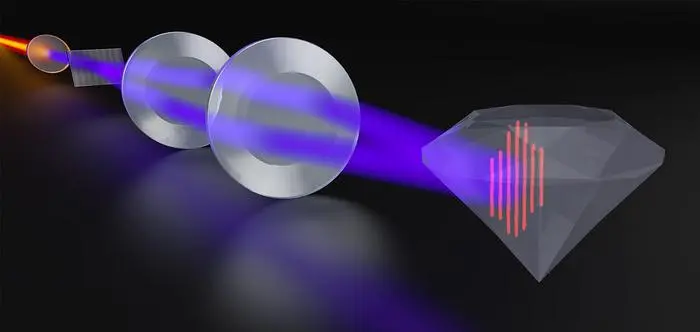
Scientists have developed a cutting-edge laser imaging technique to analyze nanoscale heat and charge transport in ultrawide-bandgap semiconductors like diamond. Using a deep-ultraviolet (DUV) laser, this method achieves an impressive spatial resolution of 287 nanometres, surpassing the limitations of traditional visible-light imaging. By enhancing the study of diamond’s transport properties, this breakthrough paves the way for improvements in high-performance power electronics and communication systems.

Revolutionary DUV Microscopy for Semiconductor Research

A recent study in Physical Review Applied highlights the development of a DUV microscope capable of producing interference patterns on material surfaces, enabling detailed heat mapping at the nanoscale. The research, led by JILA scientists Margaret Murnane and Henry Kapteyn, involved collaborations with graduate students and industrial partners from 3M. Unlike visible-light methods, which struggle with ultrawide-bandgap materials, this new approach overcomes fundamental energy gap challenges, offering unprecedented imaging precision.

Technical Innovation and System Optimization

The DUV system was constructed by converting 800-nanometre laser pulses into shorter wavelengths using nonlinear crystals, generating high-energy light essential for nanoscale analysis. This innovation allows researchers to create transient gratings on semiconductor surfaces, providing a deeper understanding of their thermal and electronic properties. Years of development and meticulous testing were required to optimize the system, with researchers fine-tuning the laser alignment to ensure precise nanoscale pattern formation.

Future Impact on Semiconductor and Electronic Technologies

By refining imaging capabilities at the nanoscale, this technique has the potential to revolutionize semiconductor research and device engineering. Enhanced understanding of heat and charge transport in diamond and other ultrawide-bandgap materials could lead to more efficient, durable power electronics and faster communication networks. As the demand for high-performance electronics grows, the insights provided by DUV microscopy will be invaluable in driving future technological advancements.

SpaceX Falcon 9 Deploys 23 Starlink Satellites, Achieves New Booster Reusability Milestone

On January 24, 2025, SpaceX successfully launched 23 Starlink satellites into orbit, marking its 11th Falcon 9 mission of the year. The rocket lifted off from Vandenberg Space Force Base at 9:07 a.m. EST, delivering its payload to low Earth orbit. Following stage separation, the Falcon 9’s first-stage booster executed a precise landing on the drone ship Of Course I Still Love You in the Pacific Ocean. This achievement marks the 401st successful recovery of an orbital-class booster, further solidifying SpaceX’s dominance in reusable rocket technology.

Falcon 9 Booster Achieves 23rd Flight

According to SpaceX, the booster supporting this mission completed its 23rd successful launch and landing, setting a new record for Falcon 9 reusability. Of its previous missions, 14 were dedicated to Starlink deployments. The rocket’s upper stage deployed the satellites approximately 64 minutes after liftoff, further advancing SpaceX’s efforts in cost-efficient spaceflight. This milestone underscores the company’s ongoing refinement of booster reuse, a crucial factor in reducing launch costs and increasing mission frequency.

Starlink’s Ever-Growing Satellite Constellation

With this latest deployment, the Starlink constellation continues its rapid expansion. This mission represents the seventh Starlink launch of 2025, pushing the total number of operational satellites beyond 6,900. Astrophysicist and satellite tracker Jonathan McDowell noted that SpaceX’s ongoing launches are enabling faster global coverage, bringing high-speed internet access to underserved regions worldwide.

Paving the Way for Future Missions

As SpaceX scales up its Starlink network, the company remains focused on increasing satellite capabilities and launch efficiency. Future missions are expected to incorporate advanced satellite models with enhanced connectivity and inter-satellite communication. With Falcon 9’s continued reusability improvements, SpaceX is paving the way for even more ambitious spaceflight endeavors, including upcoming crewed missions and deep-space exploration.

Asteroid 2024 PT5 Traced to Lunar Origins, Offering New Insights for Planetary Defense

A newly analyzed asteroid, 2024 PT5, which lingered near Earth for nearly two months last year, may have originated from the Moon. This school bus-sized space rock made another close approach in January, passing safely at a distance of 1.1 million miles. Researchers now believe that a massive impact on the lunar surface thousands of years ago could have ejected 2024 PT5 into space. The discovery provides valuable insights into the origins of near-Earth objects and their potential trajectories.

Study Confirms Lunar Composition

A study published in The Astrophysical Journal Letters analyzed observations from the Lowell Discovery Telescope in Arizona and NASA’s Infrared Telescope Facility in Hawai’i. The research linked 2024 PT5’s surface composition to lunar highland rocks, particularly those retrieved during the Apollo 14 mission. Teddy Kareta, an astronomer at Lowell Observatory, explained that the asteroid’s spectral properties closely matched silicate minerals found on the Moon, an unusual trait among typical asteroids. These findings strengthen the case for 2024 PT5’s lunar origin and contribute to ongoing studies of celestial debris.

Distinguishing Natural vs. Artificial Objects

Initial observations raised questions about whether 2024 PT5 could be artificial space debris, but further analysis confirmed its natural origin. According to Space.com, scientists determined that the asteroid’s rocky composition and exposure to solar radiation ruled out human-made origins. Its unique trajectory and mineral makeup also set it apart from other known near-Earth asteroids. This marks only the second confirmed case of a Moon-derived asteroid, following the discovery of 469219 Kamoʻoalewa.

Implications for Planetary Defense

Understanding how lunar fragments enter near-Earth space is crucial for planetary defense strategies. By studying asteroids like 2024 PT5, scientists can refine impact prediction models and assess potential risks posed by future space debris originating from the Moon. Ongoing observations may reveal additional lunar fragments in Earth’s vicinity, further expanding our knowledge of how celestial impacts shape planetary environments.