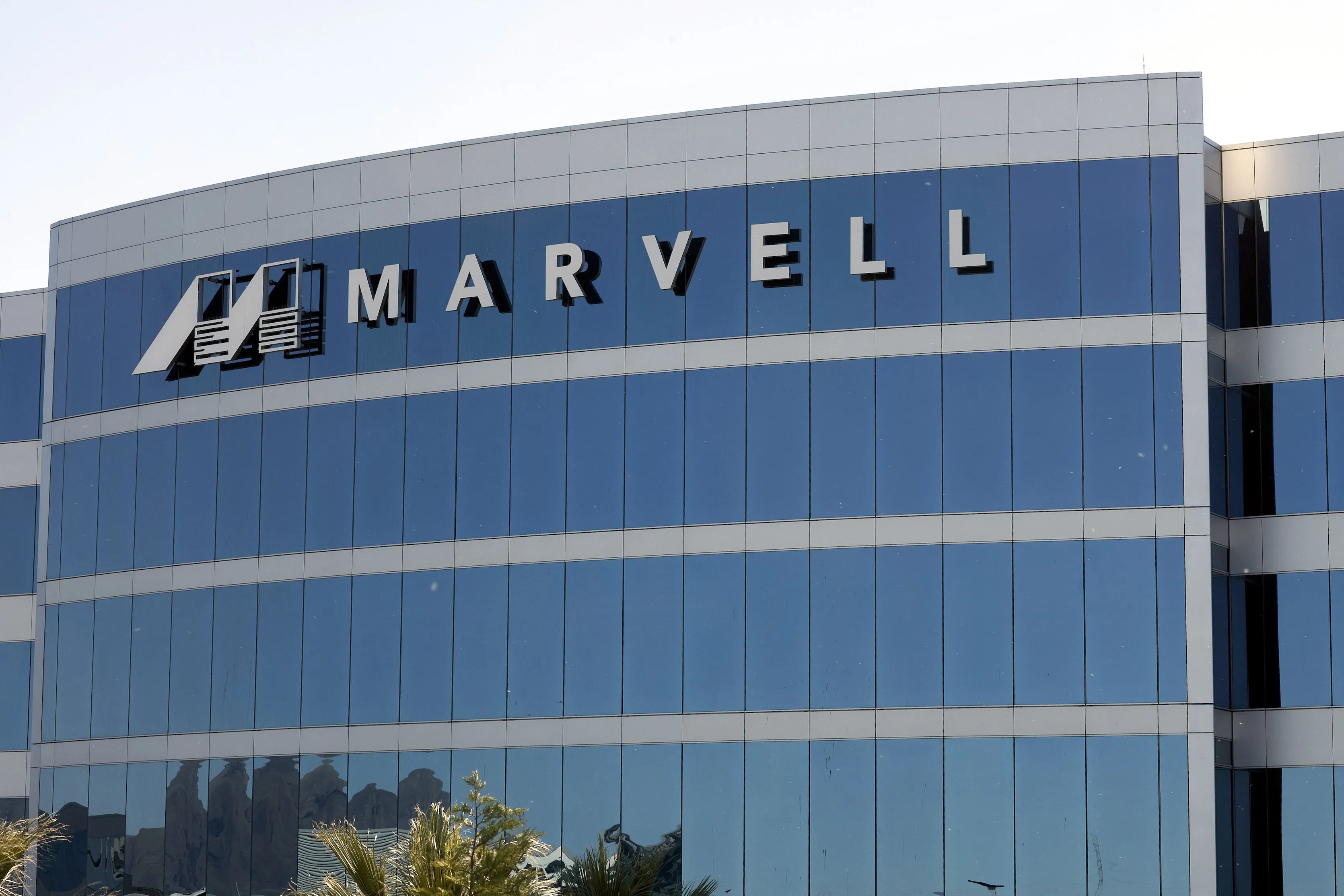
Marvell Technology Forecasts In-Line Q1 Revenue, Shares Drop 15%

Marvell Technology (MRVL.O) predicted first-quarter revenue in line with Wall Street’s expectations, but its shares fell sharply by 15% in after-hours trading. Investors were underwhelmed by the forecast, as they had hoped for more substantial growth driven by the surging demand for artificial intelligence (AI) chips.

The AI chip market has seen booming demand, particularly for sector-leader Nvidia’s (NVDA.O) AI processors. Major tech companies like Microsoft (MSFT.O), Meta Platforms (META.O), and Amazon.com (AMZN.O) have been working to reduce their reliance on Nvidia by developing their own AI chips, a trend that has benefited companies like Marvell and Broadcom (AVGO.O).

“The earnings print was generally OK, but I believe investors were expecting more given all the bullish data points in the overall AI space and the ramp of custom ASICs (AI chips) with certain hyperscalers,” said Tore Svanberg, an analyst at Stifel Nicolaus and Co.

Marvell’s data center segment performed well, with revenue up 78% year-over-year to $1.37 billion in the fourth quarter, driven by increased demand for custom AI chips as businesses work to optimize their AI workloads. In December, the company also signed a five-year chip deal with Amazon that includes custom AI chips.

“We’re engaged, we expect revenue to grow, but obviously, it’s like anything, you’ve got to show you can do it, and you’ve got to show it consistently,” Marvell COO Chris Koopmans said, emphasizing the “sticky” nature of the Amazon deal.

Marvell has pledged to focus its investments on data centers, seeing them as the best way to capitalize on the AI boom. Data center revenues accounted for 75% of its total revenue in the most recent quarter. However, Koopmans added that Marvell had not yet experienced any impact from tariffs affecting its data center business.

Despite posting solid results, Marvell’s shares dropped to $77.65 in after-hours trading, following a year-to-date increase of over 83%. In contrast, its larger competitor Broadcom saw a stock jump of around 107%. Analysts pointed to concerns over geopolitical pressures, AI monetization, and the magnitude of Marvell’s earnings beat as factors contributing to the decline.

Marvell forecast first-quarter revenue of $1.88 billion, slightly above analysts’ expectations of $1.87 billion.


Fraud Prevention Software Firm Riskified Explores Sale

Riskified, a New York-based company specializing in fraud prevention software for e-commerce, is exploring strategic options, including a potential sale, after attracting interest from multiple parties, according to sources familiar with the matter. The company, originally founded in Israel, is working with investment bank Qatalyst Partners to evaluate takeover approaches, with discussions remaining in the early stages.

Potential buyers for Riskified include digital payment processing firms, online shopping platforms, cybersecurity companies, and private equity firms. However, the sources cautioned that a deal is not assured. Following the news, Riskified’s stock price rebounded, surging nearly 9% on Wednesday.

Riskified, which went public nearly four years ago through an initial public offering, is currently valued at around $860 million. The company has faced significant challenges, with its stock plummeting more than 80% from its peak in September 2021 to its close on Tuesday. Despite its success in providing fraud prevention software for retailers, Riskified has not been profitable since its shares began trading.

For the quarter ending December 31, the company reported a widened net loss of $4.1 million, compared to a loss of $3.3 million in the previous year. This financial setback was partially attributed to the loss of several large customers in some of its key sectors.

Founded in 2013, Riskified provides fraud prevention services to e-commerce businesses, helping retailers protect digital transactions from fraudsters. Notable clients include luxury fashion brand Prada, online travel platform Booking.com, and jewelry brand Swarovski.

US Authorities Begin Releasing Some Seized Cryptocurrency Miners

U.S. authorities have recently started releasing Chinese-made cryptocurrency mining equipment that was previously seized, according to industry executives. These miners, powerful computers with specialized chips, play a key role in cryptocurrency networks by solving complex mathematical problems and building blockchains, earning rewards in digital currency.

Taras Kulyk, CEO of Synteq Digital, a cryptocurrency mining equipment broker, confirmed that thousands of seized units are being returned. At one point, up to 10,000 mining units were stuck at various U.S. ports, according to Kulyk. He suggested that some Customs and Border Protection (CBP) officials might have been hostile towards bitcoin mining, creating significant disruption for the sector.

The seizures, which began late last year, involved U.S. Customs and Border Protection (CBP) and the Federal Communications Commission (FCC). Industry publication Blockspace reported that the machines were detained, in part, because they contained chips from Sophgo, a Chinese chip company. This came amidst ongoing tensions between the U.S. and China, with U.S. authorities citing security concerns, particularly regarding radio frequency emissions from the equipment.

Ethan Vera, COO of Luxor Technology, said that although some seized shipments are being returned, most are still being held. Both Kulyk and Vera rejected concerns raised about the emissions from the machines, calling them unfounded.

The release of some of the detained equipment occurs against the backdrop of the U.S.-China trade war, with issues regarding national security and trade restrictions complicating the situation. Sophgo, which faced penalties late in the Biden administration for its alleged links to Chinese telecom giant Huawei, is at the center of the controversy.