OpenAI Denies Plans to Use Google’s In-House AI Chips Despite Cloud Collaboration

OpenAI has clarified that it has no current plans to adopt Google’s in-house AI chips (TPUs) to power its products, pushing back against recent reports that suggested the ChatGPT maker was turning to its rival’s hardware to meet increasing computing demands.

A spokesperson for OpenAI stated on Sunday that while the company is testing Google’s TPUs in early stages, there are no plans to deploy them at scale for production use. Google, for its part, declined to comment on the matter.

Testing multiple AI chip platforms is standard industry practice, but shifting large-scale workloads to a new hardware platform would require significant architectural and software adjustments. Currently, OpenAI continues to rely heavily on Nvidia’s GPUs and is also utilizing AMD’s AI chips to fuel its operations. Additionally, OpenAI is actively developing its own custom AI chip, expected to reach the “tape-out” milestone later this year — marking the point where chip design is finalized for manufacturing.

Earlier this month, Reuters reported that OpenAI had signed on to use Google Cloud services, a move seen as a notable collaboration between two competitors in the generative AI space. However, the bulk of OpenAI’s computing needs are still being handled by CoreWeave, a cloud provider specializing in GPU-based infrastructure.

Google has recently begun expanding external access to its TPUs, previously used mostly for internal projects. This shift has attracted a number of high-profile customers, including Apple, as well as AI startups Anthropic and Safe Superintelligence (SSI) — both of which were founded by former OpenAI executives and are direct rivals in the AI field.

Meta Launches ‘Superintelligence Labs’ to Revive AI Strategy Amid Fierce Competition

Meta is restructuring its artificial intelligence efforts under a new division called Meta Superintelligence Labs, in a bid to regain lost ground in the global AI race. According to a source familiar with the matter, the new unit will be headed by Alexandr Wang, the former CEO of data-labeling firm Scale AI, who now takes on the role of Chief AI Officer at Meta.

The move comes as Meta grapples with senior staff exits and underwhelming reception to its latest open-source model Llama 4, developments that have left rivals such as Google, OpenAI, and China’s DeepSeek in stronger positions. Meta CEO Mark Zuckerberg reportedly hopes the new lab will fast-track progress toward artificial general intelligence (AGI)—a long-term ambition to build machines that can surpass human intelligence.

In recent weeks, Zuckerberg has taken personal control of AI recruiting, targeting high-profile names with aggressive offers, including attempts to lure OpenAI co-founder Ilya Sutskever’s new startup Safe Superintelligence (SSI). Offers reportedly reached $1 million per candidate via direct WhatsApp outreach.

The shakeup includes Meta’s $14.3 billion investment in Scale AI earlier this month. In addition to Wang, the Superintelligence Labs will include SSI co-founder and CEO Daniel Gross, while former GitHub CEO Nat Friedman will co-lead the division, focusing on applied AI products.

Meta has also attracted talent from top AI firms, hiring at least 11 new AI researchers from OpenAI, Anthropic, and Google DeepMind. Notable names include Jack Rae and Pei Sun (DeepMind), Jiahui Yu, Shuchao Bi, Shengjia Zhao, and Hongyu Ren (OpenAI), as well as Joel Pobar (Anthropic), who had previously spent over a decade at Meta.

Earlier this month, OpenAI’s CEO Sam Altman revealed that Meta had offered some of his staff $100 million bonuses to switch companies.

Despite the hiring blitz, some analysts are skeptical of Meta’s AGI strategy. They point to the company’s Reality Labs unit, which has burned over $60 billion since 2020 with few commercial wins, outside of Ray-Ban smart glasses and Quest headsets.

The broader tech sector is expected to spend $320 billion on AI development this year. Other firms are also making bold moves: Microsoft spent $650 million acquiring most of Inflection AI’s team, and Amazon has poached key personnel from Adept.

Still, the path to AGI remains uncertain. Meta’s own Chief AI Scientist Yann LeCun has publicly said that current methods are inadequate to reach true AGI. Meanwhile, SoftBank CEO Masayoshi Son believes the breakthrough is within 10 years.

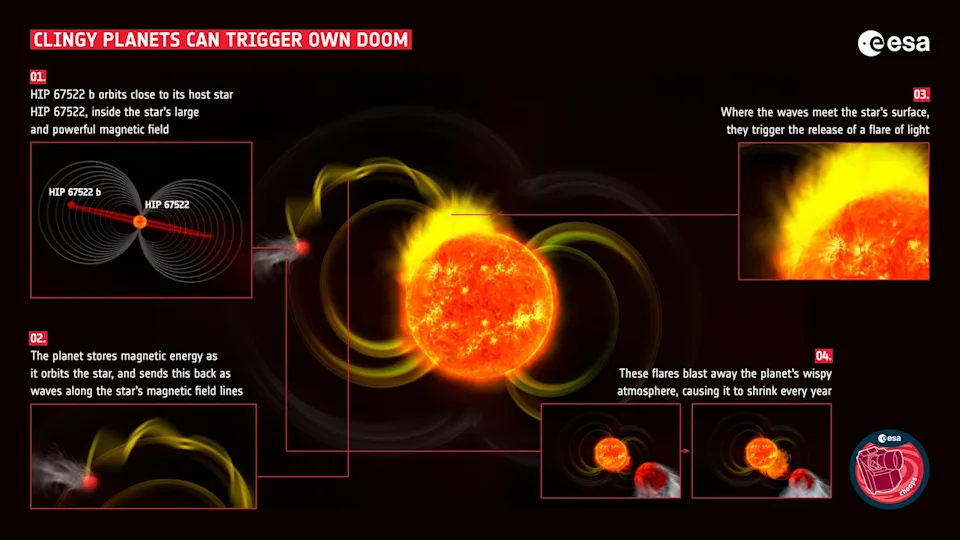
A Planet Doomed to Destroy Its Star: The Story of HIP 67522 b

Scientists have recently discovered a planet that appears to have a “death wish,” orbiting extremely close to its star at an astonishing speed. This alien world, named HIP 67522 b, is roughly the size of Jupiter and completes a full orbit in just seven days. Its rapid orbit is causing significant disturbances in the magnetic field of its host star, triggering massive explosive eruptions. These powerful blasts push back against the planet and even cause its surface to wrinkle. This remarkable interaction between a planet and its star is unprecedented, as detailed in a study published on July 2, 2025, in the journal Nature. Devamını Oku