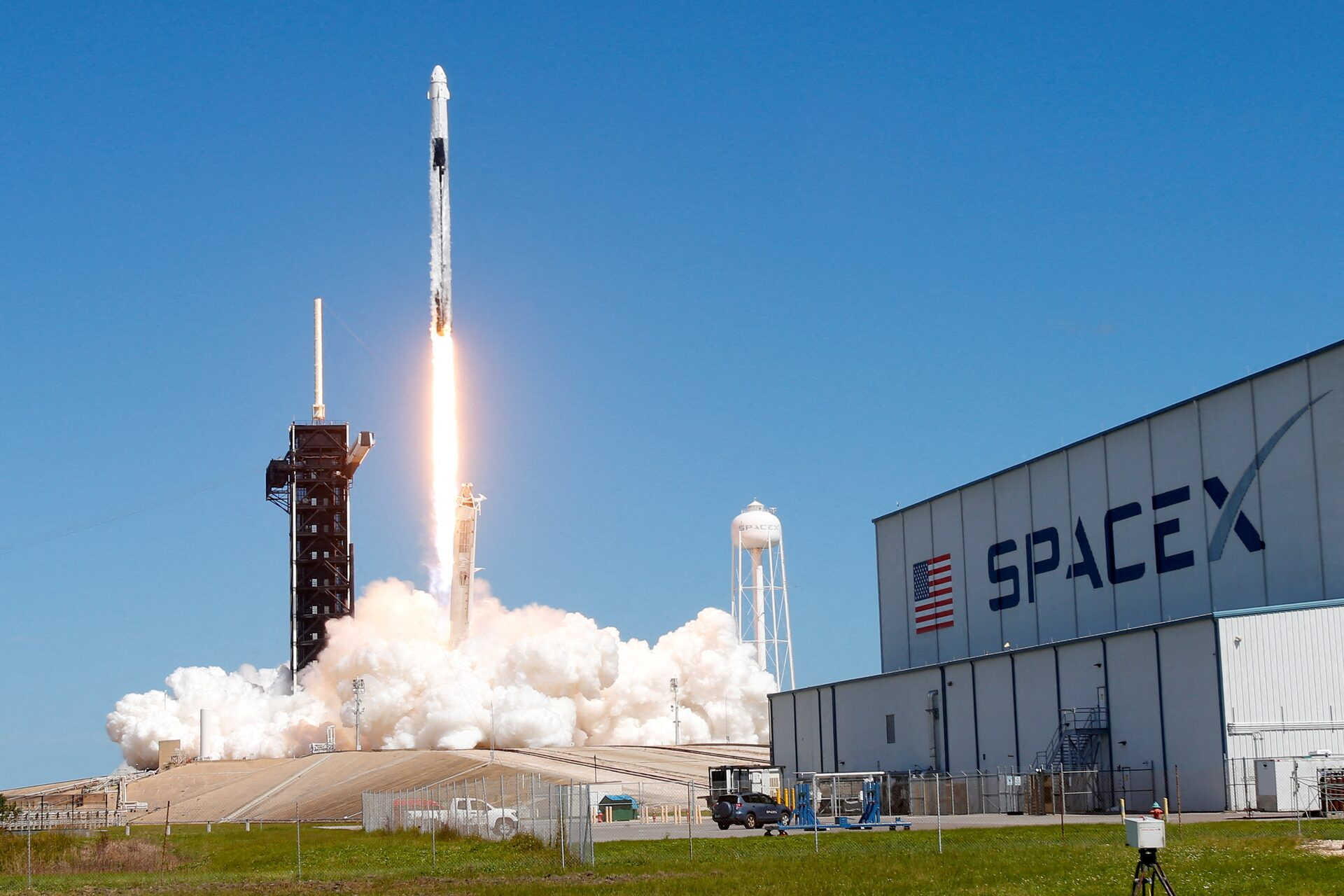
SpaceX Buys EchoStar Spectrum in $17 Billion Deal to Expand Starlink’s 5G Reach

SpaceX announced Monday that it will purchase wireless spectrum licenses from EchoStar for about $17 billion, a move designed to accelerate Starlink’s expansion into the 5G mobile connectivity business. The deal also allows EchoStar’s Boost Mobile subscribers to access Starlink’s direct-to-cell satellite service, extending coverage to underserved regions.

The acquisition gives SpaceX exclusive rights to critical mid-band spectrum, enabling it to build upgraded, laser-linked Starlink satellites that could expand network capacity by over 100 times. “With exclusive spectrum, SpaceX will develop next-generation Starlink Direct to Cell satellites… to end mobile dead zones around the world,” said SpaceX President Gwynne Shotwell.

The deal boosted EchoStar’s shares by 19%, while U.S. carriers AT&T, T-Mobile and Verizon fell 2–3% amid investor concerns over heightened competition. Americans’ mobile data usage surged 35% in 2024 to a record 132 trillion MB, underscoring the need for expanded capacity.

Since 2020, SpaceX has launched more than 8,000 Starlink satellites, with about 600 “cell towers in space” deployed in 2024 alone for direct-to-cell services. Its giant Starship rocket, now in advanced testing, will play a key role in launching the next generation of larger satellites, with operational missions expected in 2026.

The FCC, which had questioned EchoStar’s spectrum obligations, welcomed the SpaceX deal, calling it an opportunity to “supercharge competition” and extend connectivity. EchoStar recently sold $23 billion in spectrum licenses to AT&T, and the SpaceX transaction is expected to resolve regulatory inquiries.

The purchase structure includes $8.5 billion in cash, $8.5 billion in SpaceX stock, and $2 billion in debt interest coverage. EchoStar will continue to operate its Dish TV, Sling, Hughes internet service and Boost Mobile brands.

The deal marks a major win for Elon Musk’s push to control spectrum for Starlink, shifting from leasing agreements with carriers like T-Mobile to operating on frequencies SpaceX owns outright.
Apple’s iPhone Event May Lack Spark, but Rumored Slim ‘iPhone Air’ Could Drive Upgrades

Apple is set to unveil its latest iPhone lineup on Tuesday, but analysts warn the launch could feel underwhelming compared with rivals’ rapid AI integration. The highlight may be the rumored “iPhone Air”, a slimmer model designed to echo the sleekness of Apple’s MacBook Air.

The thinner device would require Apple to solve battery and camera design challenges while fitting into a price band between the base iPhone 17 and Pro models. Analysts say this new form factor could entice iPhone 14–16 users to upgrade, offering Apple its first meaningful design shift in years.

Some see the “Air” as a stepping stone toward foldable iPhones and a more advanced Siri, though foldables are not expected until next year. Competitors like Samsung and Google already have folding models, but they remain a niche category at less than 2% of global sales. Apple faces added pressure in China, where foldables are popular and its market share has slipped.

Pricing remains a sensitive issue amid Trump’s tariff policies. Apple may quietly push margins higher through storage-based price increases, avoiding direct price hikes that could trigger political backlash, analysts say.

On the AI front, Apple has lagged rivals. Plans to revamp Siri were delayed by engineering hurdles, forcing the company to lean on OpenAI’s ChatGPT integration. Apple is also in early talks to use Google’s Gemini AI to strengthen Siri. Analysts expect the company to tout the AI processing power of its next-gen Apple Silicon chips, paving the way for an “agentic Siri” that can handle tasks in the background without draining device batteries.

While Apple’s customer base remains loyal, experts warn the company now has months, not years, to prove it can match competitors in AI and form-factor innovation. “By this time next year, if Siri still disappoints and the foldable isn’t out, Apple’s content base could erode,” said Bob O’Donnell of TECHnalysis Research.

Chinese Robotics Startup Unitree Targets $7B IPO Valuation Amid Tech Push

Chinese humanoid robotics firm Unitree Robotics is preparing for a landmark IPO on Shanghai’s STAR Market, seeking a valuation of up to 50 billion yuan ($7 billion), according to sources. The company, founded in 2016 by Wang Xingxing, has gained global attention with viral videos of robots walking, climbing, and carrying loads.

Unitree confirmed last week that IPO preparations are underway, with a formal application expected in Q4, though it disputed reports on the exact valuation. If successful, this would be one of China’s largest onshore tech listings in years, underscoring Beijing’s drive to fund domestic “unicorns” and bolster self-sufficiency in robotics and AI.

The potential listing comes after a funding round in June that included investments from Alibaba, Tencent, and Geely, boosting Unitree’s valuation to 12 billion yuan. Sources say the company is already profitable, with annual revenue above 1 billion yuan, and poised for rapid growth.

Unitree’s IPO plans coincide with China’s heavy investment in robotics and AI to counter U.S. tech rivalry and address an aging population. The humanoid robot industry enjoys strong government subsidies and policy support, making Unitree a likely beneficiary.

The company’s targeted valuation would mark a sharp jump from its last funding round, testing investor appetite for humanoid robotics — a field where China is positioning itself as a global leader.