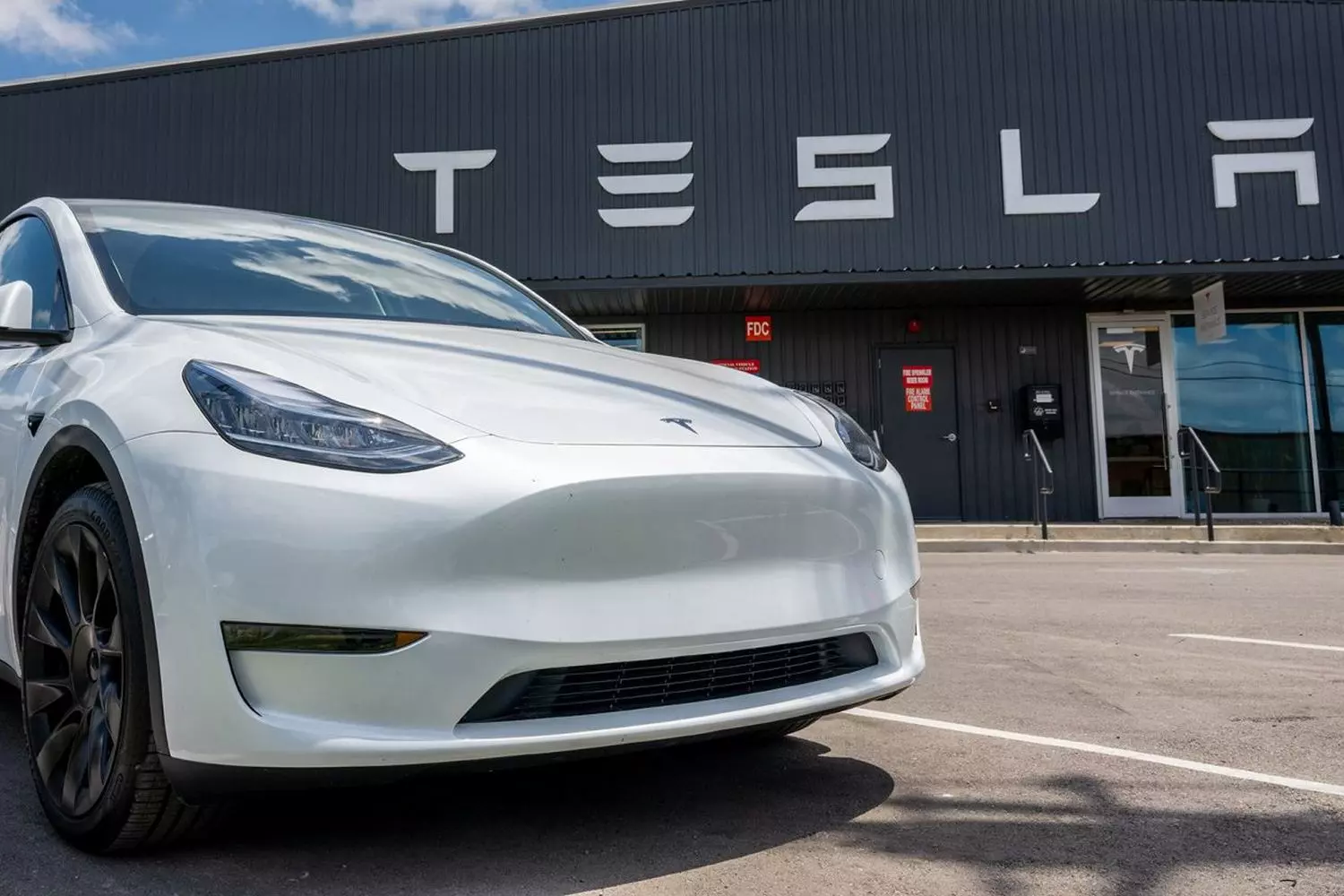
Tesla launches “affordable” Model Y and 3, but buyers call prices too high

Tesla has unveiled lower-cost versions of its Model Y SUV and Model 3 sedan, but their starting prices of $39,990 and $36,990 have left some customers and analysts questioning how “affordable” they truly are. CEO Elon Musk had previously suggested a sub-$30,000 model was key to attracting mass-market buyers.

The move comes as Tesla faces declining sales, growing competition from Chinese and European automakers, and the loss of the $7,500 U.S. EV tax credit. The new “Standard” trims cut luxury features such as heated rear seats and automated steering, though both still offer over 300 miles (480 km) of driving range.

Despite the announcement, Tesla shares fell 4.5%, with analysts saying the $5,000 price cut from premium trims is unlikely to drive major new demand. “It’s basically a pricing lever, not a product catalyst,” said Shay Boloor of Futurum Equities.

Musk canceled a separate $25,000 EV project last year, opting instead for cheaper versions of existing models — a move critics say could cannibalize Tesla’s lineup rather than expand its market.

In the U.S., Tesla now faces fresh competition from Chevrolet’s Equinox, Hyundai’s Ioniq 5, and Kia’s EV4, all targeting the under-$30,000 range. In Europe, Musk’s politics have also eroded loyalty amid rising low-cost alternatives.

Deliveries for the new models are set to begin between December 2025 and January 2026, as Tesla bets affordability — even at a premium — can revive its flagging momentum.

Revolut to launch India payments platform, targeting 20 million users by 2030

Revolut, the London-based digital finance company, will launch its first payments platform in India, marking its entry into one of the world’s largest digital finance markets. The rollout will begin later this year with 350,000 waitlisted users, before expanding nationwide.

The platform will allow users to make domestic and international transactions through partnerships with Visa and India’s Unified Payments Interface (UPI). The fintech firm, valued among Europe’s largest, sees India as a central pillar of its global expansion strategy.

Revolut India CEO Paroma Chatterjee said the company will offer prepaid cards and a digital wallet, using a payments license granted by the Reserve Bank of India earlier this year. It also holds authorization to provide foreign exchange services.

The company has invested over £40 million ($53.7 million) to localize its technology and comply with India’s data sovereignty regulations — its only market with such a setup. Revolut aims to onboard 20 million customers by 2030, targeting the country’s rapidly growing “aspirational youth” demographic.

The India launch follows Revolut’s push into banking and credit card services in other major markets, including the U.S. and Europe, as it seeks to become a global payments leader.

Toyota and Sumitomo Metal make progress on solid-state battery materials

Toyota Motor and Sumitomo Metal Mining announced progress in developing cathode materials for next-generation all-solid-state batteries, a key technology for future electric vehicles. The two Japanese companies, collaborating since 2021, have now created a highly durable cathode material designed to resist degradation during repeated charging cycles.

The partners said the breakthrough uses Sumitomo Metal’s proprietary powder synthesis technology, which enhances battery stability and lifespan. They plan to work jointly on improving performance, safety, and cost efficiency, aiming for the world’s first practical solid-state EV battery.

Solid-state batteries promise faster charging, greater safety, and longer lifespans than conventional lithium-ion systems, but remain limited by high costs and complex production methods. Toyota, the world’s largest automaker, plans to introduce EVs with solid-state batteries by 2027 or 2028.

Sumitomo Metal said it aims to begin mass production of the new cathode material by April 2028, prioritizing supply to Toyota before expanding to other customers.

The partnership underscores Japan’s push to lead the global solid-state battery race. Toyota is also working with Idemitsu Kosan, which is developing lithium sulphide, another vital component for solid-state battery technology.