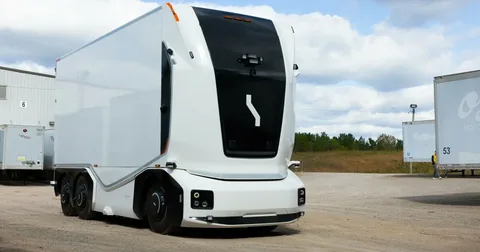
Swedish Autonomous Truck Firm Einride Secures $100 Million to Accelerate Expansion

Swedish self-driving truck company Einride has raised around $100 million in a new funding round led by EQT Ventures and quantum computing firm IonQ, the company announced on Wednesday. The investment will help scale its autonomous freight operations, boost technology development, and expand its customer network globally.

Einride’s electric and self-driving freight trucks are designed to operate on fixed highway routes, allowing for safer and more efficient automation than traditional urban self-driving vehicles. Because the trucks travel along predefined routes without intersections or pedestrians, they require less complex mapping than passenger vehicles.

Founded in 2016, Einride is a leader in autonomous and electric freight mobility, offering both fully driverless pods and remote-controlled electric trucks. Its system integrates AI logistics planning tools to optimize transport routes and energy usage.

The new funding follows previous rounds that included $110 million in 2021 from Maersk’s venture arm and Singapore’s Temasek Holdings. That same year, Einride entered the U.S. market and signed major customers such as GE Appliances, Oatly, and Bridgestone, expanding its footprint in sustainable logistics.

Einride plans to use the new funds to deploy more autonomous trucks across Europe and North America, strengthen regulatory compliance efforts, and advance its remote operations platform that allows human operators to monitor and control multiple vehicles simultaneously.

As global logistics companies push toward electrification and automation, Einride’s technology represents a major step toward reducing emissions, cutting costs, and enhancing road safety in the freight transport industry.

Spacecoin Sends Blockchain Data Through Space in First-of-Its-Kind Test to Challenge Starlink

U.S. satellite startup Spacecoin announced on Wednesday that it had successfully transmitted secured blockchain data through space, marking what it called an industry first and a potential challenge to Elon Musk’s Starlink.

The company’s goal is to create a decentralized satellite network offering connectivity and data storage for users in regions where internet access is unreliable, censored, or prohibitively expensive, according to its founder Tae Oh.

HOW IT WORKS

Unlike Starlink — where SpaceX maintains full control over its vast satellite constellation — Spacecoin envisions an open, participatory model that allows users, developers, and organizations to contribute to the network and verify transactions.
Its technology uses blockchain encryption to ensure that data sent through satellites cannot be intercepted, altered, or falsified.

During the test, Spacecoin transmitted blockchain data over 7,000 kilometers, from Chile to the Azores, entirely through a satellite link — without relying on terrestrial internet.
The nanosatellite used in the experiment was built by Bulgarian microsatellite manufacturer EnduroSat, and the company said the data returned to Earth intact and verifiable.

“Beyond end users, we are also targeting builders — such as developers, telecom companies, NGOs, and infrastructure partners,” said founder Tae Oh.
“For people using the internet, this means the information or payments they send can’t be faked, changed, or intercepted by bad actors.”

CONTEXT AND FUTURE PLANS

The success of Spacecoin’s test comes amid a boom in satellite internet services as global demand for secure broadband increases.
While J.P. Morgan previously tested blockchain payments between satellites, Spacecoin’s test is the first to bypass terrestrial networks entirely, operating solely in orbit.

Currently, Spacecoin has just one satellite, launched in December 2024 on a SpaceX rocket, and orbits in Low Earth Orbit (LEO) at up to 2,000 km altitude.
The company plans to add three more satellites by the end of 2025 to expand coverage and reliability.

With Starlink’s 8,000-satellite fleet dominating global satellite broadband, Spacecoin’s blockchain-based approach positions it as an innovative but niche challenger, combining crypto technology with space-based communication infrastructure.

T-Mobile Expands Satellite Network to Support WhatsApp, X, and Google Maps in Remote Areas

T-Mobile announced on Wednesday that its satellite-to-cell network—developed in partnership with SpaceX’s Starlink—now supports popular apps such as WhatsApp, Google Maps, and X, expanding mobile connectivity for users in dead zones and remote regions.

The service, known as T-Satellite, initially launched commercially in July 2024 with limited capabilities, allowing only SMS texting, MMS, photo messages, and short audio clips when users were outside the range of traditional mobile networks.

Now, T-Mobile says the system can support a dozen widely used apps, including Apple Music, Samsung Find, Pixel Weather, AccuWeather, and AllTrails, alongside its new flagship “Experience Beyond” plan.

“We’ve worked closely with Apple and Google to create frameworks for SAT mode so that any app can access the data channel when connected to the satellite,” said Jeff Giard, T-Mobile’s Vice President of Strategic Partnerships and Product Innovation, in an interview with Reuters.

HOW IT WORKS

The network relies on more than 650 Starlink direct-to-cell satellites, which automatically connect when a user’s device loses a terrestrial signal.
Apps that are “satellite-ready” provide essential services such as navigation, communication, and weather updates — though not full, data-heavy features like high-definition video streaming.

T-Mobile customers under the Experience Beyond plan can access the network at no extra charge, while users from AT&T and Verizon can subscribe for $10 per month.

EXPANDING DEVELOPER ACCESS

Giard said that both the App Store and Google Play Store now support SAT mode integration through a dedicated API, enabling developers to make their apps satellite-compatible.
T-Mobile is working with app makers to encourage adoption, especially for tools that provide critical communications and safety features.

“People are excited that their regular phone can now connect to space,” Giard said. “They essentially get a satellite phone experience—without having to buy new equipment.”

With this expansion, T-Mobile strengthens its push toward universal mobile connectivity, aiming to make complete coverage a reality even in the world’s most remote areas.