Malaysia to discuss semiconductor tariffs with U.S. at ASEAN summit next week

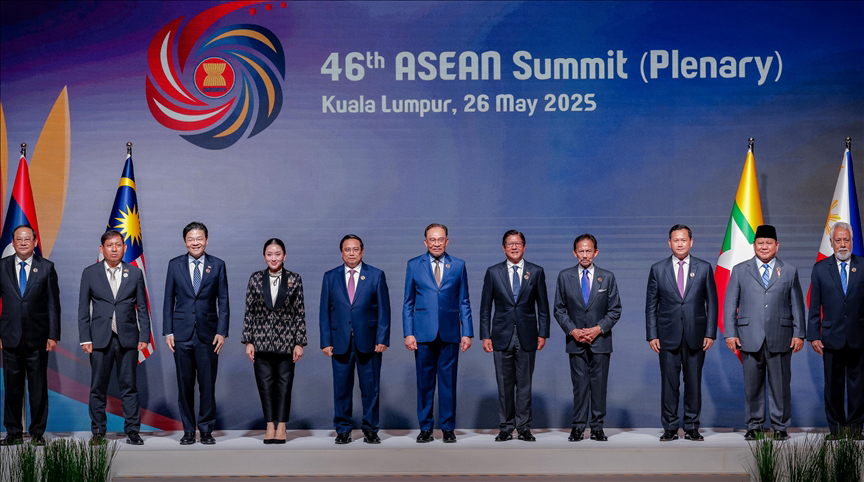
Malaysia plans to hold talks with U.S. Commerce Secretary Howard Lutnick next week on sectoral tariffs, including those on semiconductors, during the ASEAN Leaders Summit in Kuala Lumpur, state media reported on Wednesday.

The discussions come amid rising trade tensions after President Donald Trump’s administration imposed a 19% tariff on Malaysian exports to the U.S. in August. While semiconductors are currently exempt, they remain under review as part of a U.S. national security probe.

Malaysia is the world’s sixth-largest semiconductor exporter, and officials have warned that removing exemptions on chip exports could hurt competitiveness and disrupt global supply chains. Trade Minister Tengku Zafrul Aziz said he expects to finalize tariff negotiations with Washington during the summit, scheduled for October 26–28.

“I will hold discussions with Lutnick. He will also be attending the ASEAN Leaders Summit next week,” Tengku Zafrul told state news agency Bernama, adding that a final tariff agreement could be signed during the event.

The minister said Malaysia’s agriculture, industrial, and manufacturing sectors, as well as those engaged in U.S. trade and investment, are likely to benefit from the upcoming agreement. Several other ASEAN members are also expected to sign bilateral trade deals with Washington at the summit.

Under current U.S. policy, most Southeast Asian nations face tariffs between 19% and 20%, with Singapore receiving a 10% rate, while Laos and Myanmar have been hit with 40% tariffs.

Broadcom unveils Thor Ultra networking chip to challenge Nvidia in AI data centers

Broadcom has launched its new Thor Ultra networking chip, designed to help companies build massive artificial intelligence computing systems by linking together hundreds of thousands of processors — escalating its rivalry with Nvidia in the race to dominate AI infrastructure.

Unveiled on Tuesday, the Thor Ultra chip enables data center operators to connect far more AI processors than before, making it easier to train and deploy large models like OpenAI’s ChatGPT. The launch follows Broadcom’s announcement on Monday of a major deal to deliver 10 gigawatts of custom chips for OpenAI starting in 2026, further challenging Nvidia’s dominance in AI accelerators and networking technologies.

“The network plays an extremely important role in building these large clusters,” said Ram Velaga, Broadcom’s senior vice president. “So I’m not surprised that anybody in the GPU business wants to participate in networking.”

AI has become a $60 billion to $90 billion market opportunity for Broadcom by 2027, according to CEO Hock Tan, split between networking chips and custom data center processors built for companies such as Google and OpenAI. In 2024, Broadcom reported $12.2 billion in AI revenue, and in September it disclosed a $10 billion unnamed customer for its AI chips.

The Thor Ultra doubles the bandwidth of its predecessor and acts as a vital link between AI systems and the rest of the data center, improving data transfer speeds and scalability. Engineers developed it alongside Broadcom’s Tomahawk networking switches, refining every detail from power consumption to thermal management.

While Broadcom does not sell servers directly, it provides reference designs for partners to build upon. “For every dollar we invest in our silicon, our ecosystem partners invest six to ten times more,” Velaga said, emphasizing the company’s design-first strategy in the AI infrastructure market.

Intel unveils new AI data center chip “Crescent Island” to relaunch AI ambitions

Intel has announced plans to launch a new artificial intelligence chip for data centers next year, marking a renewed effort to reclaim ground in the booming AI hardware market dominated by Nvidia and AMD.

The new GPU, named Crescent Island, will prioritize energy efficiency and be optimized for AI inference workloads, Intel Chief Technology Officer Sachin Katti said at the Open Compute Summit on Tuesday. “It emphasizes our focus on inference, optimized for AI, and for delivering the best performance per dollar,” Katti said.

The announcement represents Intel’s latest bid to reenter the AI race after CEO Lip-Bu Tan pledged to restart the company’s stalled AI programs, including the Gaudi and Falcon Shores lines. Despite trailing competitors, Intel hopes to capture a meaningful share of the rapidly expanding data center market fueled by generative AI adoption since ChatGPT’s 2022 debut.

Crescent Island will feature 160 gigabytes of memory, though slower than the high-bandwidth memory (HBM) used in AMD and Nvidia’s top-tier AI chips. The chip will be based on Intel’s existing consumer GPU architecture, underscoring the company’s modular approach that allows customers to mix and match chips from multiple vendors.

Intel also committed to releasing new data center AI chips annually, matching the cadence of rivals AMD, Nvidia, and major cloud providers developing their own silicon.

The move follows Nvidia’s $5 billion investment in Intel, which gave it a 4% stake and launched a partnership to co-develop future AI and PC chips. Katti said the collaboration aims to ensure Intel CPUs remain integrated into AI systems worldwide as the company seeks to position itself as an indispensable player in next-generation computing.