NASA’s Hubble and Webb Telescopes Unveil Intense Star Formation in the Small Magellanic Cloud
NASA’s Hubble and Webb telescopes capture explosive star formation in the NGC 460 and NGC 456 clusters of the Small Magellanic Cloud.
NASA’s Hubble and Webb Reveal Explosive Star Formation in the Small Magellanic Cloud
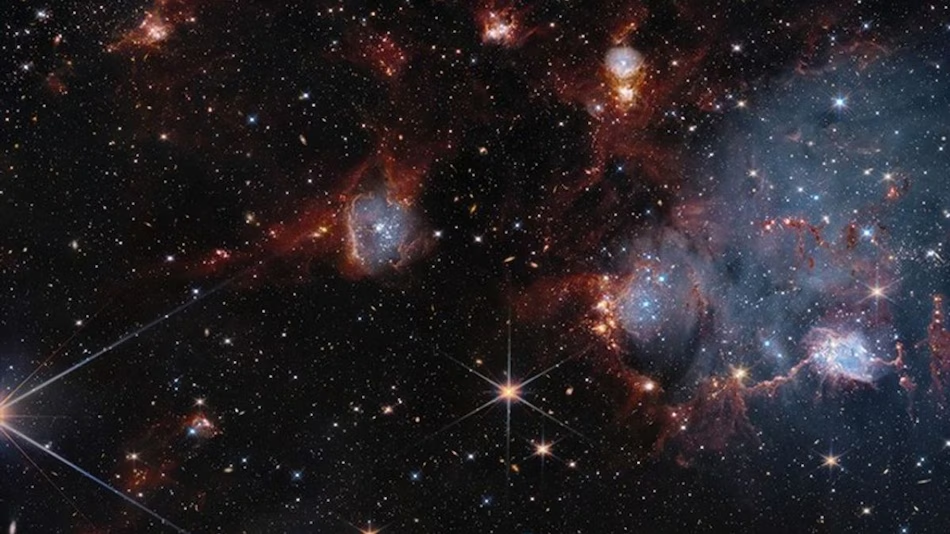
Scientists from NASA have observed a spectacular burst of gas, stars, and dust expanding from two dazzling star clusters—NGC 460 and NGC 456—using the Hubble and Webb space telescopes. These clusters reside within the Small Magellanic Cloud, a dwarf galaxy orbiting the Milky Way. Both are open clusters—loosely bound groups of stars ranging from a few dozen to many young stars—and are part of a larger complex of star clusters and nebulae likely linked by their shared origins. Stars form when clouds of gas and dust collapse under gravity.
According to NASA, Hubble’s images reveal glowing, ionized gas—illuminated by stellar radiation—that creates expanding bubbles of gas and dust appearing blue in color. In contrast, Webb’s infrared observations highlight red clumps and delicate filament-like structures of dust warmed by starlight.
NGC 460 and NGC 456: Windows into Early Universe Star Formation
While Hubble captures dust as dark silhouettes blocking light, Webb reveals the same dust glowing in infrared. The mixture of gas and dust between stars, known as the interstellar medium, fills the region containing these clusters. This area, called the N83-84-85 complex, hosts several rare O-type stars—extremely hot, massive stars that burn hydrogen similarly to the Sun.
This environment closely resembles conditions in the early universe, making the Small Magellanic Cloud a valuable nearby laboratory for studying star formation and the interstellar medium during cosmic infancy.
Through these observations, researchers aim to understand how gas flows from converging to diverging patterns, which helps differentiate the Small Magellanic Cloud from its larger neighbor, the Large Magellanic Cloud. Additionally, these studies shed light on the interstellar medium’s properties and the gravitational interactions shaping these galaxies.