
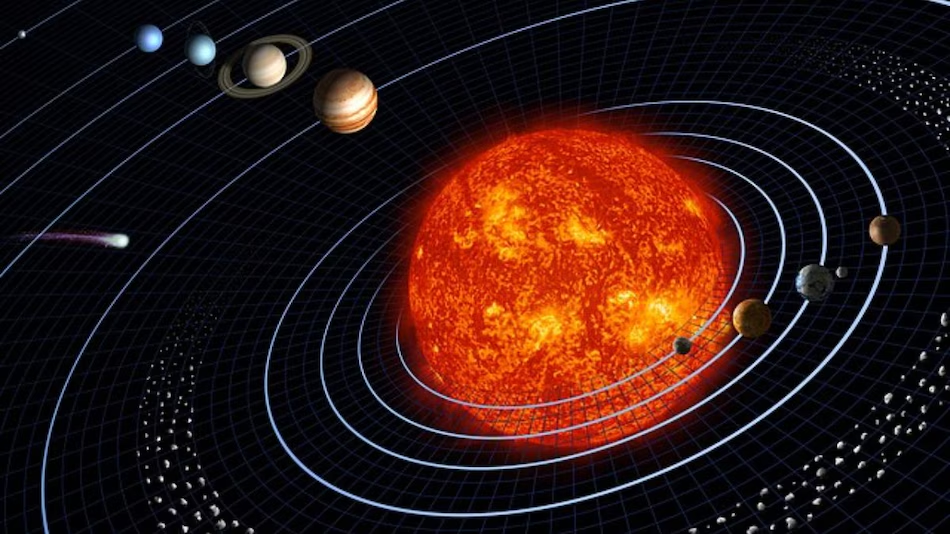
The age and composition of a meteorite indicate that rocky planets formed at the same time throughout the solar system.
A tiny meteorite is reshaping our understanding of the solar system’s early history. The 50-gram Northwest Africa 12264 meteorite is providing fresh insights into the timing and process of rocky planet formation. Previously, it was believed that inner planets like Earth and Mars formed earlier than those farther out, due to differences in temperature and composition. However, new research on this meteorite—which originated beyond the asteroid belt—suggests that planets across the solar system began forming tens of millions of years earlier than thought, significantly narrowing the time gap between the formation of inner and outer solar system bodies.
Outer Solar System Meteorite Indicates Rocky Planets Formed Simultaneously Across the Solar System
A study led by Dr. Ben Rider-Stokes from The Open University, published in Communications Earth & Environment, reveals the meteorite’s unique chemical fingerprint. Its chromium and oxygen isotope ratios trace its origin to the outer solar system, while lead isotope dating indicates an age of about 4.564 billion years. This closely matches the age of basalt samples from the inner solar system, which represent some of the earliest planetary crusts.
These findings challenge the long-held assumption that rocky planets beyond Jupiter formed two to three million years later because their icy, water-rich composition delayed internal differentiation—the layering process within planetary bodies. Instead, this meteorite’s origin and age suggest a much more synchronized formation of rocky planets throughout the solar system.