
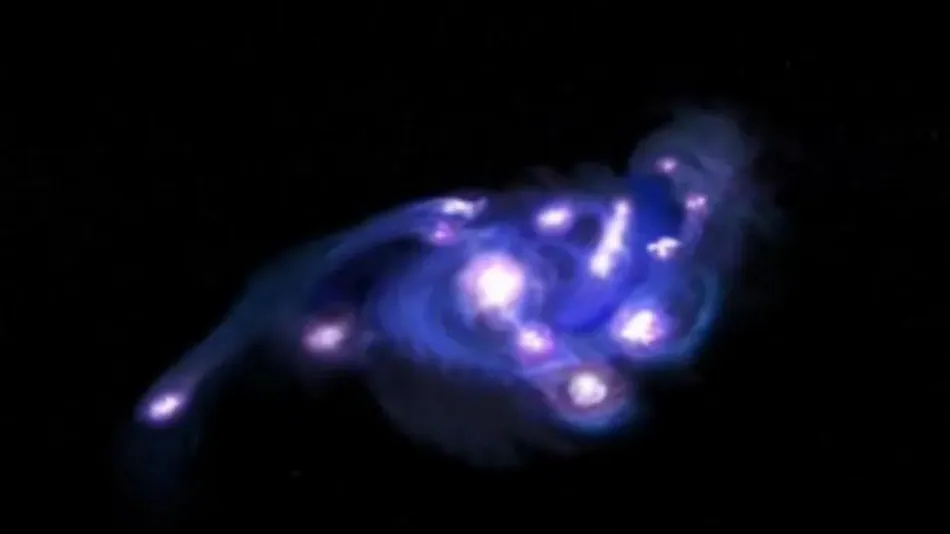
Astronomers have discovered a rare early-universe galaxy, dubbed the “Cosmic Grapes.”
Astronomers have identified a remarkable galaxy from the early universe, nicknamed “Cosmic Grapes,” notable for its more than a dozen compact star-forming clumps. Each clump measures roughly 15 light-years across, an unusually large number for a galaxy formed just 930 million years after the Big Bang. The galaxy’s structure resembles a rotating disk of bright purple grapes, giving it its unique moniker.
The discovery was made possible with the help of the James Webb Space Telescope (JWST), along with observations from the University of Texas at Austin’s McDonald Observatory and ALMA. Researchers employed gravitational lensing, where a foreground galaxy, RXCJ0600-2007, acts as a natural magnifying glass, amplifying the light from the distant Cosmic Grapes galaxy behind it.
“RXCJ0600-2007 is one of the strongest gravitational lenses for distant galaxies that has ever been found,” said study lead author Seiji Fujimoto. This natural amplification, combined with cutting-edge telescope technology, allowed astronomers to study the internal structure of the galaxy in unprecedented detail.
The discovery of Cosmic Grapes provides an extraordinary glimpse into star formation in the early universe, helping scientists understand how galaxies built up their stellar populations in the first billion years after the Big Bang.