Carnegie Mellon Develops AI-Powered Drones Capable of Constructing Mid-Air Structures With High Accuracy
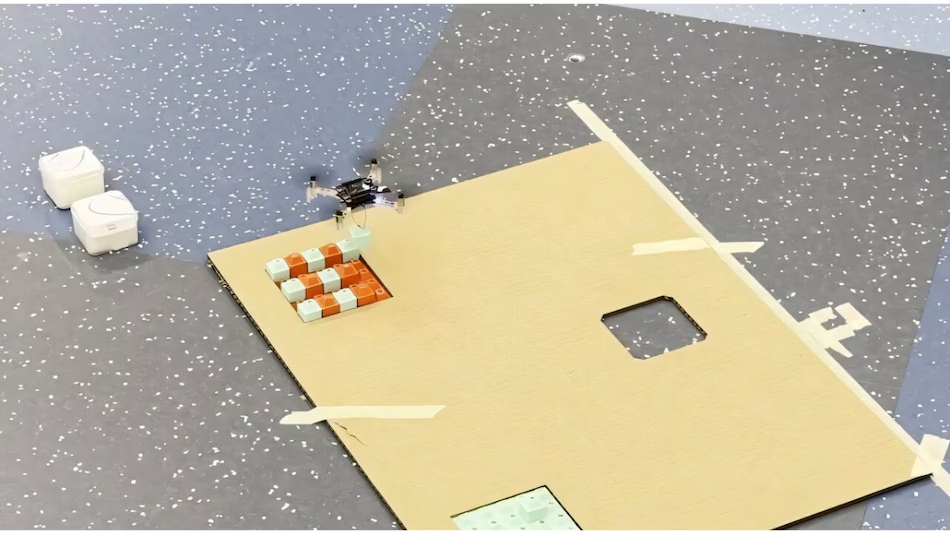
Engineers at Carnegie Mellon University have combined drones, artificial intelligence, and 3D printing to develop flying robots capable of constructing structures in mid-air. These AI-controlled drones use magnetized blocks instead of traditional extruded plastic, allowing them to assemble sturdy structures even while airborne. A large language model (LLM) translates simple instructions into construction plans and adjusts them in real time, achieving a 90 percent success rate in lab tests.
The system, described in a recent research paper, employs small quadcopter drones to carry and place magnetized blocks, forming complex structures without requiring the drones to maintain perfect stability. This “aerial additive manufacturing” approach mimics LEGO-style assembly, where blocks snap together automatically. The onboard AI interprets commands such as “build a bridge” into detailed, step-by-step instructions, while a camera monitors progress. If a block is misplaced, the AI recalculates the plan dynamically, avoiding the need to restart the construction process.
Researchers envision wide-ranging applications for the technology. In addition to laboratory tests, drones could someday repair spacecraft in orbit, construct pipelines in remote mountain regions, or even fill potholes autonomously. By combining AI planning with aerial assembly, the system could be deployed in areas inaccessible to conventional machinery, opening new possibilities for infrastructure development and maintenance.
Future work will focus on testing the system under real-world conditions, handling more complex 3D designs, and integrating new materials. The team hopes that swarms of intelligent drones could eventually build emergency shelters in disaster zones or perform critical repairs in hazardous environments, demonstrating the transformative potential of AI-driven aerial construction.