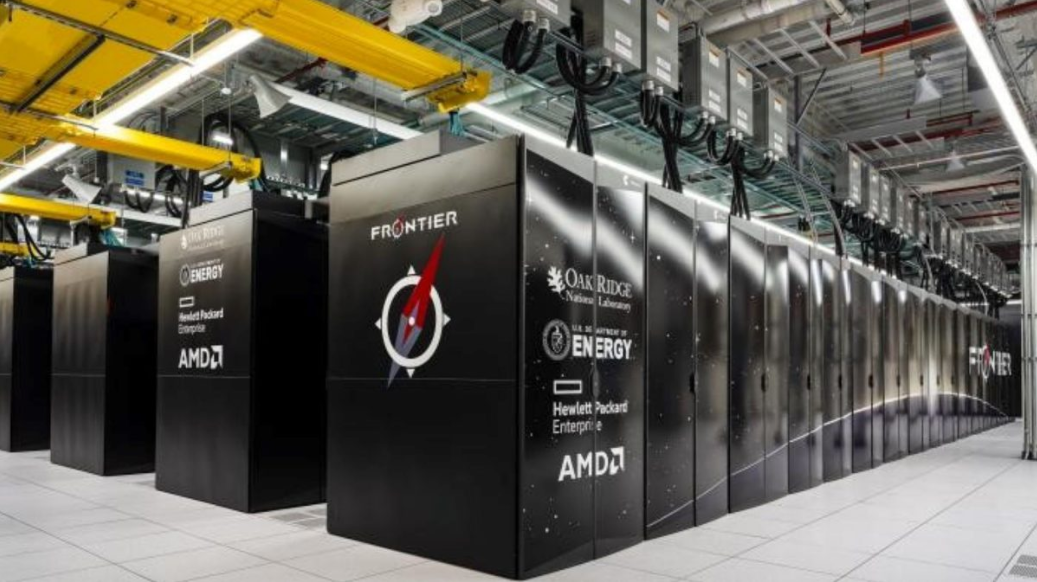
Supercomputer Frontier Models the Universe with Unprecedented Detail

A groundbreaking cosmic simulation has been achieved using the Frontier supercomputer, one of the most advanced computing systems in the world. This simulation offers an unprecedented level of detail in modeling the observable universe, incorporating not only gravitational forces but also complex interactions involving dark matter, gas, and plasma. The ability to simulate such intricate cosmic phenomena represents a major leap forward in our understanding of the universe’s large-scale structures and evolutionary processes.

The simulation was conducted as part of the U.S. Department of Energy’s Exascale Computing Project, which aims to push the boundaries of computational science. Using the Hardware/Hybrid Accelerated Cosmology Code (HACC), the research team at Oak Ridge National Laboratory (ORNL) leveraged Frontier’s immense processing power to run calculations at speeds nearly 300 times faster than previous cosmological models. This breakthrough showcases the potential of exascale computing in tackling some of the most complex problems in astrophysics.

A key component of this research was the application of hydrodynamic cosmology, which integrates dark matter and energy with traditional gravitational interactions. Previous simulations primarily focused on gravity’s role in shaping the cosmos, but the new model provides a more holistic view by incorporating additional physical factors. To achieve this, the researchers utilized 9,000 computing nodes, each equipped with AMD Instinct MI250X graphics processors, allowing for higher-resolution simulations than ever before.

The success of this simulation underscores the transformative impact of supercomputing on scientific discovery. By replicating the universe’s intricate processes with unparalleled accuracy, researchers can refine existing theories of cosmic evolution and gain deeper insights into fundamental astrophysical questions. As computational power continues to advance, future simulations may unlock even more mysteries about the formation and behavior of the universe on the grandest scales.
FAST Telescope Uncovers Emission Characteristics of Three Long-Period Pulsars in New Research

FAST Telescope Observes Emission Properties of Long-Period Pulsars in Groundbreaking Study

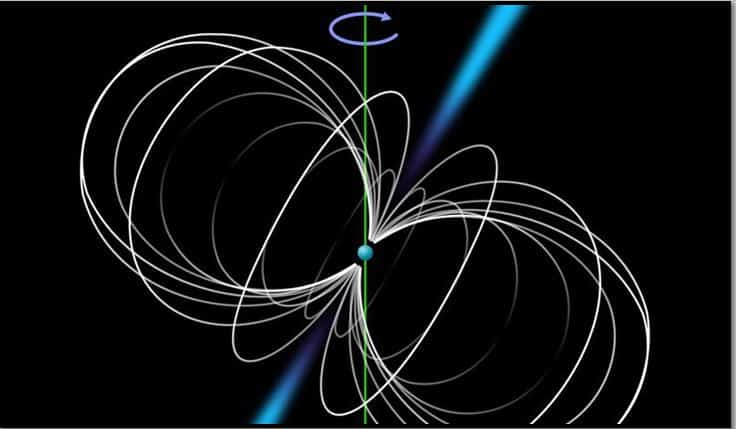
The Five-hundred-meter Aperture Spherical radio Telescope (FAST) has provided new insights into the emission properties of three long-period pulsars. The research, part of the Commensal Radio Astronomy FAST Survey (CRAFTS), focused on understanding the magnetospheric activity and emission mechanisms of these enigmatic celestial objects. Observations of PSR J1945+1211, PSR J2323+1214, and PSR J1900−0134 were conducted across a frequency range of 1.05 to 1.45 GHz, utilizing FAST’s advanced 19-beam receiver. The study highlighted key emission behaviors, including null phases, asymmetric emissions, and microstructure pulses, shedding light on the intricate nature of pulsar radio emissions and their periodicity.

Null Phases and Their Role in Pulsar Emissions

A fascinating aspect of the study was the detection of quasi-periodic nulling phenomena in all three pulsars, with null durations varying between 57 and 71.44 seconds. Nulling refers to temporary reductions or complete cessations of emission, which is a well-known yet poorly understood characteristic of pulsars. The null fractions were calculated to be 52.46% for PSR J1945+1211, 48.48% for PSR J2323+1214, and 27.51% for PSR J1900−0134. These findings are crucial for developing a deeper understanding of pulsar emission dynamics and the physical processes driving such irregularities in their behavior.

Microstructure and Pulse Asymmetry Observed in Pulsars

In addition to nulling, the study also uncovered complex emission structures in PSR J1900−0134, particularly microstructure pulses as short as 2.05 milliseconds. These rapid variations within the pulse signal add another layer of complexity to pulsar emission, which is not always uniform. Asymmetry in pulse emissions was noted in PSR J1945+1211 and PSR J2323+1214, with brighter pulses predominantly appearing in the leading component of their pulse profiles. This suggests that intrinsic factors within the pulsar’s magnetosphere may influence the shape and intensity of the emitted signals, providing further insight into the magnetospheric processes at play.

Expanding Knowledge on Pulsar Emission Variability

The study’s findings offer critical insights into the variations of pulsar emission, including changes in intensity, pulse width, and frequency. Researchers observed that the brightness of pulses could vary dramatically across different frequency bands and during burst states, where peak intensities and pulse widths expanded. These variations highlight the complex nature of pulsar emission and suggest that multiple factors contribute to the observed behaviors. With FAST’s high sensitivity and resolution, the study marks a significant step forward in pulsar research, helping to refine our understanding of these fascinating astrophysical phenomena. The ongoing exploration of pulsar behavior using FAST continues to be essential for advancing knowledge of neutron stars and their radio emissions, revealing the complexities of the universe’s most intriguing objects.

Artemis IV Powered by NASA’s SLS Block 1B: Greater Payload, Greater Potential

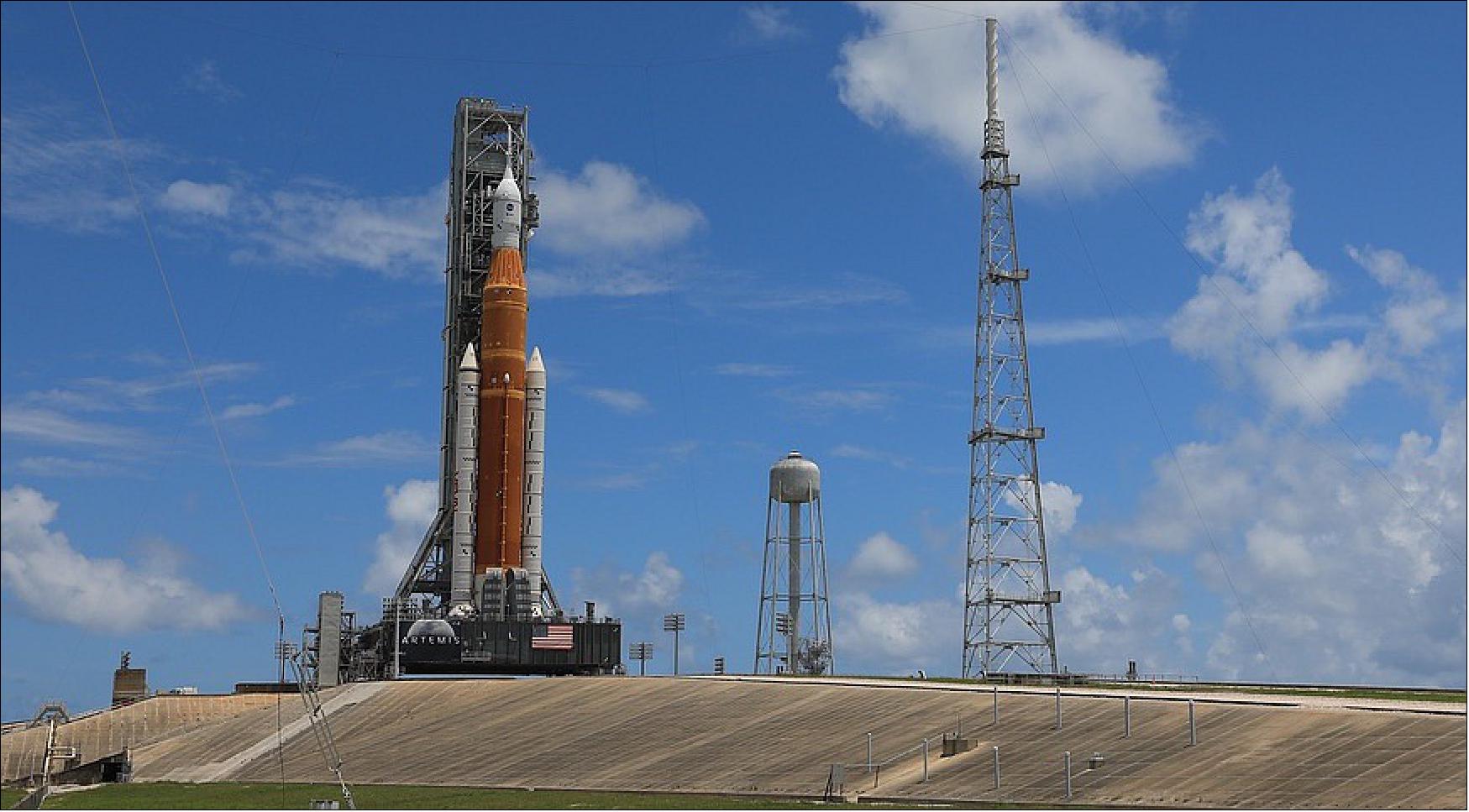
NASA’s Artemis program continues to push the boundaries of deep space exploration, with the upcoming Artemis IV mission set to introduce a significant upgrade to the Space Launch System (SLS). This mission will mark the debut of the SLS Block 1B variant, featuring the powerful Exploration Upper Stage (EUS). The enhanced design significantly increases payload capacity, making it possible to transport heavier and more complex components, such as the Orion spacecraft and the European Space Agency’s Lunar I-Hab module. These advancements are crucial for the Gateway lunar space station, a key element in sustaining long-term human presence on the Moon and beyond.

Advanced Structural Design for Payload Integration

A critical component of the SLS Block 1B is the payload adapter, an essential structure developed at NASA’s Marshall Space Flight Center in Huntsville, Alabama. This adapter facilitates the secure attachment of diverse payloads to the rocket and has undergone extensive innovation to optimize efficiency. Constructed from eight composite panels reinforced with an aluminum honeycomb core and supported by aluminum rings, the adapter is both lightweight and strong. To ensure precise assembly, engineers have employed structured light scanning technology, which eliminates the need for traditional, expensive tooling methods.

Cost-Effective and Adaptive Engineering

NASA has highlighted the advantages of the structured light scanning technique, which significantly reduces manufacturing costs while improving flexibility. This method allows for quick adjustments to the adapter’s dimensions based on mission requirements. According to Brent Gaddes, Lead for the Orion Stage Adapter and Payload Adapter at NASA Marshall, the technology enables rapid design modifications without the need for extensive retooling. This adaptability ensures that the SLS Block 1B can accommodate a wide range of payload sizes, making it a versatile launch system for future deep space missions.

A Step Forward for Lunar Exploration

With its increased payload capacity and adaptable engineering, the SLS Block 1B is set to play a crucial role in the Artemis IV mission and beyond. The successful deployment of this upgraded rocket variant will lay the foundation for more ambitious lunar and deep space missions, bringing NASA closer to its long-term goal of sustained human presence on the Moon and eventual crewed missions to Mars. As Artemis IV takes shape, it represents a major milestone in space exploration, demonstrating the power of innovation and international collaboration in pushing the boundaries of human spaceflight.