
Ancient 69-Million-Year-Old Bird Fossil in Antarctica Offers New Insights into Waterfowl Evolution

A recently discovered fossilized bird skull in Antarctica is offering new insights into the evolutionary history of waterfowl. Estimated to be around 69 million years old, the skull belonged to Vegavis iaai, a prehistoric bird closely related to modern ducks and geese. Scientists believe this nearly complete specimen provides the most definitive evidence of the bird’s classification within the waterfowl family. Previous studies had already suggested that Vegavis iaai displayed traits seen in modern birds, including the presence of a syrinx—an anatomical structure responsible for vocalization.

In a study published in Nature, a research team led by Christopher Torres from the University of the Pacific analyzed the skull’s features in detail. They found key similarities between Vegavis iaai and present-day waterfowl, including a toothless beak and a compact upper jaw. The structure of the braincase, particularly the position of the optic lobes, indicates that the bird likely had advanced vision and motor coordination. These adaptations suggest that Vegavis iaai may have been a capable diver, potentially hunting for fish in the coastal waters surrounding prehistoric Antarctica.

The discovery of this skull supports the hypothesis that Antarctica played a crucial role in the survival and evolution of early birds. Some scientists propose that during the mass extinction event 66 million years ago, caused by the Chicxulub asteroid impact, certain avian species may have found refuge in the Southern Hemisphere. The skull’s well-preserved features suggest that waterfowl ancestors were already highly adapted before the extinction event, reinforcing the idea that modern birds evolved from lineages that survived this global catastrophe.

This finding adds to a growing body of evidence that birds were not only present in Antarctica during the late Cretaceous period but were thriving in a diverse and complex ecosystem. As researchers continue to analyze fossils from the region, they hope to uncover more clues about how these early birds lived, evolved, and ultimately gave rise to the waterfowl species that exist today.
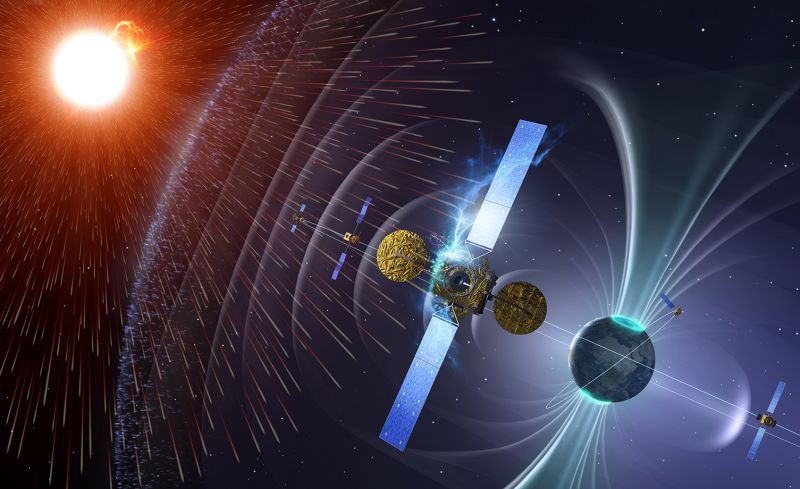
AMS Data Sheds Light on Charged Particle Fluctuations in the Heliosphere Throughout the Solar Cycle

Analysis of Charged Particle Movement in the Heliosphere Over the Solar Cycle

Researchers have uncovered significant variations in the movement of charged particles across the heliosphere, focusing on an 11-year period marked by the solar cycle. By studying data collected from the Alpha Magnetic Spectrometer (AMS) aboard the International Space Station, they have tracked how fluctuations in the heliospheric magnetic field influence the behavior of these particles. The data reveals key insights into the effects of solar modulation on cosmic rays, highlighting how shifts in the solar environment affect particle interactions and movement throughout the solar system.

Heliospheric Magnetic Field and Its Effect on Charged Particles

Two groundbreaking studies, published in Physical Review Letters, detail how changes in the heliospheric magnetic field shape the trajectory and energy of charged particles. These particles, which include both solar wind particles and galactic cosmic rays (GCRs), originate from different sources but are affected similarly by the magnetic field. The AMS’s long-term measurements have enabled scientists to track shifts in the mass and energy of these particles, shedding light on their response to the varying levels of solar activity during the solar cycle.

Antiproton and Cosmic Nuclei Flux Variations

The research highlights the observed fluctuations in the flux of antiprotons and cosmic nuclei within the heliosphere. Specifically, the study found that antiproton fluxes experience temporal variations, which change in response to different heliospheric conditions. These fluctuations are particularly noticeable in particles with rigidities up to around 10 GV, where they show substantial shifts. At higher rigidity levels, however, these fluctuations tend to decrease. In addition to antiprotons, cosmic nuclei such as helium, lithium, beryllium, boron, and heavier elements were also studied, showing similar trends in flux variations, providing a more comprehensive understanding of cosmic ray modulation.

Solar Modulation and Its Role in Cosmic Ray Variability

The data further establishes a clear connection between solar modulation and the variability of cosmic ray fluxes. As the solar cycle progresses, the intensity of solar wind and its magnetic field fluctuations influence the cosmic rays traveling through the heliosphere. The AMS’s ability to monitor these changes over an extended period has provided new insights into the way solar activity impacts both the local and galactic environment, offering a unique perspective on how the solar cycle shapes the behavior of particles within our solar system.

Roman Artifacts Discovered in Cova De Les Dones Cave in Spain

Archaeologists have uncovered significant Roman-era artifacts in the Cova de les Dones cave, located in eastern Spain. Among the discoveries are a corroded coin and 15 inscriptions, which date back nearly 1,900 years. These findings suggest the cave was used as a site for rituals during the Roman occupation of the Iberian Peninsula. The coin, which dates to the reign of Emperor Claudius (A.D. 41-54), was found embedded in a fissure between a stalactite and the ceiling, possibly placed there as an offering. The inscriptions carved into the rock further support the theory that the cave was seen as a sacred or ceremonial space.

The discovery of these Roman artifacts is significant, as it offers new insights into the use of natural caves in the Roman world. The location of the coin and the intricate rock carvings suggest that Cova de les Dones may have served as a sanctuary or a place of worship. While the exact meaning of the inscriptions remains unclear, experts believe they may hold clues to the spiritual and cultural practices of the time. The coin itself, a rare find in such a context, further reinforces the idea of the cave’s ritualistic significance.

Cova de les Dones is no stranger to archaeological discoveries. Previous excavations have revealed evidence of human activity stretching back to prehistoric times. The cave has yielded Iron Age ceramics and an array of prehistoric rock art, including depictions of animals like aurochs and stags. One study in 2023 documented over 110 cave paintings, with some believed to be over 24,000 years old, providing a rare glimpse into early human life. These ancient artworks, combined with the more recent Roman-era finds, highlight the cave’s long history as a place of both daily life and spiritual significance.

This latest discovery underscores the ongoing importance of Cova de les Dones in understanding the cultural evolution of the Iberian Peninsula. The cave’s role as a site of worship and its connection to both prehistoric and Roman periods make it a crucial piece in the puzzle of Spain’s ancient past. Archaeologists are continuing to study the inscriptions and other findings, which may yet reveal more about the rituals and practices that took place in this unique location.