What Became of the Apollo Mission Flags Left on the Moon?

The fate of the American flags planted on the Moon during the Apollo missions has captured the imagination of both space enthusiasts and scientists alike. These flags, planted as symbols of the United States’ triumph in space exploration, were part of the historic Apollo landings from 1969 to 1972. Each flag was placed by astronauts on the lunar surface to commemorate the success of these groundbreaking missions. Over the years, questions have emerged regarding the current condition of these flags, particularly considering the harsh and unforgiving lunar environment, which is marked by extreme temperature fluctuations, a lack of atmosphere, and intense, unfiltered sunlight. As such, the long-term durability of the flags has become a subject of scientific inquiry and curiosity.

Reports suggest that these flags were designed with the moon’s unique conditions in mind. Anne Platoff, a historian and NASA contractor, was involved in detailing the flags’ construction in a report titled Where No Flag Has Gone Before. The Apollo flags were crafted from nylon, chosen for its ability to withstand the lunar conditions. To ensure the flags would remain visible without wind to hold them aloft, a horizontal bar was added to keep them extended. The design also considered astronaut mobility and the need for a lightweight material, though the flags were still inserted into the lunar soil only a few inches deep due to the density of the surface, as noted by astronaut Buzz Aldrin.

As time has passed, the effects of the lunar environment on these flags have become a point of interest. One of the major concerns is the degradation of the nylon material due to prolonged exposure to the sun’s harsh ultraviolet radiation. This degradation, often referred to as “sun rot,” likely caused the flags to become brittle and weakened. The lack of atmosphere on the Moon means there is no protective ozone layer to block out harmful UV rays, making the nylon material highly susceptible to damage over time. Furthermore, the Moon’s surface is constantly bombarded by micrometeoroids, which may have also contributed to the breakdown of the fabric.

Some theories suggest that the flags may have lost their vibrant colors and could now appear white due to the intense sunlight and exposure to lunar elements. However, there is no definitive proof of this outcome, as scientists remain uncertain about the precise chemical processes occurring in the Moon’s extreme conditions. While the physical state of the flags may be degraded, they continue to serve as enduring symbols of human achievement and the pioneering spirit of space exploration.

Breaking the Rules: Scientists Predict Exotic Paraparticles Outside Known Classifications

Physicists have introduced a groundbreaking concept in particle physics: a new category of particles known as “paraparticles.” These theoretical entities defy the conventional classifications of matter into fermions and bosons, offering an entirely fresh perspective on the fundamental building blocks of the universe. Unlike fermions, which obey the Pauli exclusion principle, and bosons, which tend to exist in shared states, paraparticles follow unique exclusion rules. Their predicted behaviors could lead to revolutionary advancements in quantum mechanics and open up new avenues in quantum computing.

The mathematical framework for paraparticles, as described in a study published in Nature, was developed by Zhiyuan Wang of the Max Planck Institute for Quantum Optics and Kaden Hazzard of Rice University. Their research demonstrates that paraparticles can theoretically exist in any number of dimensions, significantly expanding the potential scope for their application. This innovative framework paves the way for the possibility of experimental realization, with researchers emphasizing the importance of advanced quantum computing technologies in recreating such particles.

Wang revealed that the concept of paraparticles emerged unexpectedly during his Ph.D. research in 2021. Despite the theoretical foundation being well-established, reproducing these particles in a controlled environment remains a significant challenge. Experts in the field are optimistic that the rapid advancements in quantum computing technology will soon provide the tools necessary to test these predictions. If realized, paraparticles could have profound implications, including reducing error rates in quantum computational systems and enhancing their overall efficiency.

The discovery also raises intriguing possibilities about the natural world. Paraparticles may exist in forms that have yet to be observed, potentially hinting at hidden layers of the universe’s structure. This work serves as a reminder of how theoretical physics can push the boundaries of what we understand about reality, challenging established paradigms and sparking innovation across multiple disciplines.

Authenticity of Mosasaur Fossil Discovered in Moroccan Mine Under Scrutiny

Authenticity of Mosasaur Fossil Sparks Debate

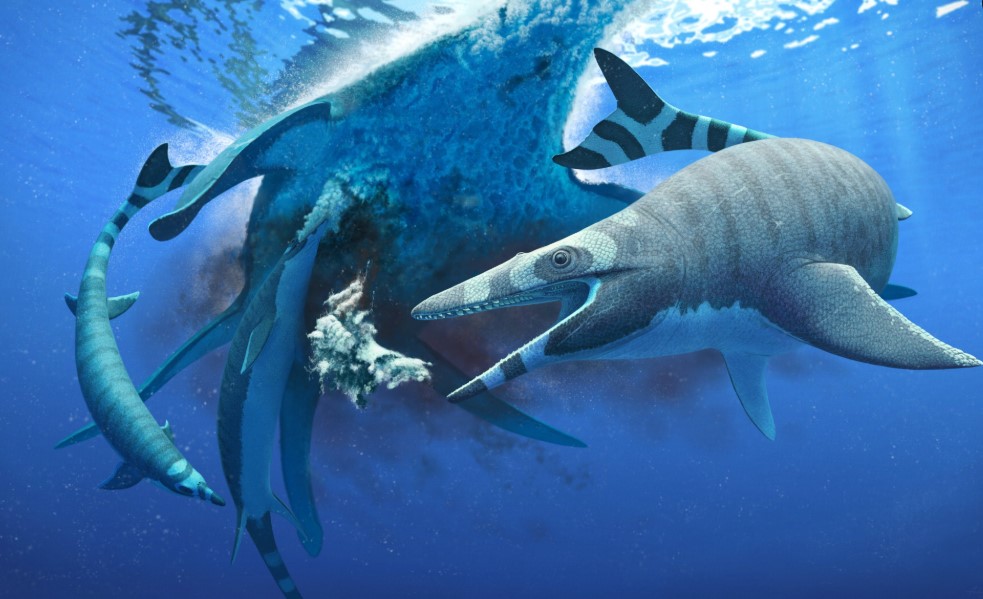
Questions have emerged regarding the authenticity of a fossil used to describe Xenodens calminechari, a mosasaur species believed to have existed between 72 and 66 million years ago. Discovered in a phosphate mine in Morocco, the fossil formed the basis for identifying the unique marine predator, notable for its saw-like teeth. However, researchers have pointed out structural inconsistencies in the fossil that undermine its credibility. Published in The Anatomical Record, a recent study highlights anomalies in the jawbone and teeth, raising suspicions about the specimen’s integrity. Notably, two teeth were found sharing a single socket—a feature at odds with typical mosasaur anatomy. Dr. Michael Caldwell from the University of Alberta explained that mosasaurs replace their teeth continuously, with individual sockets formed by surrounding bone, making this anomaly particularly concerning.

Evidence Suggesting Possible Tampering

Further scrutiny has revealed additional irregularities in the fossil’s structure. Overlapping material around the teeth suggests that the specimen may have been altered or tampered with. This revelation casts doubt on the conclusions drawn in the 2021 study that introduced Xenodens calminechari to the scientific community. Given Morocco’s reputation as a hotspot for fossils with fabricated elements, researchers argue that rigorous verification methods, such as computed tomography (CT) scans, are essential to confirm the fossil’s authenticity.

Access Issues and Ethical Concerns

The fossil’s current inaccessibility has compounded the controversy. Held by Nick Longrich, a paleontologist at the University of Bath and the lead author of the 2021 study, the specimen has not been made available for independent verification. Henry Sharpe, the lead author of the recent paper questioning the fossil, criticized this lack of access as unethical. Sharpe emphasized that holotype specimens, which serve as the definitive reference for species classification, must be open to scientific examination to ensure transparency and accuracy in research.

Implications for Paleontology

The debate surrounding Xenodens calminechari highlights broader challenges in paleontology, particularly the need for stringent verification of fossil specimens from regions prone to forgeries. Without access to key specimens or advanced imaging methods like CT scans, the scientific community risks drawing conclusions based on compromised data. The controversy underscores the importance of collaboration and transparency in ensuring the integrity of paleontological discoveries, especially when new species are introduced.