Chinese Astronomers Decode X-ray Outburst of Binary Star System Using Insight-HXMT
Wuhan University Scientists Analyze 2022–23 X-ray Outburst of RX J0440.9+4431 via Insight-HXMT
Wuhan University Astronomers Decode X-Ray Outburst in RX J0440.9+4431
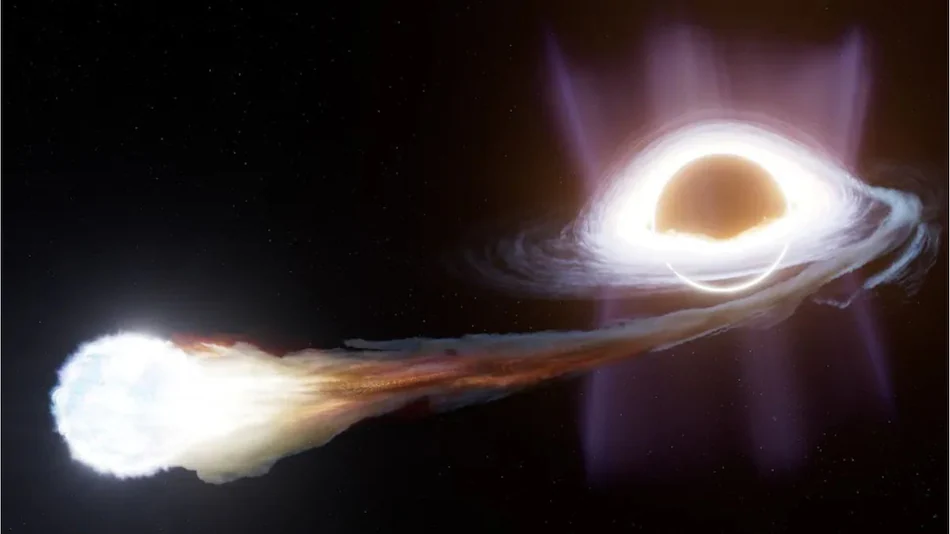
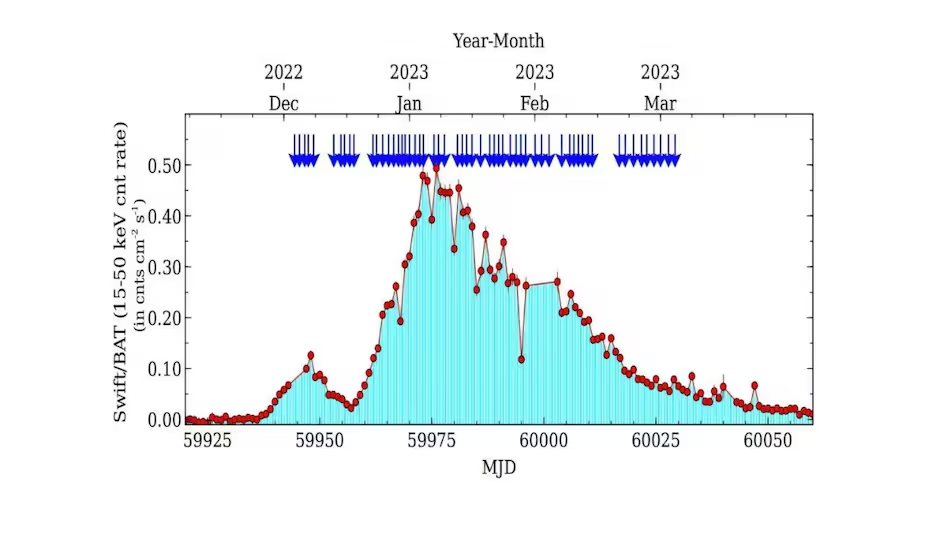
Astronomers at Wuhan University utilized the Insight-HXMT satellite to study a significant X-ray outburst that occurred in 2022–23 from the binary system RX J0440.9+4431. Their findings, published on arXiv on July 24, 2025, provide a comprehensive analysis of the system’s behavior during the event. X-ray binaries (XRBs) are systems where one star, often a white dwarf or a normal star, transfers mass to a compact object such as a neutron star or black hole, producing intense X-ray emissions. These binaries are classified into low-mass and high-mass X-ray binaries based on the mass of the donor star.
X-ray Outburst in Be/X-ray Binary System
The RX J0440.9+4431 system belongs to a subtype called Be/X-ray binaries (BeXRBs), where the optical companion is a Be star, which can be a dwarf, giant, or subgiant. Observing and analyzing X-ray outbursts in such systems is crucial to understanding the evolution and dynamics of high-mass X-ray binaries. These studies provide insights into how mass transfer, magnetic fields, and pulsar rotation influence the X-ray emissions over time.
Luminosity-Driven Pulse Profile Changes in RX J0440.9+4431
RX J0440.9+4431, first identified in 1997 through the ROSAT Galactic Plane Survey, is located roughly 8,000 light-years away. The system contains a neutron star pulsar that emits X-rays with a stable period of 202.5 seconds. During the 2022–23 outburst, astronomers observed luminosity-dependent changes in the pulse profile, which offer clues about the interaction between the pulsar’s magnetic field and the accreted matter from the Be star companion.
Significance of the Study
The study of RX J0440.9+4431’s outburst sheds light on the complex behavior of high-mass X-ray binaries. It allows scientists to better model the accretion processes, understand the magnetic field configurations of neutron stars, and predict future X-ray outbursts. As more XRBs are studied with satellites like Insight-HXMT, researchers can refine the theoretical frameworks that describe stellar evolution and the physics of extreme environments.