NASA Considers Industry Partnerships to Enhance Swift Observatory’s Orbit and Prolong Mission
NASA partners with U.S. companies to explore orbit-boost options for Swift, seeking to extend the observatory’s operational lifespan.
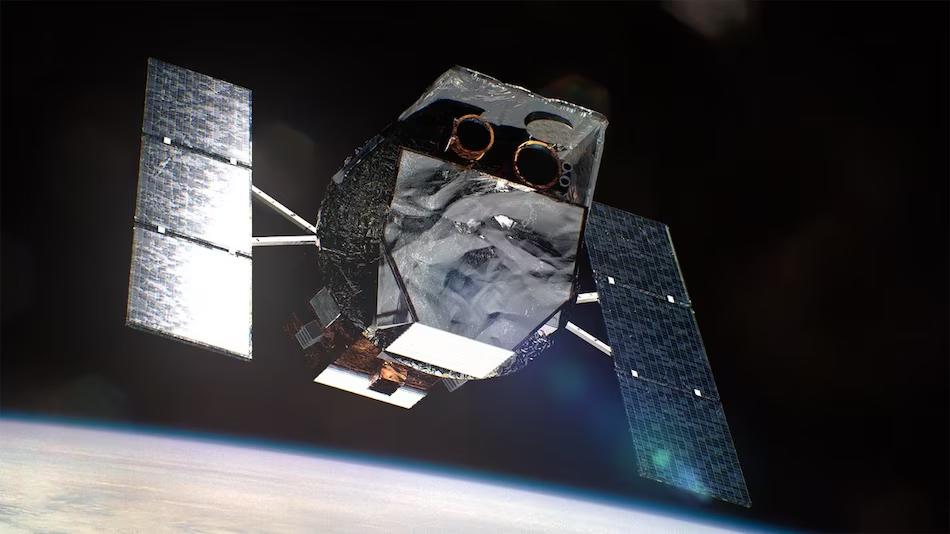
NASA is partnering with U.S. companies to explore raising the orbit of the Neil Gehrels Swift Observatory, a space telescope that has been studying the high-energy universe since 2004. The initiative aims to demonstrate orbital boost technology, extend Swift’s operational life, and advance U.S. capabilities in space servicing. Two companies—Cambrian Works of Virginia and Katalyst Space Technologies of Arizona—have been selected under NASA’s Small Business Innovation Research (SBIR) Program to develop concept designs for the mission. Accelerated orbital decay, driven by increased solar activity, has created both urgency and opportunity for this effort.
The studies will evaluate whether boosting Swift’s orbit is more cost-effective than replacing the observatory with a new spacecraft. The telescope’s low-Earth orbit is experiencing faster decay due to heightened atmospheric drag, presenting a challenge to its continued operation. By engaging industry partners, NASA hopes to explore solutions more rapidly, with each company receiving $150,000 in Phase III SBIR funding for their concept designs.
Nicky Fox, director of NASA’s Science Mission Directorate, emphasized the significance of leveraging commercial technology for space science missions. She highlighted that in-space servicing could become a cornerstone of American leadership in spacecraft servicing, demonstrating the potential of public-private collaboration to extend mission lifespans and innovate within space operations.
This collaboration marks a strategic step toward keeping Swift operational for additional years while simultaneously advancing U.S. expertise in orbital servicing and commercial space technologies. It underscores NASA’s commitment to extending the scientific return of its missions while exploring innovative approaches to spacecraft maintenance in orbit.