NASA’s James Webb Space Telescope Uncovers Detailed Structure of a Planetary Nebula
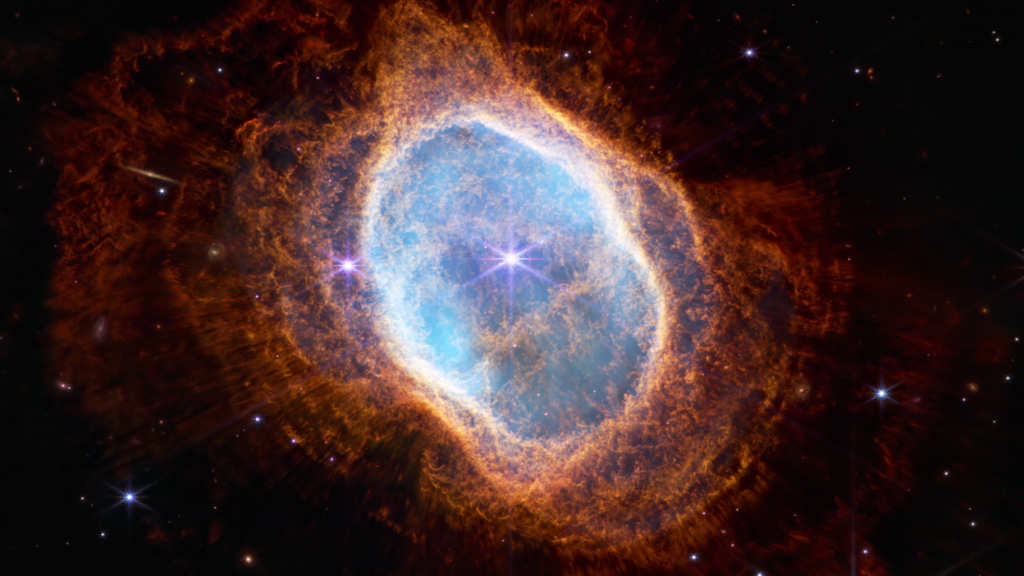
NASA’s James Webb Space Telescope (JWST) has uncovered the intricate details of NGC 1514, a planetary nebula that has been evolving over a span of at least 4,000 years. The nebula, which can only be seen in infrared light, exhibits a series of “fuzzy” clusters arranged in twisted patterns. These patterns highlight the complex structure of the nebula, revealing the presence of sharper holes near the center. These holes indicate areas where faster-moving materials have pierced through, providing insight into the dynamics of the nebula’s formation. An orange arc of dust surrounds the stars at the center of the nebula, which are in a close, elongated orbit that lasts about nine years. One of these stars, which was once several times more massive than the Sun, played a critical role in shaping the nebula’s structure.
The JWST has allowed astronomers to observe the dual gas rings that surround the dying star at the core of the nebula. The star’s interaction with its companion, as well as its evolution, is thought to have influenced the nebula’s distinctive hourglass shape. The rings of gas are unevenly illuminated, with the mid-infrared light casting a textured appearance. In particular, the clumped pink center of the nebula contains high concentrations of oxygen, particularly around the boundaries of the bubble-like holes. The nebula’s structure is of particular interest because of what it lacks: the absence of certain complex molecules. This absence may be due to the merging orbits of the two central stars, which have hindered the formation of these molecules.
NGC 1514, located in the Taurus constellation and situated 1,500 light-years from Earth, offers astronomers a valuable opportunity to study the final stages of a star’s life. The nebula’s dual rings of expelled material, traced back to the interaction of the two central stars, are particularly fascinating. The study of these rings offers a unique glimpse into the ongoing processes that shape star systems over long periods. These insights could help astronomers better understand the role of gravitational pull in shaping the dynamics of star outflows, providing key data on how stars evolve and interact over time.
The stars at the center of NGC 1514 are part of a binary system with one of the longest known orbits—about nine years. Astronomers believe that the creation of the nebula is largely attributed to the more massive of the two stars. As this star aged, it shed layers of gas and dust, producing a hot, compact core known as a white dwarf. The winds from this white dwarf likely carried away the earlier, slower-moving material, forming faint, clumped rings that are visible only in infrared light. Despite the lack of complex carbon-based molecules, JWST’s observations have revealed significant oxygen concentrations in the nebula, furthering the understanding of stellar processes. These findings underscore the importance of the JWST in advancing our knowledge of stellar evolution and the life cycles of stars.