
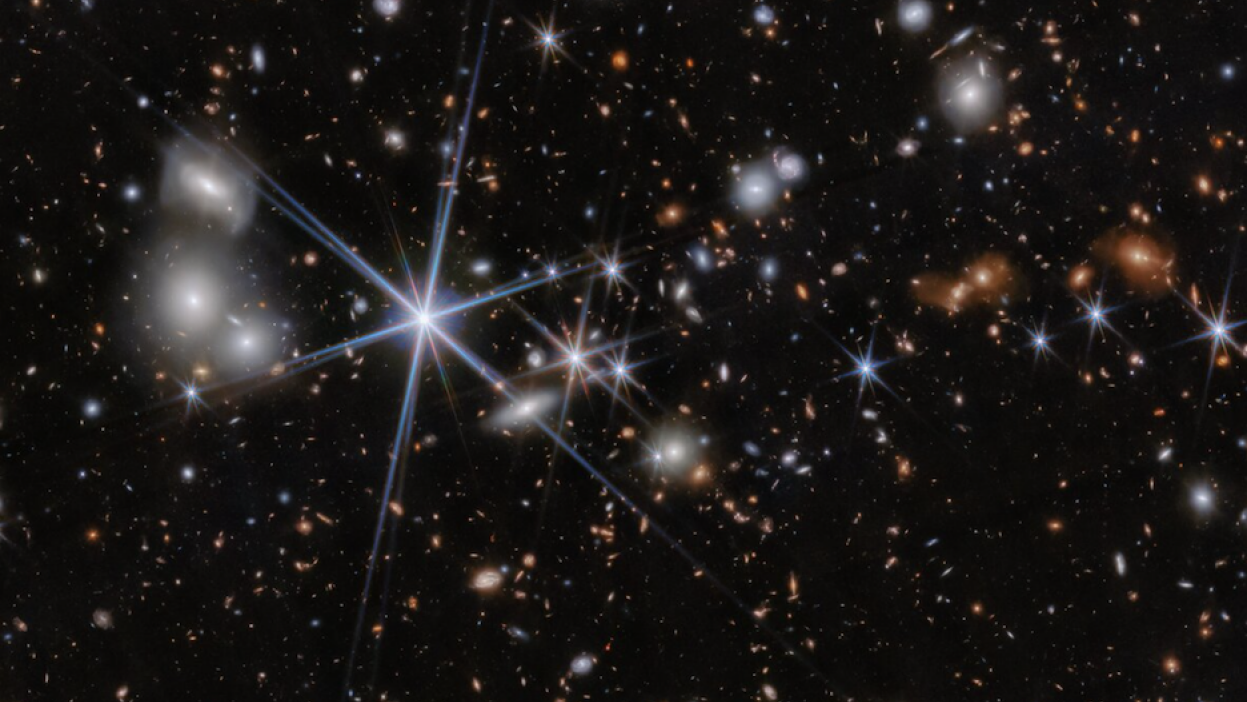
In a groundbreaking discovery, NASA’s James Webb Space Telescope (JWST) has revealed a galaxy that closely mirrors our own Milky Way—yet it formed much earlier in the universe’s history. This newly identified galaxy, named Zhúlóng, features hallmark traits of a mature spiral galaxy: a dense central bulge of ancient stars, a bright disk of ongoing star formation, and two clearly defined spiral arms. Its remarkable resemblance to the Milky Way—despite existing in the early universe—challenges long-standing cosmological models that suggest such massive galaxies evolve through a gradual process of smaller galaxy mergers over billions of years.
Zhúlóng’s impressive scale further intensifies the mystery. Estimated to contain about 100 billion solar masses—making it slightly more massive than the Milky Way—the galaxy’s star-forming disk spans roughly 60,000 light-years. What sets this discovery apart is not just its size, but its timing: Zhúlóng existed more than a billion years earlier than Ceers-2112, another early spiral galaxy, and at a time when the universe was only a quarter of its current age. This raises crucial questions about how such complex structures could have emerged so soon after the Big Bang.
The findings, published in Astronomy & Astrophysics, underscore the transformative power of JWST in exploring the deep past of our cosmos. The telescope’s sensitive instruments have captured the swirling spiral arms of Zhúlóng with astonishing clarity, allowing researchers to trace its structure and composition across billions of light-years. These observations contradict the prevailing belief that well-ordered, Milky Way-like galaxies are the end products of chaotic evolutionary histories stretching over eons. Instead, Zhúlóng appears as a fully formed spiral galaxy just a billion years after the universe’s birth.
This discovery not only shakes the foundation of current galaxy formation theories but also reinforces the notion that our understanding of cosmic history is still evolving. Scientists are now calling for follow-up observations using both JWST and the Atacama Large Millimetre/submillimetre Array (ALMA) in Chile. By examining galaxies like Zhúlóng more closely, astronomers hope to uncover how such early, massive spirals came to exist—and in doing so, may rewrite key chapters of how the universe, and ultimately galaxies like our own, came to be.