

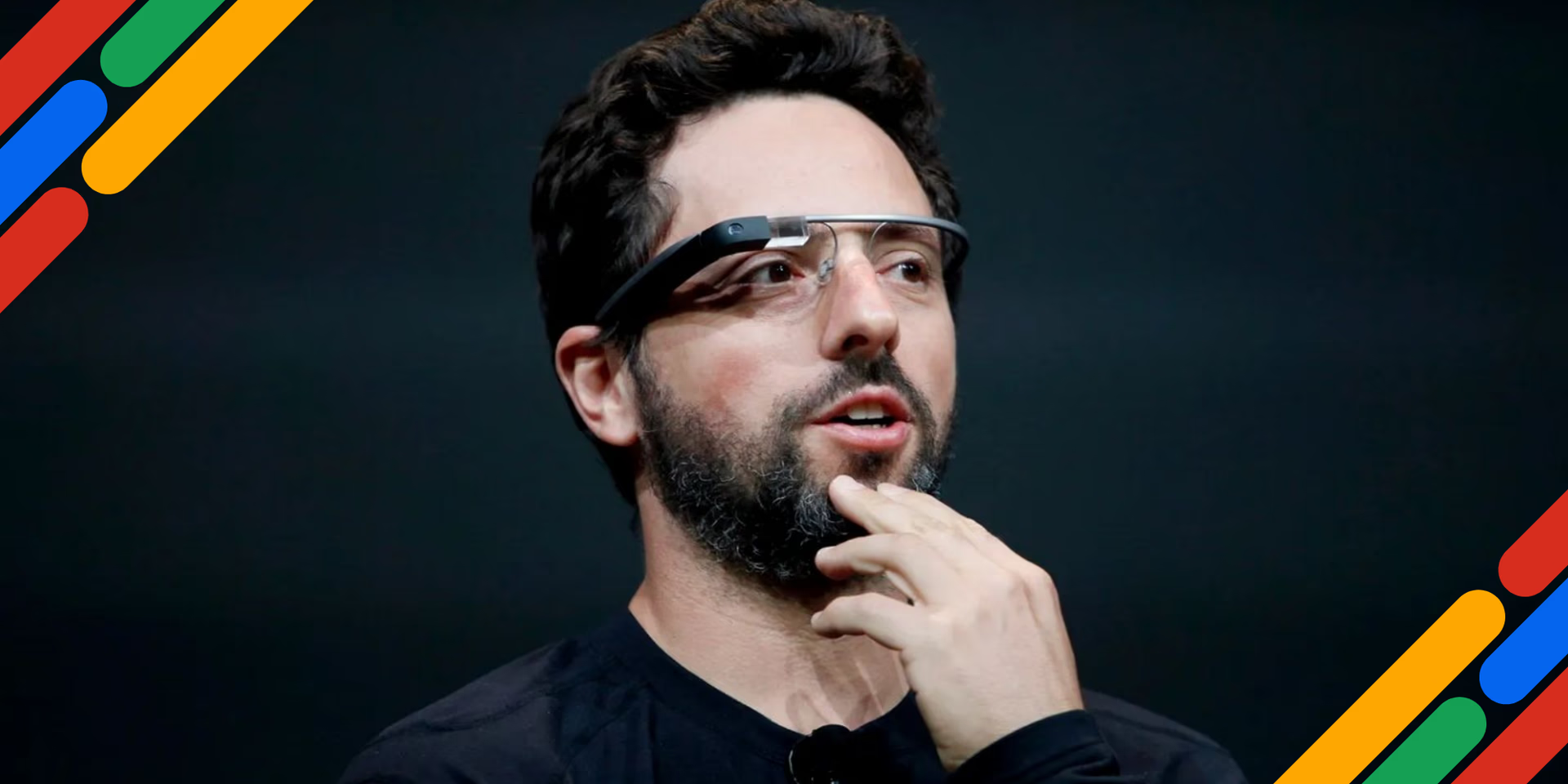
At the Google I/O 2025 developer conference, attendees were treated to a major surprise on day one: the unexpected appearance of Google Co-Founder Sergey Brin. Scheduled as a fireside chat between DeepMind CEO Demis Hassabis and moderator Alex Kantrowitz, the session quickly turned into something far more notable when Brin joined the stage. The conversation centered around artificial intelligence, highlighting Google’s latest Gemini tools, the capabilities of its newest AI models, and a bold look toward the future of artificial general intelligence (AGI). Brin also used the opportunity to share why he returned to Google after years of stepping away from day-to-day operations.
Brin’s reentry into the spotlight appeared to be driven by a renewed sense of purpose. He expressed his excitement about the progress in AI and the potential for meaningful breakthroughs that could reshape technology—and even society. Speaking candidly, Brin acknowledged that developments like Gemini represent a pivotal shift in computing, and he believes his presence can help steer Google toward achieving AGI responsibly and effectively. “This is the most interesting and important challenge I’ve seen in decades,” he remarked.
Throughout the discussion, Demis Hassabis emphasized the distinction between current AI models and true AGI. According to Hassabis, AGI is not just about performing tasks—it’s about replicating the broad cognitive flexibility of the human brain. He explained that while today’s models are capable of impressive feats, they still fall short of the consistency, reasoning, and creativity that define general intelligence. Hassabis pointed to the need for breakthroughs in world modeling and logical reasoning before AGI becomes a reality, though he remains optimistic that those breakthroughs are within reach.
When pressed on a timeline for AGI, the panelists offered slightly different forecasts. Brin confidently predicted that AGI would arrive before 2030, aligning with Google’s ambitions for its Gemini platform. Hassabis, slightly more cautious, estimated it might emerge just after that milestone. Regardless of the exact date, both leaders agreed that AGI is no longer a distant dream but a near-future goal—one that Brin is now personally invested in helping realize.
A cybersecurity researcher recently leveraged OpenAI’s o3 artificial intelligence (AI) model to uncover a critical zero-day vulnerability in the Linux kernel’s Server Message Block (SMB) implementation, known as ksmbd. This previously unknown security flaw, now tracked as CVE-2025-37899, involved complex interactions between multiple users or connections, making it particularly difficult to detect through traditional methods. Fortunately, a patch addressing the vulnerability has already been released to protect affected systems.
The discovery marks a significant milestone in the use of AI for cybersecurity, as such models are seldom used to find zero-day bugs—security flaws that are unknown and potentially unexploited before detection. While manual code audits remain the predominant approach for finding vulnerabilities, they can be painstaking and time-consuming when dealing with massive codebases. Researcher Sean Heelan explained in a detailed blog post how the o3 model accelerated the identification process, demonstrating AI’s emerging role as a powerful aid in vulnerability research.
Interestingly, Heelan initially employed the AI to examine a different security issue, CVE-2025-37778, a Kerberos authentication vulnerability categorized as a “use-after-free” bug. This type of flaw occurs when a system frees a block of memory but subsequent processes continue to reference it, potentially causing crashes or exploitable conditions. While testing the AI on this bug, the model unexpectedly flagged the SMB flaw in about eight out of 100 runs, underscoring the AI’s potential to uncover hidden vulnerabilities beyond its primary task.
This breakthrough with OpenAI’s o3 model highlights the growing synergy between artificial intelligence and cybersecurity research. As AI tools become more sophisticated, they offer promising avenues for automating complex code analysis and enhancing the detection of elusive security threats. The Linux SMB vulnerability case exemplifies how AI can augment human expertise, making systems safer in an era of increasingly sophisticated cyberattacks.