Yazılar

TCS Posts Modest Revenue Beat as AI Demand Lifts North America Growth

Tata Consultancy Services reported a slim third-quarter revenue beat on Monday, driven by artificial intelligence-led demand, with its key North America market returning to growth for the first time in two years.

Consolidated revenue for India’s largest software services firm rose 4.9% year-on-year to 670.87 billion rupees ($7.44 billion) for the quarter ended December 31, slightly above analysts’ estimate of 666.76 billion rupees, according to LSEG data. The traditionally weak December quarter benefited from increased AI spending by clients, with AI services generating about $1.8 billion annually and accounting for roughly 5.8% of total revenue.

Chief Executive K Krithivasan said strong deal momentum and growing leadership in AI underpin the company’s outlook. “Based on the client conversations, strong deal momentum and the leadership we are gaining in AI, we are confident of a good calendar year 2026,” he said during a post-earnings analyst call.

North America, which contributes nearly half of TCS’s revenue, posted growth for the first time since the July–September 2023 quarter, signaling a potential bottoming out of the slowdown. Five of the company’s eight geographic regions recorded growth, led by the Middle East and Africa with an 8.3% increase, followed by Continental Europe at 3.5%.
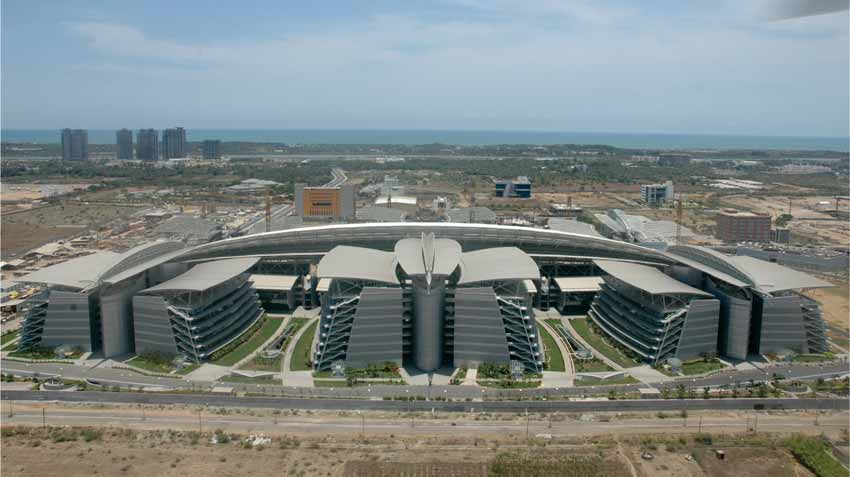
TCS Campus Siruseri, Chennai - MGS Architecture

Despite these gains, caution persists across India’s $283 billion IT services industry as clients remain wary of non-essential technology spending amid macroeconomic uncertainty in the United States. Analysts cited ongoing concerns around tariffs and proposed $100,000 visa fees as additional headwinds. Ambarish Shah of Systematix said North America’s recovery is likely to be gradual as structural weaknesses continue.

TCS noted that softer performance in banking and financial services and retail was largely due to year-end seasonality, with an expected recovery from the current quarter. The company’s total order book stood at $9.3 billion, down from $10.2 billion a year earlier.

Quarterly net profit fell 14% to 106.57 billion rupees, missing analysts’ expectations of 130.24 billion rupees. The decline was attributed to one-time restructuring costs linked to layoffs, the impact of India’s new labour codes enacted in November 2025, and other legal expenses.

The Mumbai-based firm declared a dividend of 11 rupees per share, along with a special dividend of 46 rupees per share. TCS shares listed in Mumbai closed 1.3% higher ahead of the results.

HCLTech Narrows Annual Revenue Outlook as Deal Momentum Strengthens

HCLTech narrowed its annual revenue growth forecast on Monday, citing a stronger deal pipeline and a modest beat in quarterly revenue, even as global demand for discretionary technology spending remains muted.

The Indian software services exporter reported a 13.3% year-on-year rise in revenue to 338.72 billion rupees ($3.8 billion) for the quarter ended December 31, exceeding analysts’ average estimate of 330.46 billion rupees, according to LSEG data. New deal bookings during the quarter climbed to $3 billion, prompting HCLTech to revise its full-year revenue growth outlook to a range of 4% to 4.5%, compared with its earlier forecast of 3% to 5%.

Chief Executive C Vijayakumar said client spending is selectively returning in areas that support artificial intelligence adoption, though he cautioned that overall demand is unlikely to rebound to post-pandemic peaks. “While uncertainty persists in the global market leading to slowing growth, the fundamental demand for technology as a driver for business transformation remains structurally intact,” he said during a post-earnings briefing.

Analysts viewed the updated outlook as a positive signal. Jefferies said the revised guidance provides “stronger visibility for growth in FY27,” while Centrum Broking analyst Piyush Pandey noted that the results were encouraging despite the December quarter typically being seasonally weak for IT firms.

India’s $283-billion IT services sector continues to face headwinds from cautious client spending in the United States, where macroeconomic uncertainty and geopolitical tensions have delayed non-essential technology investments. Earlier on Monday, industry leader Tata Consultancy Services also posted revenue slightly above expectations. Peers Infosys, Wipro, and Tech Mahindra are scheduled to report earnings later this week.

HCLTech’s quarterly profit fell 11.2% to 40.76 billion rupees, missing analysts’ forecasts, after the company took a one-time charge of 9.56 billion rupees linked to the impact of India’s new labour codes.

Nvidia Says No Upfront Payment Required for H200 AI Chips

Nvidia said on Tuesday it does not require upfront payment for its H200 artificial intelligence chips, pushing back against reports that it had imposed unusually strict payment terms on Chinese customers.

In a statement to Reuters, Nvidia said it “would never require customers to pay for products they do not receive,” responding to a January 8 report that suggested the company was demanding full advance payment from Chinese buyers seeking access to its AI processors.

According to a source familiar with the matter, Nvidia’s standard commercial terms for Chinese clients have previously included advance payment requirements, though customers were sometimes permitted to place a deposit instead of paying the full amount upfront. The source added that, for the H200 chip, Nvidia has been more cautious in enforcing its conditions due to uncertainty over whether Chinese regulators would approve shipments.

Concerns over regulatory approval have been heightened by ongoing geopolitical tensions and export controls affecting advanced semiconductors. Any requirement for full prepayment would effectively shift financial risk from Nvidia to customers, forcing them to commit capital without assurance that Beijing would authorize the imports or that the chips could be deployed as planned.

The H200 is one of Nvidia’s most advanced AI accelerators, designed for large-scale data center workloads, and demand for the chip has surged globally as companies race to expand AI computing capacity.