
Yazılar

Tinder Eyes Camera Access to Enhance Match Recommendations

Tinder is experimenting with a new AI feature called Chemistry, aimed at easing the fatigue users often feel while swiping for matches. This feature is designed to analyze a user’s camera roll—once explicit permission is granted—to suggest highly relevant profiles each day. By leveraging personal images, Chemistry intends to better understand users’ preferences and surface compatible matches, potentially streamlining the search for meaningful connections. However, the approach may spark privacy concerns, particularly around the handling of sensitive or personal images.

The feature was revealed during Match Group’s third-quarter earnings call, where executives described Chemistry as a “major pillar” of Tinder’s product strategy for 2026. Chemistry combines interactive prompts and AI-driven analysis to learn about a user’s personality, style, and interests. By integrating multiple signals, the system aims to reduce the randomness of traditional swiping and increase the relevance of match suggestions.

According to the company, users will have to explicitly grant access to their camera roll before the AI can process any images. Once authorized, deep learning algorithms analyze the content to infer preferences and generate a curated set of matches. The service promises to present only a small number of high-quality profiles each day, rather than overwhelming users with endless swiping options.

While Chemistry could improve match accuracy and engagement, it also raises questions about data privacy and consent. Users will need to trust that sensitive photos are handled securely and not misused for other purposes. As AI-driven matchmaking becomes more sophisticated, balancing personalization with privacy will be critical for user adoption and trust in the platform.
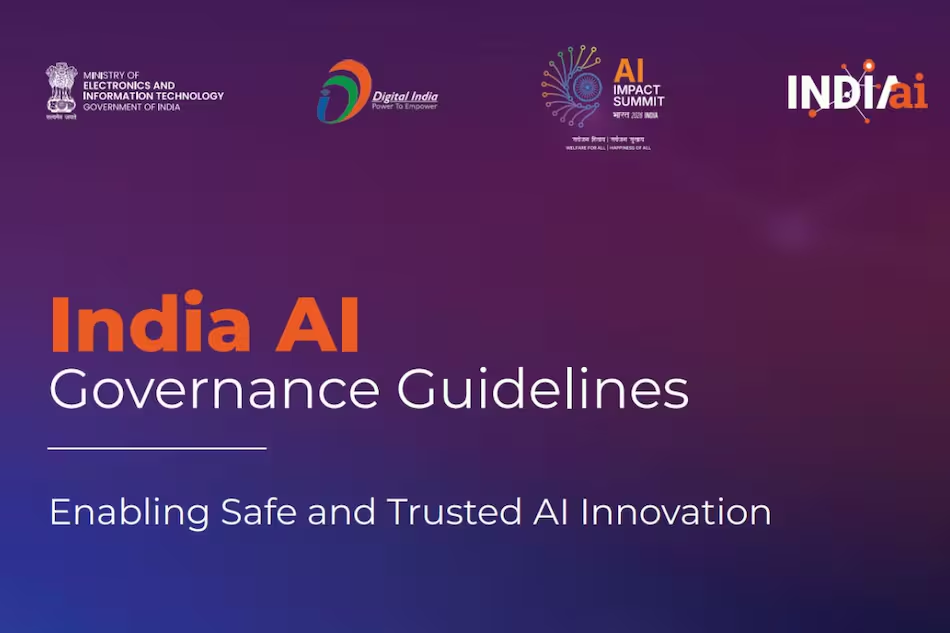
India Launches AI Governance Framework Outlining Principles and Future Roadmap

The Ministry of Electronics and Information Technology (MeitY) has officially released India’s Artificial Intelligence (AI) Governance Framework, providing a comprehensive set of guidelines and recommendations for regulators, policymakers, and stakeholders. The framework was formally unveiled by Professor Ajay Kumar Sood, Principal Scientific Adviser to the Government of India, along with other senior officials, signaling the government’s commitment to building a structured approach toward AI adoption and oversight. Among its key proposals are the establishment of new regulatory bodies, updates to existing laws, and amendments to relevant legal provisions to address the unique challenges posed by AI technologies.

The 68-page report emphasizes foundational principles that should guide AI development and deployment across India. Central to the framework are respect for human rights, non-discrimination, safety, transparency, and fairness. MeitY underscores the importance of ensuring AI systems are trustworthy and inclusive, benefiting a broad spectrum of communities, especially those historically underserved or marginalized. The framework aims to strike a balance between encouraging innovation and safeguarding public interest.

Rather than imposing blanket prohibitions, the framework advocates a risk-based approach to AI governance. This means the level of scrutiny and oversight would be proportional to the potential harm and societal impact associated with a given AI system. Systems with higher risk profiles would be subject to stricter regulatory requirements, while low-risk applications could operate with lighter oversight, allowing for greater flexibility and innovation.

To facilitate practical adoption, the guidelines propose a phased implementation model. This includes pilot projects, iterative evaluations, and stakeholder consultations to refine and improve regulatory mechanisms over time. The framework also encourages collaboration between government agencies, industry, academia, and civil society to ensure that India’s AI ecosystem develops responsibly, ethically, and competitively on a global scale.

Gemini AI Set to Make Google Maps a Conversational Travel Companion

Google Maps is being reimagined with the help of Gemini, Google’s flagship artificial intelligence system, transforming the navigation app into a more conversational and interactive companion for drivers.

The new design, announced Wednesday, integrates Gemini’s generative AI to create a hands-free experience that allows users to ask for directions, recommendations, and insights naturally — as if speaking to a knowledgeable passenger. Instead of relying solely on distances and street names, the upgraded app will reference landmarks to make navigation more intuitive.

“No fumbling required — now you can just ask,” Google said in a blog post unveiling the redesign. The company emphasized that Gemini’s new conversational features will help users discover restaurants, shops, and attractions on the go while keeping their focus on the road.

Google said it has implemented safeguards to prevent AI “hallucinations” — instances where chatbots generate incorrect information — to ensure accurate and reliable guidance. The data powering Gemini’s responses will come from Google Maps’ extensive database of more than 250 million places built up over two decades of user reviews.

The AI-powered Maps update will roll out soon to both iPhone and Android devices, reaching Google’s global user base of over 2 billion people. By embedding Gemini directly into Maps, Google aims to demonstrate the real-world utility of its AI technology and strengthen its position against rivals like OpenAI’s ChatGPT.

This move continues Google’s broader AI transformation, which has already reshaped its search engine to prioritize conversational results over traditional web links.