


A massive interstellar object, possibly eight times the mass of Jupiter, may have drastically reshaped the orbits of the outer planets in our solar system. According to a new study, this mysterious planetary-mass body could have passed through our solar neighborhood billions of years ago, coming dangerously close to the Sun—near the present orbit of Mars. Such an event could have altered the paths of Jupiter, Saturn, Uranus, and Neptune, potentially explaining long-debated irregularities in their current trajectories. If confirmed, this theory would provide a compelling new perspective on the early history of our solar system.
To investigate this possibility, a research team led by planetary scientist Renu Malhotra from the University of Arizona conducted an extensive set of computer simulations. The study, published in the arXiv preprint database, tested 50,000 different scenarios to determine whether a passing interstellar object could have significantly influenced planetary orbits. The team focused on celestial bodies larger than Jupiter but smaller than stars, including brown dwarfs and rogue planets. Remarkably, in about 1% of the simulations, the flyby event caused shifts in planetary orbits that closely align with what astronomers observe today.
The research suggests that the object may have approached as close as 1.69 astronomical units (AU) from the Sun—just beyond Mars’ current orbit at 1.5 AU. This proximity would have created a strong gravitational interaction, disturbing the orbits of the outer planets and leaving lasting imprints on their motion. Previous models have struggled to fully explain subtle orbital variations, but this new hypothesis could fill in the missing gaps. As Malhotra noted in an interview with Live Science, the findings suggest that the solar system’s past may have been more chaotic than previously thought.
If further research supports this theory, it could reshape our understanding of planetary formation and evolution. The idea that an interstellar wanderer influenced the architecture of our solar system raises intriguing questions about how often such encounters occur in the cosmos. Future studies, potentially aided by upcoming space telescopes and improved astronomical surveys, may reveal whether similar events have shaped other planetary systems—and whether they continue to happen today.
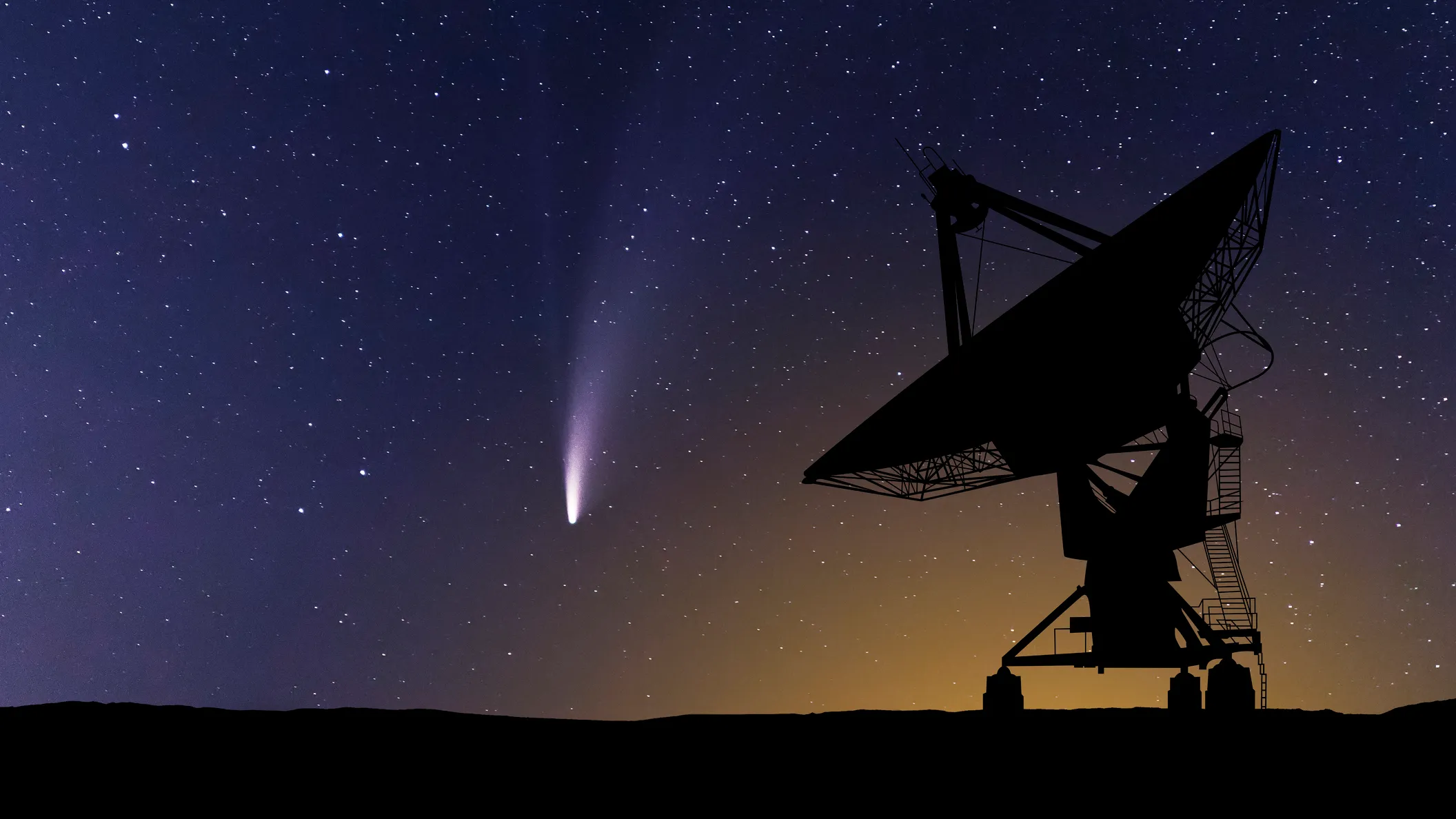
Comet 2024 G3 (ATLAS) has truly captivated skywatchers, earning the title of the “Great Comet of 2025” thanks to its extraordinary celestial display. The comet’s bright, vivid tails and remarkable brightness have drawn attention from astronomy enthusiasts across the globe. Discovered on April 5, 2024, by the Asteroid Terrestrial Impact Last Alert System (ATLAS) in Chile, it has delivered a breathtaking show that many observers won’t soon forget. The comet reached its closest approach to the Sun on January 13, 2025, dazzling viewers with a complex tail and heightened luminosity.
The celestial event is being hailed as historic due to the comet’s unprecedented brightness, reaching magnitudes not seen since Comet McNaught in 2007. During its perihelion, Comet 2024 G3 shone brightly, rivaling Venus in the sky, with a recorded magnitude of -3.8. This was based on careful data analysis from experts, including Polish researcher Mieczyslaw Paradowski. The Solar and Heliospheric Observatory (SOHO) also contributed observations, highlighting the comet’s brilliance as it moved closer to the Sun, offering a rare and awe-inspiring sight for observers around the world.
Although Comet 2024 G3 was visible to those in the Northern Hemisphere for a brief period in early January, its position soon shifted, making it more prominent in the Southern Hemisphere. Observers in southern regions were treated to a spectacular view, with the comet’s tail stretching across an impressive 15 degrees of the sky. This stunning display was particularly noted by astronomer Michael Mattiazzo in Swan Hill, Australia, who confirmed the breathtaking sight visible to many in the Southern Hemisphere.
As the comet continues its journey, it has left an indelible mark on those who had the opportunity to witness it, and its status as the “Great Comet of 2025” is firmly established. Its beauty and brightness serve as a reminder of the wonders of our universe and the excitement that celestial phenomena can bring to the global community of skywatchers.