Yazılar

Scientists Explore Earth’s Mysterious ‘Ignorosphere’ for Clues About Auroras

Unlocking the Secrets of Earth’s ‘Ignorosphere’: New Research Sheds Light on Auroras and Climate

The upper layers of Earth’s atmosphere remain a scientific frontier, largely unexplored compared to the well-studied lower layers. Among these is the mesosphere, situated between the stratosphere and outer space, often referred to as the “ignorosphere” due to the scarcity of reliable data. Its inaccessibility has hindered a comprehensive understanding of atmospheric processes that influence weather patterns, climate dynamics, and natural light displays such as auroras.

A Breakthrough in Atmospheric Research
In a recent study published in Progress in Earth and Planetary Science, researchers led by Kaoru Sato, an atmospheric physics professor at the University of Tokyo, have unveiled a groundbreaking dataset covering nearly two decades. This dataset extends atmospheric models up to 110 kilometers above Earth’s surface, integrating rare observations from sounding rockets, radar systems, and lidar technology. Sato emphasized that this data helps bridge significant knowledge gaps, allowing for detailed simulations of complex phenomena like gravity waves and auroras, which were previously difficult to analyze.

Understanding Space Weather and Its Terrestrial Impact
One of the key insights from this research is the mesosphere’s critical role in mediating space weather effects. Solar storms, which release streams of charged particles, often interact with this atmospheric layer, influencing both auroral activity and ozone chemistry. These interactions can trigger gravity waves—oscillations in the atmosphere that transport energy and momentum across vast distances. Despite their importance in shaping global weather and climate systems, gravity waves have remained poorly understood due to limited observational data.

Future Implications for Climate Science and Space Exploration
The new dataset not only enhances our understanding of the ignorosphere but also holds promise for improving climate models and space weather forecasting. By accurately representing how solar activity affects Earth’s upper atmosphere, scientists can better predict disruptions to communication systems, satellite operations, and even GPS signals. Moreover, this research could inform future space missions, as understanding atmospheric dynamics at the edge of space is crucial for spacecraft re-entry and the design of high-altitude vehicles.
Solar Storm Creates Stunning Northern Lights Display Across the Western Hemisphere on New Year’s Eve

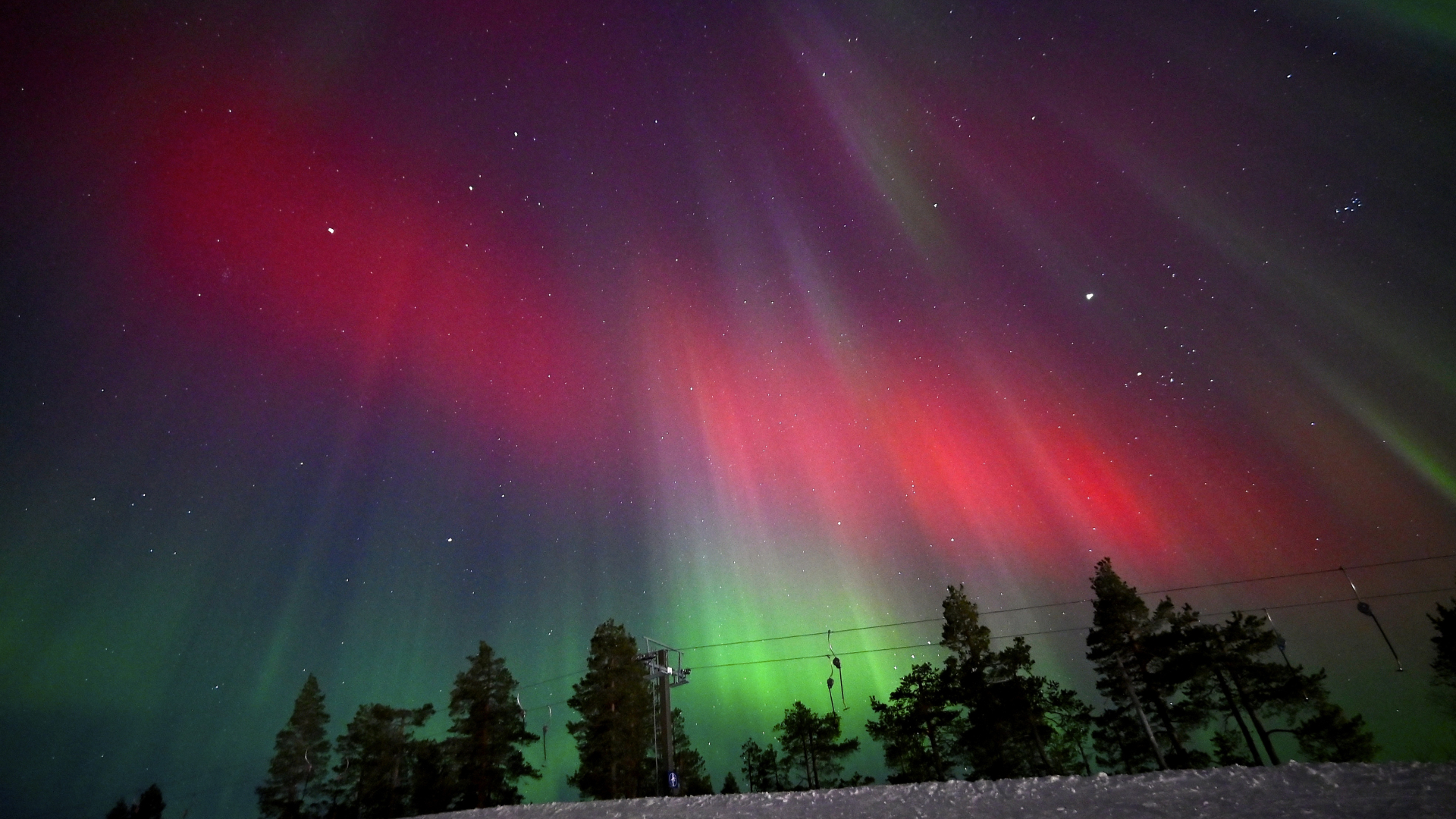
A stunning display of the northern lights illuminated the night skies as the world welcomed the New Year. This breathtaking auroral event, triggered by powerful solar storms, captivated observers from the central United States to Europe. The vibrant ribbons and pillars of green and red light painted the skies, with the aurora visible as far south as California in the United States and Austria and Germany in Europe. The spectacle lasted into the early hours of January 1, drawing stargazers and photographers eager to capture the celestial show.

The spectacular display was a result of intense geomagnetic activity caused by solar storms on New Year’s Eve. The solar events, linked to coronal mass ejections (CMEs) from the Sun, collided with Earth’s magnetic field, producing the auroral phenomenon. These CMEs released high-energy particles that traveled toward Earth, triggering geomagnetic storms. According to the National Oceanic and Atmospheric Administration (NOAA), the storms began at a G1-level intensity but intensified to G3-level disturbances by January 1, making the northern lights more visible across various regions.

The interaction between the solar particles and Earth’s magnetosphere caused atmospheric gases to ionize, releasing energy in the form of light. This energy emitted as colorful glows in the sky, with green and red being the most prominent hues in the northern lights. While this phenomenon, known as the aurora borealis, typically occurs in the Northern Hemisphere, a similar light show, called the aurora australis, can be seen in the Southern Hemisphere.

This celestial event served as a reminder of the dynamic relationship between the Earth and the Sun. While such solar storms can sometimes disrupt satellite communication or power grids, their ability to create awe-inspiring natural light displays is a beautiful byproduct of solar activity. As scientists continue to study these phenomena, public interest in space weather and its effects on Earth only grows, with events like the New Year’s Eve aurora offering a visual spectacle for people around the world.

Why Are We Seeing the Northern Lights So Often Lately?

Once considered a rare spectacle seen only near the Arctic Circle, the Northern Lights, or Aurora Borealis, have become increasingly visible across various parts of the world, including much of the US. On Thursday night, these vivid colors were once again on display. Experts point to heightened solar activity as the main reason for the frequency of these sightings.

The Northern Lights are tied to the sun’s 11-year solar cycle, which governs solar activity. Currently, the sun is nearing the “solar maximum,” a phase of the cycle characterized by increased solar flares and eruptions. During this period, the sun’s magnetic poles flip, causing significant solar storms that affect Earth.

NASA explains that at the solar minimum, the sun is relatively calm, but at its maximum, bright solar flares and Coronal Mass Ejections (CMEs) occur, sending streams of charged particles, known as solar wind, hurtling toward Earth. When these particles interact with gases in Earth’s atmosphere, especially near the magnetic poles, they create the brilliant light displays we recognize as auroras.

The current solar cycle, the 25th since records began in 1755, started in 2019 and is expected to reach its peak in 2025. As the sun continues its active phase, the chances of witnessing these displays will remain high over the next several months.

The recent surge in auroral activity stems from an eruption on October 8, when a large sunspot sent charged particles towards Earth. As these particles collide with gases like oxygen and nitrogen in the atmosphere, light is emitted in various colors, forming the shimmering displays of green, pink, purple, and red.

While the Northern Lights are typically most visible near the Arctic Circle, increased solar activity can push the auroral zone farther south, allowing more people to witness the phenomenon. With a high number of sunspots and ongoing solar eruptions, scientists predict that more auroras are likely in the near future.

To catch a glimpse of the Northern Lights, it’s best to find a dark location, away from artificial light, and ensure the skies are clear of clouds. As solar activity remains strong, the beauty of the Northern Lights may continue to be more accessible to people across the globe in the coming months.