Yazılar

James Webb Telescope Reveals Chaotic Early Formation of the Universe’s First Galaxies

New observations from the James Webb Space Telescope (JWST) reveal that the first galaxies in the universe were far more chaotic and turbulent than the orderly spiral and elliptical galaxies we see today. Researchers at the University of Cambridge analyzed over 250 galaxies formed 0.8 to 1.5 billion years after the Big Bang, finding that most were clumpy, irregular, and dominated by turbulent gas motions. Unlike modern galaxies, these early systems struggled to settle due to intense gravitational forces and rapid star formation, which stirred their gas and prevented stable rotation. Devamını Oku

How the James Webb Space Telescope Allows Us to See the Past

The ability to observe space allows scientists to essentially look back in time, thanks to the way light travels across vast distances in the universe. Telescopes like the James Webb Space Telescope enable us to capture light from distant celestial bodies, acting as time machines that reveal what the universe looked like in the past. This phenomenon is rooted in the fact that light, despite traveling at incredible speeds, still requires time to travel across the vast expanses of space.

Light travels at approximately 186,000 miles (300,000 kilometers) per second, which is incredibly fast in human terms. However, even at this speed, the immense distances between objects in space mean that the light we see today actually left those objects millions or even billions of years ago. For example, light from the Moon takes just 1.3 seconds to reach Earth, while light from Neptune, the furthest planet in our solar system, takes about four hours. This delay in light’s arrival means that when we observe these objects, we are seeing them as they were in the past, not as they are right now.

When we look beyond our solar system, the distances become even more staggering. Within our galaxy, the Milky Way, distances are often measured in light-years—the distance that light travels in one year. For instance, Proxima Centauri, the closest star to Earth after the Sun, is over four light-years away. That means when we observe Proxima Centauri, we are actually seeing it as it was over four years ago. The light that reaches us today from that star began its journey back in time, traveling through space at a constant speed.

The James Webb Space Telescope, with its advanced instruments and capabilities, is able to observe objects that are far further away than ever before. By studying the light emitted from galaxies, stars, and other celestial bodies billions of light-years away, Webb allows scientists to peer into the distant past of the universe. The further the light travels, the further back in time we are able to see, offering a glimpse into the early stages of the universe, helping us understand its origins and evolution over time.

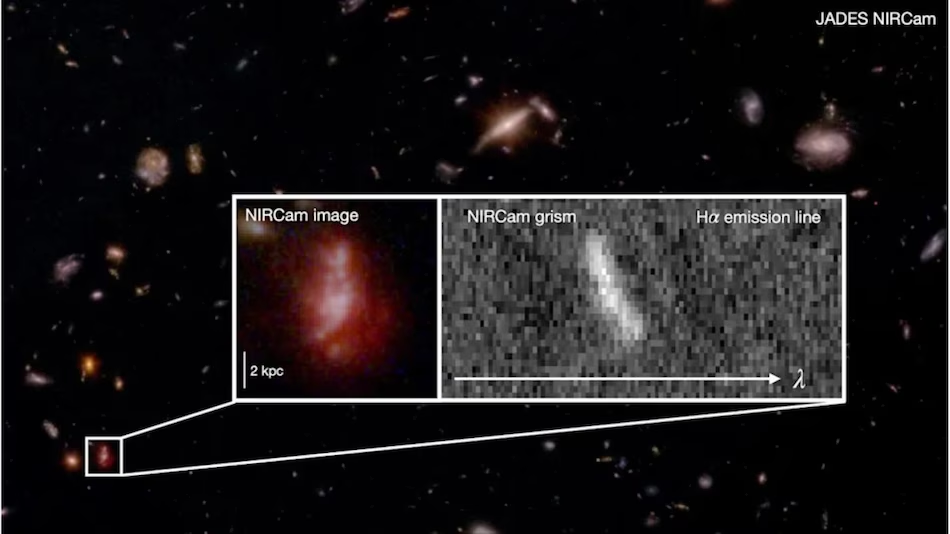
NASA’s Webb and Hubble Telescopes Capture Haunting, ‘Blood-Red Eye’ Galaxies IC 2163 and NGC 2207

NASA’s Hubble Space Telescope and the James Webb Space Telescope (JWST) have recently provided a breathtaking view of two merging galaxies, IC 2163 and NGC 2207, located in the Canis Major constellation, about 80 million light-years from Earth. These spiral galaxies are in the process of colliding and merging, a cosmic event that will take roughly a billion years to complete. The image, which has been released just in time for Halloween, has sparked excitement among astronomers and the public alike due to the galaxies’ eerie appearance, with scientists describing them as having a “blood-soaked” or “blood-red eye” look. This captivating view offers a glimpse into a dramatic transformation occurring far beyond our solar system.

The combined capabilities of the Hubble and Webb telescopes have allowed scientists to observe this galactic collision from different perspectives. Hubble’s visible and ultraviolet light sensors capture the intricate spiral arms of the galaxies, glowing in hues of blue, while their dense central cores emit a vivid orange. Meanwhile, JWST’s mid-infrared imagery provides a more ethereal view, highlighting the swirling gas and dust with ghostly white hues. This contrast between the two telescopes’ observations offers valuable insights into the complex interactions between the galaxies, particularly the turbulence caused by their gravitational forces and the burst of new star formation happening in the collision zone.

Over the course of their slow merger, IC 2163 and NGC 2207 are rapidly producing new stars, with an estimated 24 solar-sized stars being born each year. This rate of star formation is considerably higher than what we observe in our own Milky Way galaxy, which produces roughly one new star every year. The interaction between the two galaxies has also led to a strikingly high frequency of supernovae, with at least seven observed over recent decades. This is much higher than the one supernova every 50 years observed in the Milky Way. This heightened stellar activity provides a dynamic and volatile environment, as the galaxies continue their long, drawn-out collision.

IC 2163 and NGC 2207 first began their cosmic dance around 40 million years ago, and over time, their orbits have brought them into closer proximity, setting the stage for the ongoing merger. While this process will unfold over billions of years, the current observations show a galaxy pair that is already undergoing intense transformation. The Hubble and Webb telescopes’ joint observations offer a rare and detailed look into the chaotic yet beautiful forces that shape the evolution of galaxies and star systems. These images not only deepen our understanding of galactic collisions but also underscore the incredible power of modern space telescopes in unraveling the mysteries of the universe