Yazılar

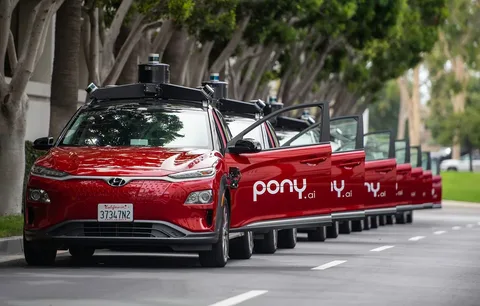
Pony.ai Shares Fall 12% in Hong Kong Debut as Autonomous Rivals WeRide Also Slide

China’s leading autonomous driving startup Pony.ai saw its shares drop more than 12% on Thursday in its Hong Kong debut, while rival WeRide fell nearly 13%, reflecting investor caution toward the fast-evolving self-driving sector.

Pony.ai raised HK$6.71 billion (about $860 million) and WeRide HK$2.39 billion through their initial public offerings, both of which come as Chinese tech firms increasingly seek dual listings in Hong Kong amid geopolitical uncertainty and stricter U.S. regulations.

Both Guangzhou-based firms are investing heavily in Level 4 autonomous driving — vehicles that can operate without human intervention under specific conditions. Pony.ai CEO James Peng said proceeds would help expand autonomous parking and charging infrastructure, while WeRide’s CEO Tony Xu Han said funds would support AI development and data center expansion.

The companies have already launched robotaxi services in several Chinese cities and plan to expand to new regions including the Middle East, Europe, and Singapore, though full regulatory approvals remain pending.

The listings come at a delicate time for Chinese tech firms facing mounting U.S. restrictions. A new rule effectively bans Chinese technology in connected vehicles, complicating Pony.ai and WeRide’s ambitions to partner with Uber for robotaxi operations in the U.S.

“The dual listings are about risk mitigation,” said Tu Le, managing director at Sino Auto Insights. “They acknowledge it will take significant capital — and a market outside the U.S. — for these firms to succeed.”

The weak debut mirrored declines in New York, where WeRide shares dropped 5.2% and Pony.ai fell 2% the previous day. Still, analysts said the Hong Kong listings will help both companies secure Asia-based funding and reinforce the city’s growing image as a tech hub.

Chinese humanoid robot maker AgiBot plans $6.4 billion Hong Kong IPO

Chinese robotics firm AgiBot is preparing for a Hong Kong initial public offering (IPO) next year that could value the company between HK$40 billion and HK$50 billion ($5.14–$6.4 billion), according to multiple sources familiar with the matter. The move positions AgiBot as one of China’s most prominent humanoid robot startups entering public markets amid the country’s rapid push into automation and AI-driven robotics.

Backed by major investors including Tencent, HongShan Capital Group (HSG), LG Electronics, and BYD, AgiBot has hired CICC, CITIC Securities, and Morgan Stanley to manage the listing. The firm reportedly plans to issue 15–25% of its shares and aims to file a preliminary prospectus in early 2026, targeting a Q3 listing.

Founded in 2023 by former Huawei engineers Deng Taihua and Peng Zhihui, Shanghai-based AgiBot develops the Yuanzheng and Lingxi humanoid robot series, which perform complex manual tasks such as folding clothes, making coffee, and cleaning. The robots are designed for industrial and service applications in manufacturing and logistics, and the company also provides data collection tools for AI model training.

AgiBot’s rise has been accelerated by Chinese President Xi Jinping’s public endorsement, following his visit to its Shanghai facility earlier this year. The company recently partnered with Fulin Precision Engineering to deploy nearly 100 Yuanzheng robots in automotive part factories.

The IPO would follow that of Ubtech Robotics, the first humanoid robot firm to list in Hong Kong, whose shares have surged 150% this year. Rival Unitree Robotics is also seeking a $7 billion listing on Shanghai’s STAR Market.

Hong Kong has emerged as the world’s top IPO destination in 2025, with more than 270 listings raising $24 billion, largely from mainland Chinese companies. AgiBot’s debut would further solidify the city’s growing role as the hub for AI and robotics capital markets.

CATL’s Soaring Hong Kong Debut Signals Renewed Optimism for Chinese Fundraising

Chinese EV battery giant CATL surged 16.4% on its Hong Kong trading debut, raising $4.6 billion in the world’s largest listing of 2025 so far, and signaling strong international investor appetite for Chinese equities. The successful listing has significantly boosted expectations for other Chinese companies seeking to raise capital in Hong Kong.

CATL shares, listed at HK$263, closed at HK$306.20 on Tuesday, outperforming the Hang Seng Index’s 1.5% rise. At peak trading, the stock hit HK$311.40. The offering was met with overwhelming demand, with the retail tranche oversubscribed by 151 times and the institutional tranche by over 15 times.

This robust debut came despite global market uncertainties, a slowing Chinese economy, and CATL’s inclusion earlier this year on a U.S. Department of Defense list over alleged military ties — a claim CATL has refuted in its prospectus, noting it was cooperating with the U.S. authorities to address the “false designation.”

Strong interest from global investors — including Americans with offshore accounts — underscores growing confidence in Chinese companies, even amid ongoing U.S.-China trade tensions. CATL’s listing gained additional momentum as it coincided with a 90-day U.S.-China trade truce announced on May 12, the same day the company began bookbuilding.

The company, which holds a 38% global market share in EV batteries, plans to use much of the funds to build a major battery factory in Hungary. This facility will support European automakers such as BMW, Stellantis, and Volkswagen as part of CATL’s international expansion.

The deal brought Hong Kong’s total equity fundraising for 2025 to $7.73 billion, far surpassing the $1.05 billion raised by this time last year. According to Bonnie Chan, CEO of Hong Kong Exchanges and Clearing, over 40 mainland-listed A-share firms are considering Hong Kong listings, citing access to offshore capital for global expansion.

CICC, JPMorgan, Bank of America, and China Securities International sponsored the offering, which could grow to $5.3 billion if the green shoe option is fully exercised — making it the largest Hong Kong IPO since Kuaishou’s $6.2 billion debut in 2021.