Yazılar

Intel Reshuffles Top Leadership as Products Chief Holthaus Departs

Intel (INTC.O) announced a major executive shake-up on Monday, including the departure of Michelle Johnston Holthaus, the company’s products chief, as CEO Lip-Bu Tan moves to streamline operations and push a turnaround strategy.

Holthaus, a 30-year Intel veteran, previously held several senior leadership positions, including serving as interim co-CEO following the ouster of Pat Gelsinger in 2024. She will step down but remain as a strategic adviser in the coming months.

The restructuring includes:

  • Kevork Kechichian joining as EVP and head of the Data Center Group. Kechichian is a seasoned industry leader who previously held senior roles at Arm, NXP Semiconductors, and Qualcomm.

  • A new Central Engineering Group, to be led by Srinivasan Iyengar, tasked with building a custom silicon business for external clients.

  • Naga Chandrasekaran, Intel EVP and CTO, expanding his remit to oversee Foundry Services.

  • Jim Johnson appointed as GM of Intel’s Client Computing Group.

The leadership reshuffle comes as Intel grapples with a difficult business environment and political pressure. U.S. President Donald Trump recently announced plans for the government to take a 10% stake in Intel, while also calling for CEO Tan’s resignation over alleged conflicts of interest.

Tan’s strategy aims to flatten Intel’s leadership structure, cut jobs, and restore competitiveness as the company struggles to keep pace with rivals in advanced chipmaking.
Trump Meets with Intel CEO Tan After Resignation Demands

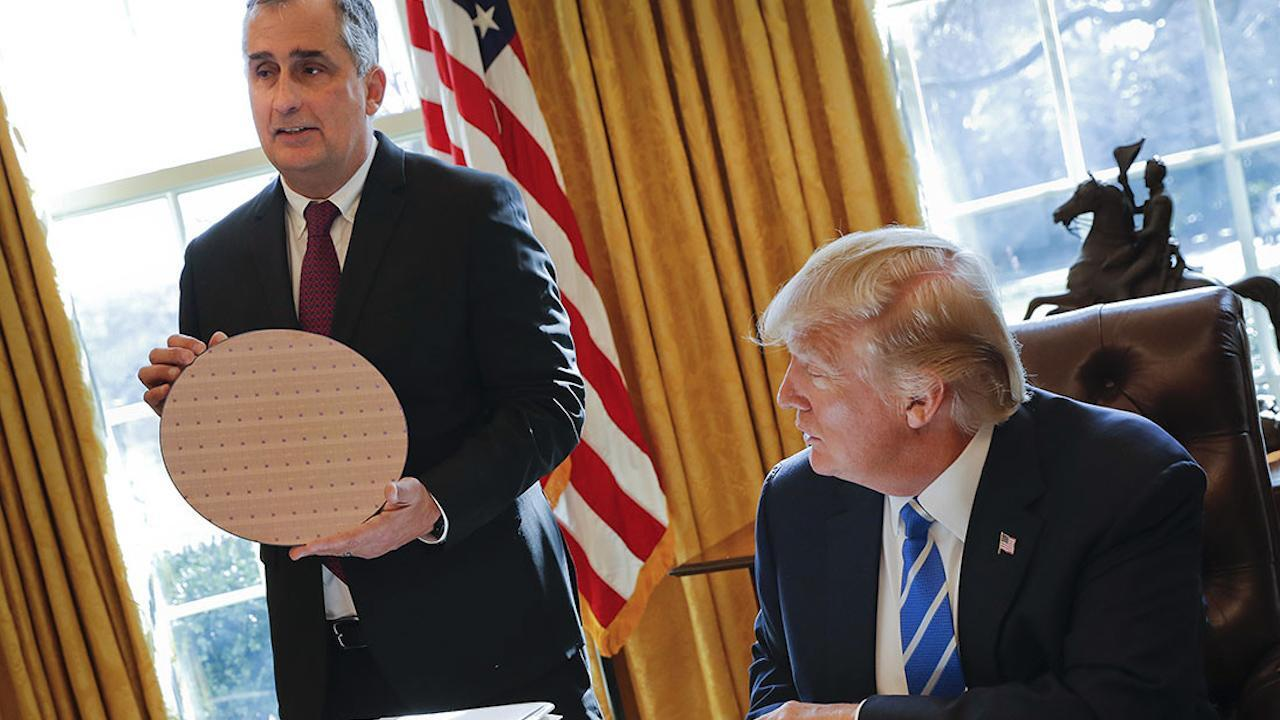
U.S. President Donald Trump met with Intel CEO Lip-Bu Tan on Monday, just days after publicly demanding his resignation over alleged conflicts of interest tied to investments in Chinese firms. Following the meeting, Trump praised Tan, calling the discussion “very interesting.” Intel’s stock rose 3% in extended trading.

Last week, Trump had accused Tan of being “highly conflicted” due to his extensive ties to Chinese companies, some of which were reportedly linked to China’s military. Though such investments are not illegal unless involving entities on the U.S. Treasury’s restricted list, the revelations created uncertainty around Intel’s ongoing turnaround effort.

During the White House meeting, Trump was joined by Commerce Secretary Howard Lutnick and Treasury Secretary Scott Bessent. Trump said the officials, along with Tan, would provide him with further recommendations next week. Despite earlier criticism, Trump acknowledged Tan’s career as “an amazing story.”

Tan, who has been Intel’s CEO for roughly six months, is leading efforts to reposition the company amid heavy losses and fierce competition from Nvidia in the AI chip market. His strategy has included major asset sales, layoffs, and resource reallocation. However, Trump’s intervention—demanding his resignation—has raised concerns among investors and industry insiders that political pressure could derail Intel’s recovery.

Intel released a statement emphasizing Tan’s constructive dialogue with Trump and reaffirming its commitment to U.S. technology and manufacturing leadership. The company pledged to work closely with the administration to “restore this great American company.”

Trump’s direct involvement highlights his unusual influence over corporate governance, following a recent deal requiring Nvidia and AMD to share 15% of their China sales revenue with the U.S. government.

Trump’s Call for Intel CEO Lip-Bu Tan’s Resignation Sparks Mixed Reactions

U.S. President Donald Trump has called for the immediate resignation of Intel CEO Lip-Bu Tan, citing concerns over his extensive investments in Chinese technology companies — including at least eight with reported links to China’s People’s Liberation Army. The demand comes just months after Tan took over leadership of the struggling semiconductor giant.

According to an April Reuters investigation, Tan’s decades-long career includes hundreds of investments in Chinese firms, both personally and through venture funds he founded. On Wednesday, Reuters also reported that Senator Tom Cotton had raised questions about Tan’s ties to China and a recent criminal case involving his former company, Cadence Design Systems.

Reactions from analysts and investors have been sharply divided. Some view Tan’s knowledge of China’s semiconductor industry as an invaluable asset for Intel and the U.S., while others see Trump’s intervention as a sign of escalating political pressure and market uncertainty.

Key reactions:

  • Anshel Sag, Moor Insights & Strategy – Criticized Trump’s call, arguing that Tan’s deep understanding of China’s semiconductor capabilities could benefit Intel and the U.S., making him more valuable rather than less.

  • David Wagner, Aptus Capital Advisors – Said Trump’s move reflects his broader push to bring business back to the U.S., noting the momentum from the recent Apple deal.

  • Ryuta Makino, Gabelli Funds – Suggested Trump’s motives may be tied to Intel’s manufacturing strategy and possible deals with TSMC, calling it “very much a political move.”

  • Blake Anderson, Carson Group – Warned that such political disputes highlight Intel’s reliance on external factors for its manufacturing turnaround, increasing long-term uncertainty.

  • Shiraz Ahmed, Sartorial Wealth – Noted that Trump has a history of publicly criticizing corporate leaders and predicted it will not be the last such intervention.

  • Phil Blancato, Ladenburg Thalmann – Called it a troubling precedent for presidents to dictate corporate leadership, but acknowledged Trump’s opinion carries weight. He added that Intel’s problems extend beyond its CEO and require “real, radical change.”

The Intel board has yet to respond publicly, but the controversy underscores the growing intersection of geopolitics and corporate governance in the U.S. technology sector.