Yazılar

Meta’s Mark Zuckerberg Considered Instagram Spinoff Amid Ongoing Antitrust Scrutiny, Documents Reveal

In 2018, Meta CEO Mark Zuckerberg seriously considered spinning off Instagram, fearing increasing antitrust scrutiny, according to a document presented during a trial in Washington. The document was revealed on the second day of Zuckerberg’s testimony in a high-profile case where the U.S. Federal Trade Commission (FTC) is attempting to reverse Meta’s acquisitions of Instagram and WhatsApp. This legal battle aims to undo the mergers, which the FTC claims reduced competition in the social media market.

The memo, shown during the trial, revealed Zuckerberg’s candid thoughts on the matter. In it, he mused, “I wonder if we should consider the extreme step of spinning Instagram out as a separate company.” At the time, Meta was contemplating a major reorganization, aiming to better integrate its social media platforms. However, Zuckerberg also acknowledged that consolidating the apps could foster “strong business growth,” even though it could risk undermining Facebook’s flagship app and its broader family of services.

Despite these concerns, Meta ultimately decided against spinning off Instagram, choosing instead to push forward with its integration plans the following year. The decision not to break off Instagram underscores Zuckerberg’s assessment of the antitrust risks at play. The document reflects his awareness of the potential legal and regulatory challenges Meta might face, with antitrust pressure mounting in the tech industry.

Zuckerberg’s memo also highlighted a broader concern about the future of big tech. He expressed that, with rising calls to dismantle large tech corporations, it was likely that Meta could face forced separations in the future. Specifically, he noted that a shift in U.S. leadership, particularly under a “next Democratic president,” could lead to actions to break up major tech companies, including Meta’s prized acquisitions like Instagram and WhatsApp.

OpenAI Said to Be Developing an AI-Driven Social Media Network

OpenAI is reportedly preparing to launch its own social media platform, according to recent reports. The San Francisco-based artificial intelligence company is said to be working on integrating AI capabilities into this new social app, though specifics about how the AI features will be used remain unclear. The platform is rumored to be positioned as a competitor to Elon Musk’s X (formerly Twitter) and the suite of social apps owned by Mark Zuckerberg’s Meta. Notably, both X and Meta have recently introduced AI features into their ecosystems, highlighting a growing trend of blending AI with social experiences. This news surfaces just days after OpenAI announced its latest advancements with the GPT-4.1 family of models.

According to a report from The Verge, OpenAI’s social platform could be based heavily on ChatGPT. Sources close to the project suggest that an internal prototype already exists, reportedly emphasizing GPT-4o’s image-generation capabilities. The platform’s design includes a public feed where AI-created images may be displayed, hinting at a highly visual, content-driven experience. While it has been described as similar to X, the integration of generative AI at the core could set OpenAI’s project apart from more traditional social networks.

CEO Sam Altman has reportedly sought external feedback on the early prototype, though major questions remain. It is still unclear whether OpenAI intends to launch a standalone social app or incorporate these features directly into the existing ChatGPT interface. Observers have pointed out similarities to OpenAI’s video generation platform, Sora, which also features a content feed—though Sora lacks a true social element, as creators are not identified. Early indications suggest that OpenAI’s approach might prioritize showcasing AI capabilities in a social context, rather than building a purely human-driven network supplemented by AI, like X or Instagram.

The move into social media would also intensify OpenAI’s ongoing rivalry with X and Meta. Elon Musk, owner of X, has been openly critical of Sam Altman and OpenAI’s shift toward a for-profit structure. Musk previously filed a lawsuit against the company and even made a bid to acquire it, to which Altman responded sharply, joking that OpenAI would instead offer to buy Twitter for $9.74 billion. With tensions already high, OpenAI’s entry into the social networking space could further escalate competition among tech giants racing to dominate the future of AI-powered digital experiences.

Mark Zuckerberg Defends Meta Against US Antitrust Allegations During Trial Testimony

Meta CEO Mark Zuckerberg testified on Monday in a closely watched antitrust trial in Washington, defending the company against claims that it acquired Instagram and WhatsApp to stifle competition. US regulators argue that Meta’s multibillion-dollar deals were strategically aimed at neutralizing emerging threats to Facebook’s dominance in the social media landscape.

The Federal Trade Commission (FTC) is seeking a major structural remedy that could force Meta to divest Instagram and WhatsApp. This case, viewed as a major test of the US government’s willingness to challenge Big Tech, comes at a critical time when Meta’s revenue heavily depends on platforms like Instagram, which reportedly contributes to nearly half of the company’s US advertising income.

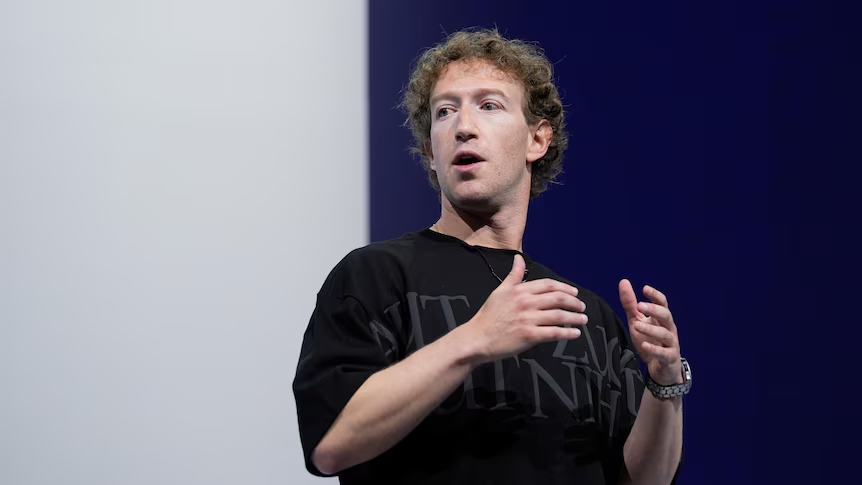
During his testimony, Zuckerberg, dressed in a dark suit and light blue tie, maintained a calm demeanor as he refuted claims that the acquisitions were motivated solely by a desire to crush competition. He insisted that connecting friends and family was only one part of Meta’s broader vision for its apps. Zuckerberg highlighted that Facebook’s strategy also emphasized helping users discover public content, beyond just personal sharing.

Zuckerberg also addressed a pivotal 2018 decision when Facebook shifted its focus back to content shared by friends, a move that failed to keep pace with how users were increasingly sharing through private messages rather than public posts. Meanwhile, the FTC presented internal communications suggesting Zuckerberg had viewed acquiring Instagram and WhatsApp as strategic moves to preempt future rivals, particularly with the rising competition from newer platforms like TikTok.