Yazılar

Groundbreaking Study Uncovers the Role of Dynamo Reversals in Shaping Mars’ Magnetic History

New Insights into Mars’s Magnetic Field Dynamics
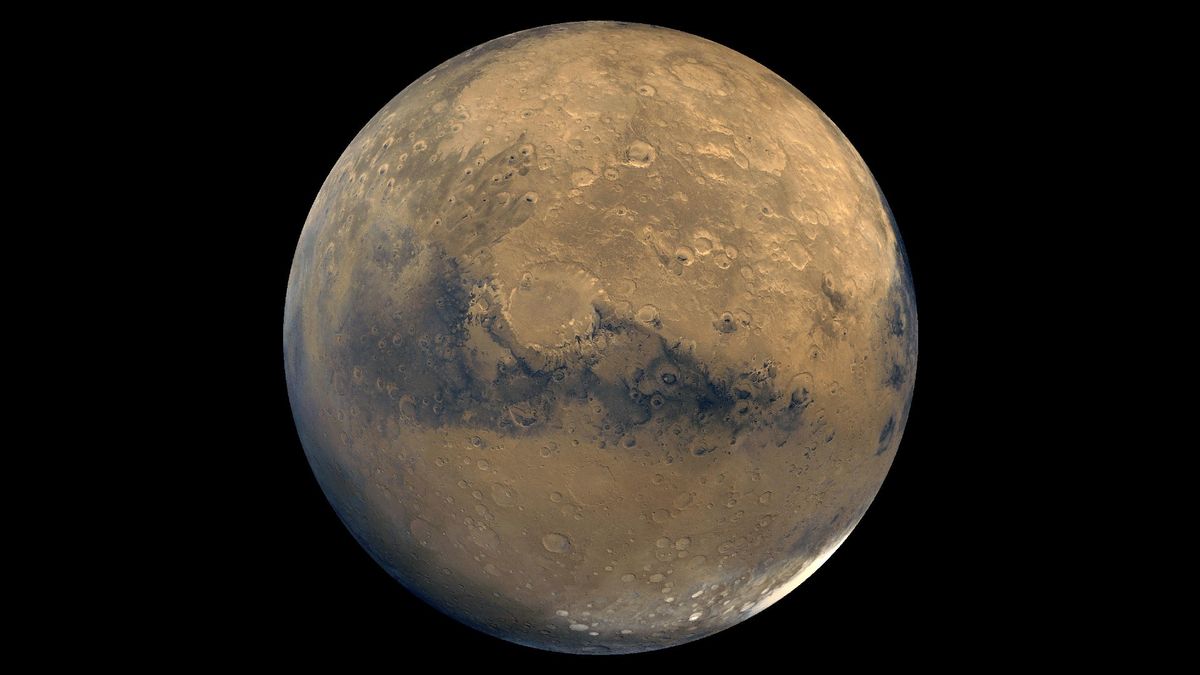
Martian impact basins, previously thought to be demagnetized due to the early cessation of Mars’s planetary dynamo, may instead provide evidence of a reversing magnetic field, according to a new study. Led by Dr. Silpaja Chandrasekar, the research suggests that Mars’s dynamo—the mechanism generating its magnetic field—was active longer than previously believed, with significant implications for our understanding of the planet’s evolution.

Impact Basins and Reversing Fields
Published in Nature Communications, the study delves into the magnetic anomalies in large Martian impact basins, which exhibit weaker magnetism than surrounding regions. Rather than indicating a permanently inactive dynamo, the researchers propose that these weak signals result from prolonged cooling and frequent polarity reversals. By modeling cooling processes within these basins, they demonstrated how these magnetic field reversals diminished the strength of magnetism, creating a demagnetized appearance. This overturns the notion that a dying dynamo alone explains the anomalies.

Extended Dynamo Activity
Traditionally, Mars’s dynamo was assumed to have ceased early in the planet’s history, but recent evidence, including young volcanic rocks and the meteorite Allan Hills 84001, suggests otherwise. The study posits that Mars’s dynamo may have persisted until around 3.7 billion years ago. During this time, the magnetic field experienced regular reversals, forming oppositely magnetized layers in cooling impact basins. This process likely contributed to the weak magnetic signatures detected today.

Implications for Planetary Evolution
These findings reshape our understanding of Mars’s magnetic history and its broader planetary evolution. A prolonged, reversing dynamo could have influenced Mars’s climate stability and surface conditions, offering clues about its transition from a warmer, wetter environment to the arid planet we see today. The study also highlights how magnetic field dynamics play a pivotal role in shaping planetary crusts, offering new perspectives for studying other celestial bodies with similar features.


NASA’s Perseverance Rover Captures ‘Googly Eye’ Eclipse on Mars

NASA’s Perseverance rover, stationed in Mars’ Jezero Crater, recently captured a stunning celestial event as the Martian moon Phobos passed across the Sun. This moment, observed on September 30, provided a rare glimpse into the Martian sky and featured an intriguing “googly eye” effect, which was recorded by the rover’s Mastcam-Z camera. The eclipse offered a unique visual of Phobos’ orbit and helped scientists gain valuable data about the moon’s trajectory as it continues to slowly move closer to Mars. The footage released by NASA showcases the intricate dance of Mars’ moons and the dynamic nature of the Martian system.

The event unfolded as Perseverance observed Phobos casting its shadow across the Sun, creating a brief and distinctive visual effect. This “googly eye” effect occurred when Phobos partially blocked the sunlight, leaving a silhouette that was especially noticeable against the Martian backdrop. The eclipse, occurring on the 1,285th Martian day (sol) of the Perseverance mission, highlighted the moon’s rapid orbit around Mars. Phobos takes just 7.6 hours to complete one orbit, a much faster motion compared to Earth’s moon, which results in quick transits across the sky that last only about 30 seconds. This provides a fleeting but beautiful spectacle that is rarely visible from Earth.

Phobos, the larger of Mars’ two moons, follows an increasingly tight orbit around the Red Planet. Measuring around 27 kilometers at its widest point, Phobos appears much smaller in the Martian sky compared to Earth’s moon, and its proximity to Mars means that it crosses the sky more frequently. However, this close orbit comes at a cost: Phobos is gradually moving closer to Mars over time, and scientists predict that within the next 50 million years, it will either crash into the Martian surface or break apart, forming a ring around the planet. The periodic eclipses caused by Phobos’ orbit, including those recorded by Perseverance and previous rovers like Curiosity and Opportunity, have provided crucial insights into the moon’s orbit and its eventual fate.

This recent observation of Phobos’ eclipse adds to a growing body of knowledge about Mars and its moons. Each eclipse captured by rovers helps scientists refine their understanding of Phobos’ path, and in turn, offers important clues about the evolution of Mars’ natural satellites. As Perseverance continues its mission on Mars, more such events are expected, providing scientists with deeper insights into the Martian system and the behavior of its moons. These observations not only enrich our understanding of Mars’ present but also offer a glimpse into the future of the Red Planet and its celestial companions

New NASA Research Indicates Potential for Microbial Life Beneath Martian Ice

NASA Research Hints at Possible Microbial Life Hidden Under Martian Ice

Recent findings from NASA indicate that conditions beneath the icy surface of Mars may be suitable for microbial life, particularly in meltwater pools formed under layers of dust and ice. This intriguing research suggests that these hidden pockets of water could provide a hospitable environment where life might not only survive but potentially thrive. The study draws parallels to similar habitats on Earth, where organisms manage to exist in icy environments, raising the possibility of finding life on the Red Planet.

The potential for life beneath Martian ice hinges on the remarkable ability of sunlight to penetrate through water ice, which could allow for photosynthesis in these concealed meltwater pools. According to Aditya Khuller from NASA’s Jet Propulsion Laboratory, this phenomenon mirrors the conditions found in Earth’s cryoconite holes, where microbial life flourishes in pockets of meltwater trapped beneath glacial ice. This research emphasizes the significance of understanding how light interacts with Martian ice and the implications it has for the existence of microbial ecosystems.

Mars features two primary forms of ice: frozen water and carbon dioxide ice. The study focuses specifically on the frozen water that has accumulated over time, influenced by ancient dust and snow during the planet’s ice ages. The researchers hypothesize that the presence of dust within the ice matrix could play a crucial role in creating localized melting. In the thin Martian atmosphere, surface melting is rare, but beneath the ice, dust particles may absorb enough solar energy to warm the surrounding ice, leading to the formation of small pools of liquid water.

These findings not only enhance our understanding of Mars’ potential for hosting life but also have significant implications for future exploration missions. Understanding where to look for life on Mars is critical as we prepare for more advanced robotic missions and, eventually, human exploration. The concept of microbial life existing in these hidden environments opens up exciting new avenues for research and discovery, positioning Mars as a prime candidate in the search for extraterrestrial life within our solar system. As scientists continue to analyze the Martian landscape, the prospect of uncovering life beneath the ice fuels both curiosity and ambition in planetary science.