Yazılar

US Commerce Department Withdraws Plan to Restrict Chinese-Made Drones

The U.S. Commerce Department said on Friday it has dropped plans to impose new restrictions on Chinese-made drones aimed at addressing national security concerns, stepping back from a proposal that followed an earlier crackdown on passenger cars and trucks.

The decision comes after the Federal Communications Commission last month barred imports of new models of foreign-made drones and critical components on national security grounds, including products from China’s DJI and Autel. The FCC said this week it would exempt some non-Chinese drones from those restrictions.

The Commerce Department had said in September that it planned to issue rules that could restrict or potentially block imports of Chinese drones due to concerns over information and communications technology supply chains. The proposal was sent to the White House for review on October 8, but was formally withdrawn on Thursday, according to a government website posting released on Friday.

Under the FCC’s current measures, Chinese drone manufacturers cannot obtain the approvals needed to sell new drone models or key components in the United States. However, the rules do not ban the import, sale or use of existing drone models previously authorized, nor do they affect drones already purchased by users.

Records posted online show that the White House and the Commerce Department discussed the drone proposal through December 19 and met with DJI officials on December 11. During those discussions, DJI argued that blanket restrictions on drones manufactured in China would be “unnecessary, conceptually flawed, and extremely harmful to U.S. stakeholders.”

The withdrawal appears to be linked to a broader pause in actions targeting China ahead of a planned meeting in April between U.S. President Donald Trump and Chinese President Xi Jinping, according to a government official briefed on the matter.

The Commerce Department had previously warned that threats from China and Russia could allow adversaries to remotely access or manipulate drone systems, potentially exposing sensitive U.S. data. It had also been considering restrictions on key drone systems such as onboard computers, communications equipment, flight control systems, operating software and data storage — measures that some experts said could amount to an effective ban on Chinese drones.

Chinese imports account for the majority of commercial drone sales in the United States, with DJI alone representing more than half of the market. Neither the Commerce Department nor DJI immediately responded to requests for comment.
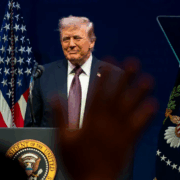
Trump Blocks Chip Deal, Citing National Security and China Concerns

Donald Trump on Friday blocked a $3 million deal in which U.S. photonics firm HieFo Corp sought to acquire assets from New Jersey-based aerospace and defense supplier Emcore, citing national security and China-related risks.

In an order released by the White House, Trump said HieFo was “controlled by a citizen of the People’s Republic of China,” raising concerns that the transaction could threaten U.S. national security. He ordered HieFo to divest all interests in the Emcore assets within 180 days.

The decision followed a review by the Committee on Foreign Investment in the United States, which identified national security risks linked to the deal, according to the U.S. Treasury Department. Officials did not specify the nature of those risks.

Emcore has said HieFo acquired its chip business and indium-phosphide wafer fabrication operations for about $2.92 million. The company was publicly traded at the time of the transaction and has since gone private.

HieFo previously said it was co-founded by Genzao Zhang, a former Emcore vice president of engineering, and Harry Moore, a former senior sales director at Emcore. Neither company immediately responded to requests for comment following Trump’s order.

U.S. lawmaker warns TikTok algorithm licensing deal poses national security risks

A senior U.S. lawmaker raised fresh concerns Thursday over a proposed licensing deal for TikTok’s algorithm as part of the planned sale of the app’s U.S. operations by its Chinese parent company ByteDance, warning that any continued Chinese influence over the technology could threaten national security.

Representative John Moolenaar, chair of the House Select Committee on China, said he is awaiting a formal briefing on the deal, which would reportedly allow the new U.S. owners of TikTok to license the platform’s algorithm from ByteDance.

“I think anytime you have China with leverage over the algorithm, that’s a problem,” Moolenaar said during remarks at the Hudson Institute, adding that the arrangement could leave room for undue influence.

The White House previously said the agreement meets the national security requirements set out in a 2024 law mandating ByteDance to divest TikTok’s U.S. assets or face a ban. President Donald Trump signed an executive order on September 25 approving the sale and granting 120 days to complete the transaction.

Under the proposal, ByteDance would retain less than 20% ownership in the new U.S. entity, with Americans holding the remaining board seats. The algorithm, which drives TikTok’s recommendation system, would be retrained and monitored by U.S. security partners.

Moolenaar, however, expressed skepticism that the algorithm could be fully reprogrammed or separated from its Chinese origins, noting, “It’s still very much a work in progress.”

TikTok did not immediately respond to requests for comment.