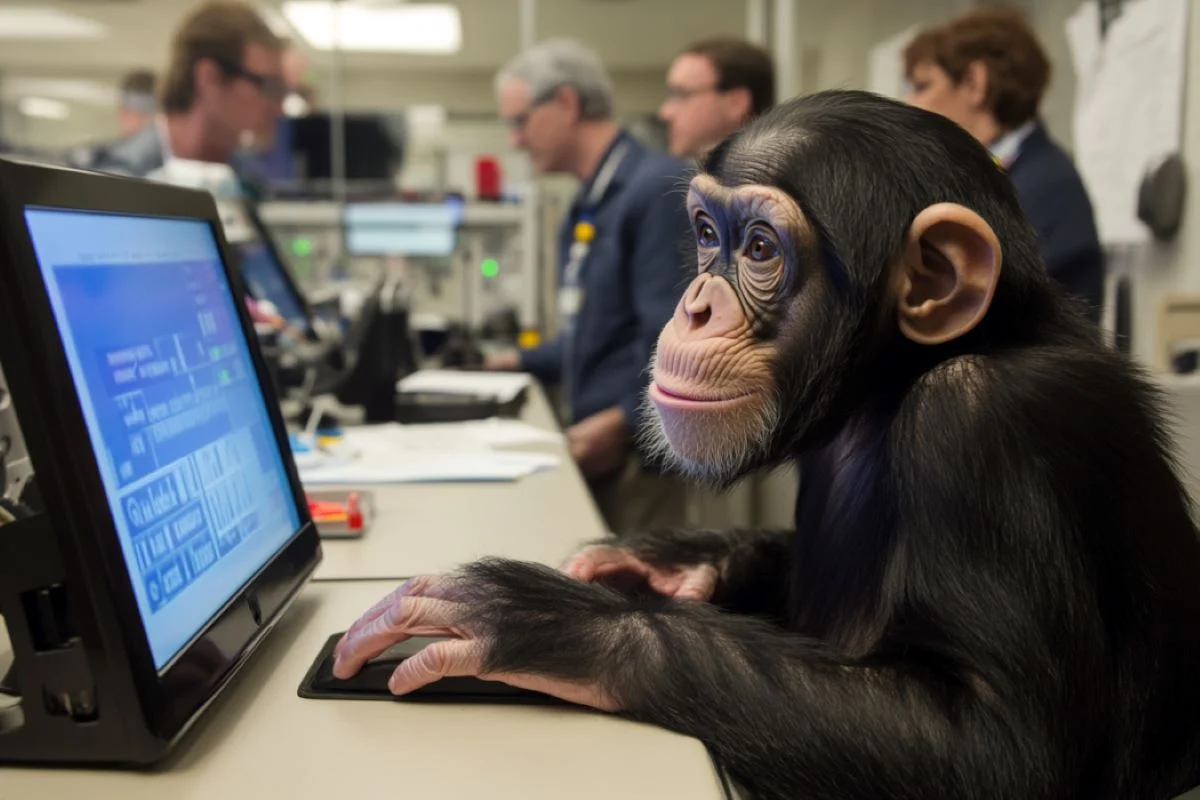
Chimpanzees have demonstrated improved performance on challenging tasks when they are observed by humans, according to a study published in iScience on November 8. Conducted at Kyoto University, the research focused on chimpanzees performing number-based tasks on touchscreens. The study found that their task performance improved with increased task difficulty when a greater number of human observers were present. However, for simpler tasks, chimpanzees performed worse when observed by larger audiences, suggesting that the presence of humans has a complex impact on their behavior and task outcomes.
The study, led by Shinya Yamamoto and Akiho Muramatsu, sought to explore whether chimpanzees experience what is known as an “audience effect,” a phenomenon often associated with humans who modify their behavior based on the presence of others. In this case, the researchers were interested in understanding if chimpanzees, who are regularly exposed to human interaction, would exhibit a similar response. The study’s participants were chimpanzees familiar with touchscreen tasks and accustomed to receiving food rewards for correct answers. The comfortable relationship between the animals and humans allowed the researchers to assess how the presence of an audience might affect the chimpanzees’ performance.
Over six years and thousands of experimental sessions, the researchers measured the chimpanzees’ ability to complete tasks of varying difficulty levels. The results were striking: chimpanzees performed better on more complex tasks when watched by a larger human audience. However, their accuracy declined when performing simpler tasks in the presence of more observers. This nuanced response challenges previous assumptions about animal cognition, suggesting that chimpanzees are capable of some level of social awareness, similar to the audience effects seen in humans.
This finding sheds light on the cognitive abilities of chimpanzees and raises interesting questions about the role of social dynamics in animal behavior. The researchers’ conclusion that chimpanzees may adjust their performance based on the presence of others opens up new avenues for studying animal intelligence and social interaction. The study suggests that, like humans, chimpanzees may be influenced by the social context in which they perform tasks, revealing a more complex and socially-aware animal behavior than previously understood.