Yazılar

Revolutionary Biosensor in Seatbelts Monitors Driver Stress and Health Conditions

A new breakthrough in biosensor technology could revolutionize how we monitor driver and pilot health, particularly focusing on stress and alertness levels. Developed by researchers at the National University of Singapore and Tsinghua University, this innovative device is seamlessly integrated into seatbelts and tracks vital signs such as heartbeat and respiration without direct skin contact. Detailed in the journal Nature Electronics, this biosensor promises to improve safety in vehicles and aircraft by enabling real-time monitoring of cardiopulmonary data, even in dynamic and challenging environments.

The key to the success of this non-contact biosensor lies in its use of advanced metamaterials. These engineered materials are designed to optimize the transmission of signals, allowing the device to gather physiological data efficiently. Conductive threads are embroidered into the seatbelt in a comb-shaped pattern, which allows radio waves to interact with the user’s body. According to Xi Tian, co-author of the study, this design minimizes interference from vibrations caused by vehicle movements, ensuring that the sensor remains sensitive to subtle physiological signals. The integration of a processing system further ensures that the data collected is consistent and reliable, even when the user is in motion.

In real-world testing, the biosensor demonstrated its reliability across multiple environments. In trials conducted in both a car and an airline cabin simulator, the device proved capable of adapting to the user’s body shape while consistently detecting physiological signals. During a 1.5-hour vehicle journey in Singapore, the biosensor was able to monitor heart rate variations, while in an aircraft setting, it successfully detected sleep-wake cycles, providing valuable insights into a user’s health and stress levels. These promising results highlight the potential of this technology for health monitoring, regardless of the environment.

The introduction of this biosensor could greatly enhance safety by allowing for continuous health tracking in vehicles and aircraft, providing crucial data to alert drivers or pilots to fatigue or stress before they become a hazard. As the technology evolves, it could lead to broader applications in transportation, improving overall safety standards and offering more personalized and proactive health monitoring for those operating high-stakes machinery.
Up Close with the 300-Tonne Driverless Trucks: The Future of Mining Automation in Remote Australia

At Rio Tinto’s Greater Nammuldi iron ore mine, located in inland Western Australia, automation is at the forefront of operations. The mine, situated in the Pilbara region, is so remote that workers are flown in for shifts, spending four to eight days on-site before returning home. With over 400 workers present at any given time, their task is to manage an expansive operation where massive, driverless trucks navigate the red-earth roads.

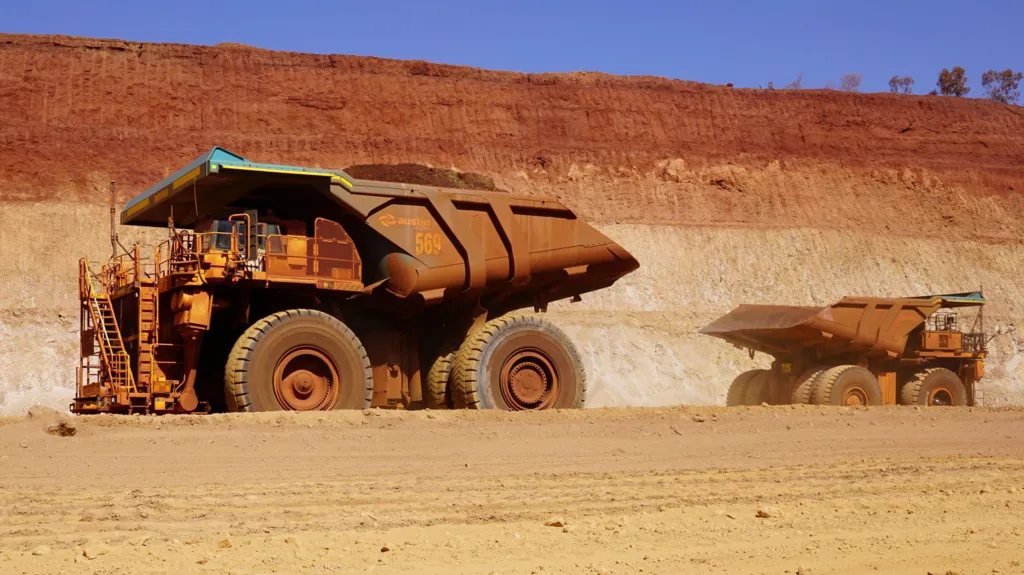
These autonomous trucks, some of the largest on earth, weigh up to 300 tonnes and crisscross the open-pit mine without human drivers. For someone unfamiliar with such technology, the sheer size of these trucks is daunting, especially when they operate without a driver at the wheel. During a site tour, the sight of one of these self-driving giants approaching from a side road is enough to raise the question: can they really be trusted?

Greater Nammuldi boasts a fleet of over 50 autonomous trucks, with several other vehicles, such as the self-driving water cart “Henry,” also operating to maintain the mine’s roads. While a few trucks still rely on manual drivers, most of the operations are automated. The autonomous trucks follow predefined routes and are monitored remotely from Rio Tinto’s Operations Centre (OC) in Perth, over 1,500 kilometers south. Here, controllers ensure the smooth functioning of the fleet, as well as other automated systems like drills and a long-distance rail network transporting mined ore.

The safety benefits of these self-driving trucks are clear. Mining is a dangerous industry, and by removing human drivers from the trucks, Rio Tinto aims to reduce accidents caused by fatigue or unpredictable behavior. According to the company’s Pilbara managing director, Matthew Holcz, automation has significantly improved safety and increased productivity by about 15%. The trucks operate continuously, without the downtime associated with shift changes, and can travel faster when fewer human-operated vehicles are in the mix.

Despite the cost – which Rio Tinto estimates at billions of dollars – automation has not led to mass job losses. Instead, former truck drivers are being retrained as controllers or reassigned to operate manual vehicles at different sites. At the OC, I meet Jess Cowie, a former manual driller who now remotely operates autonomous drills. She reflects on the benefits of automation, such as fewer environmental hazards and more time spent at home with her family.

However, the shift to automation isn’t without its challenges. Professor Robin Burgess-Limerick, an expert on human factors in mining, acknowledges the progress made but points out that improvements are still needed. For instance, the interfaces that staff use to monitor autonomous vehicles can be confusing, and there have been instances where human operators lost situational awareness. Additionally, some autonomous vehicles have had trouble detecting moisture on wet roads, which can lead to traction issues.

Labor representatives, such as Shane Roulstone from the Western Mine Workers Alliance, also raise concerns. He cites a recent incident where an autonomous train collided with a stationary vehicle on the tracks, though he recognizes that Rio Tinto has developed robust safety strategies for automated operations. Still, Roulstone believes that as automation increases, the potential for job losses will grow.

Despite these issues, Rio Tinto’s investment in automation continues, with further expansion of its autonomous truck fleet and the introduction of new technologies like self-driving excavators and dozers. While automation continues to change the landscape of mining, it’s clear that humans and robots will have to coexist, each adapting to a future where technology plays a central role.