Ukraine Destroys Second Russian Bridge in Kursk Offensive; Zelensky Reveals Buffer Zone Strategy

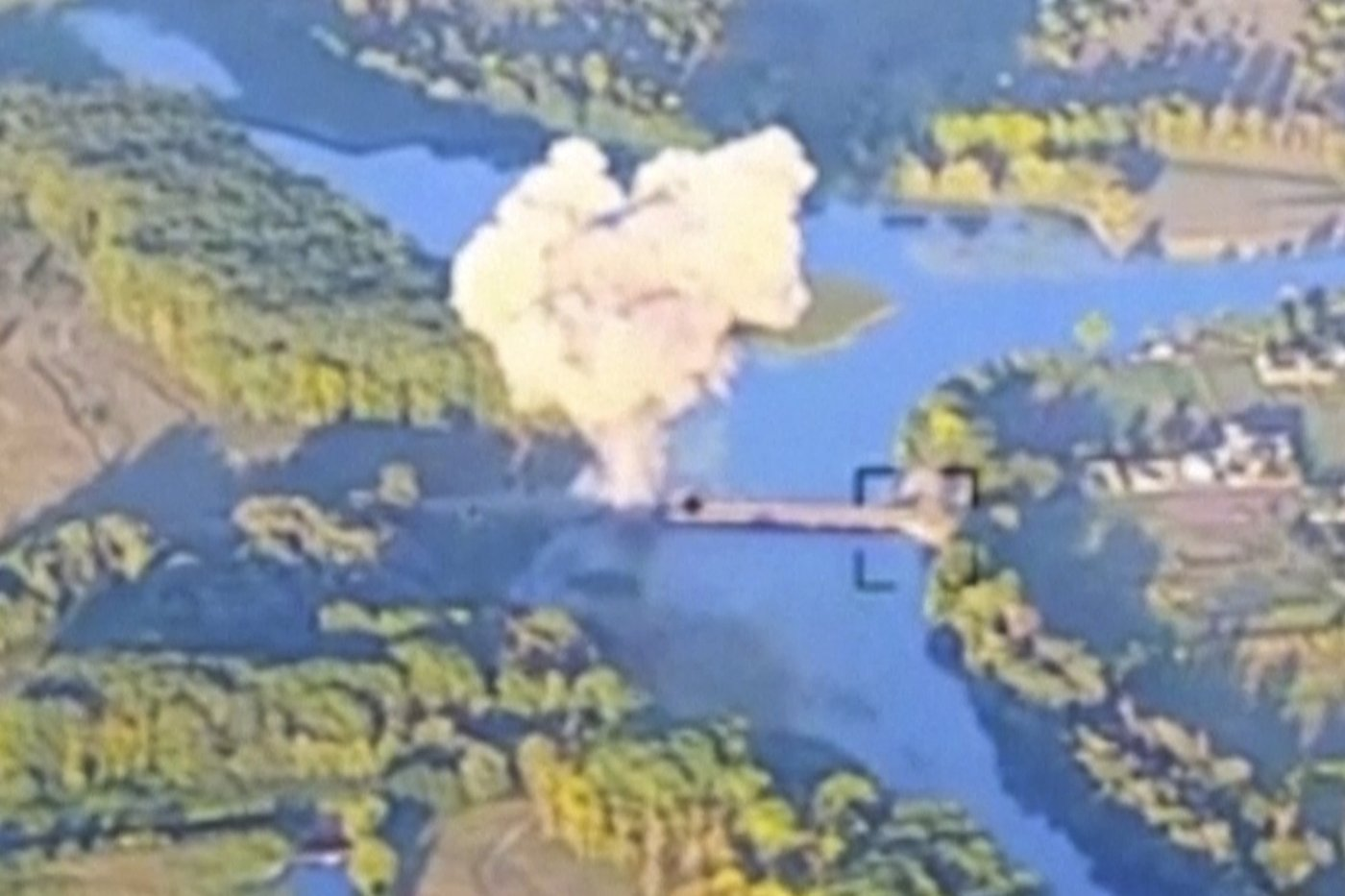
Ukraine has announced the destruction of a second strategic bridge in the Kursk region within a week, continuing its offensive into Russian territory. On Sunday, Ukrainian forces released aerial footage of the attack on a bridge over the Seym River in Zvannoe. Ukrainian Air Force commander Lt Gen Mykola Oleschuk shared the video, highlighting the significant impact of precision airstrikes on Russian logistics.

This development follows the earlier destruction of another Seym River bridge near Glushkovo, which was a key supply route for Russian troops. Ukrainian President Volodymyr Zelensky confirmed that the aims of the incursion include establishing a “buffer zone” to prevent further Russian attacks.

Zelensky emphasized that the ongoing operation in Kursk is intended to “destroy as much Russian war potential as possible” and to conduct maximum counteroffensive actions. He noted that Ukrainian troops are strengthening their positions and expanding further into Russian territory, marking nearly two weeks of sustained military presence in Kursk.

In response, Moscow has labeled the incursion a significant provocation and vowed retaliation. Meanwhile, in eastern Ukraine, Russian forces continue to make gains, claiming control over several villages.

The situation at the Zaporizhzhia nuclear power plant, located in Russian-occupied Ukraine, is also under scrutiny. Rafael Grossi, head of the International Atomic Energy Agency (IAEA), expressed deep concern over the plant’s safety following a recent drone strike near its perimeter. The IAEA called for “maximum restraint” to protect the facility, which has been under attack and is currently not operational.

This ongoing conflict marks the first time foreign troops have entered Russian soil since World War II, leading to a significant escalation in the war’s intensity.

Deadly Explosion Rocks Tel Aviv as Police Investigate Possible Link to Regional Tensions

Israeli police are investigating a deadly explosion that occurred in Tel Aviv on Sunday evening, resulting in one fatality and another person injured. The deceased, whose identity has not been disclosed, is believed to have been carrying the explosive material, according to District Commander Peretz Amar. The injured individual was hospitalized with shrapnel wounds to the lower body.

The explosion happened on HaLehi Street and prompted numerous emergency calls from residents. The incident has occurred against a backdrop of heightened security and regional tensions related to the ongoing conflict in Gaza. At this stage, authorities have not confirmed whether the explosion was a terrorist attack, with Amar stating that it is “too early to say” if there is a direct link to the complex security situation. The city remains on high alert as investigations continue.

Former Soviet Aircraft Carrier Catches Fire During Renovation in China

A former Soviet aircraft carrier, the Minsk, caught fire over the weekend while undergoing renovations in a lagoon near Shanghai, China. The blaze, which broke out on Friday afternoon, raged for about 24 hours before being extinguished, leaving extensive damage to the ship. The Minsk, once a formidable part of the Soviet Pacific Fleet, had been converted into a Chinese tourist attraction and was anchored in Nantong, Jiangsu province, for the past eight years.

The carrier was in the process of being refurbished to become the centerpiece of a military theme park when the fire erupted. Images circulating on social media depicted thick smoke and flames engulfing the deck, with later photos revealing significant damage to the ship’s superstructure and charred metal along its side. Fortunately, there were no casualties reported, and authorities are currently investigating the cause of the fire.

The Minsk, built between 1970 and 1987 as one of four Kiev-class aircraft carriers by the Soviet Union, was a key asset of the Soviet Pacific Fleet until the Soviet Union’s dissolution in 1991. After being decommissioned in 1993, the ship was sold to a South Korean company for scrap. However, environmental concerns in South Korea led to the Minsk being sold to a Chinese company, eventually finding a new life as a tourist attraction at the Minsk World theme park in Shenzhen, which operated from 2000 until its closure in 2016 due to financial difficulties.

The recent fire has cast doubt on the future of the Minsk as a tourist attraction, with officials expressing uncertainty about the project’s prospects following the extensive damage. The ship’s history as part of the once-mighty Soviet fleet, coupled with its journey from a warship to a theme park centerpiece, highlights the complex legacy of decommissioned military vessels.

Of the four Kiev-class carriers constructed by the Soviets, only the last one, the Baku, remains in service today. After being sold to India in 2004, it was refurbished and commissioned into the Indian Navy as the INS Vikramaditya in 2013, where it now serves as the navy’s flagship. The fate of the Minsk and its future as a tourist attraction remains uncertain in the wake of this recent disaster.