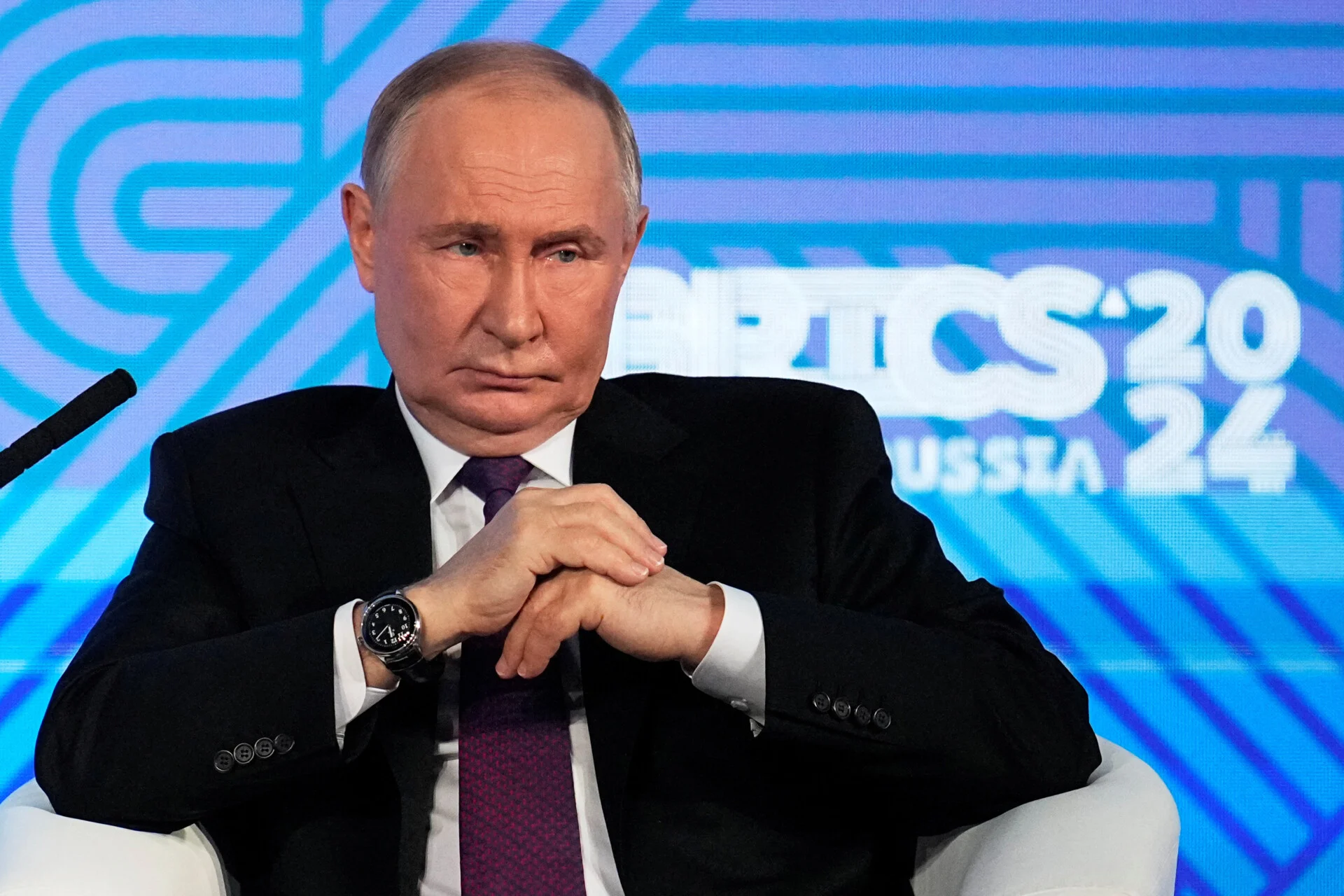
Putin Claims BRICS Will Lead Future Global Economic Growth, Not the West

Russian President Vladimir Putin stated on Friday that the BRICS group, consisting of Brazil, Russia, India, China, and South Africa, along with its new members—Egypt, Ethiopia, Iran, and the United Arab Emirates—will be the primary drivers of global economic growth in the coming years. Putin emphasized that the size and faster economic growth of BRICS nations, compared to Western countries, position them as the future leaders of global economic expansion.

Putin’s remarks were delivered ahead of a major BRICS summit set to take place in Kazan, Russia, from October 22 to 24. He described BRICS as an essential counterbalance to Western dominance in global politics and trade, suggesting that the group will increasingly gain economic sovereignty by depending less on external influences.

“The countries in our association are essentially the drivers of global economic growth. In the foreseeable future, BRICS will generate the main increase in global GDP,” Putin said during a BRICS business forum in Moscow.

Next week’s summit, according to Putin, will showcase how Western efforts to isolate Russia over the conflict in Ukraine have largely failed. Instead, Russia seeks collaboration with other nations to reform the global financial system and reduce the dominance of the U.S. dollar.

Leaders from China, India, and the UAE have already confirmed their attendance at the summit, which is expected to discuss further BRICS expansion. Putin stated that around 30 countries have expressed interest in joining or cooperating with BRICS.

“The doors are open, we are not barring anyone,” Putin commented regarding BRICS’ enlargement.

Russia has laid out several financial initiatives for the summit, including the development of a SWIFT-like financial messaging system to bypass Western sanctions and the promotion of national digital currencies for investment projects. While the idea of a unified BRICS currency has been discussed, Putin noted that such a concept remains “premature.”

Putin also called for greater investment in technology, infrastructure, e-commerce, and artificial intelligence through the New Development Bank, BRICS’ primary development institution. He emphasized that the bank could serve as an alternative to Western financial mechanisms, especially for nations in the Global South.

Additionally, Putin highlighted Russia’s new transport megaprojects, such as the Arctic Sea Route and the North-to-South corridor, which aim to boost trade between Eurasia and Africa by connecting Russia to the Gulf and the Indian Ocean via the Caspian Sea and Iran.


 

Boeing Machinists Set to Vote on New Proposal with 35% Raises to Potentially End Strike

Boeing and its machinists’ union have reached a new contract proposal that could bring an end to the month-long strike that has impacted the company’s aircraft production. The union, the International Association of Machinists and Aerospace Workers District 751, announced on Saturday that the vote on the new deal is scheduled for Wednesday.

The proposed agreement includes a significant 35% wage increase over the next four years, a $7,000 signing bonus, guaranteed annual bonus payouts, and improved 401(k) contributions. These terms represent a more favorable offer compared to Boeing’s previous proposal.

This breakthrough came after Acting U.S. Secretary of Labor Julie Su facilitated discussions between both parties earlier in the week. The union stated, “With the help of Acting U.S. Secretary of Labor Julie Su, we have received a negotiated proposal and resolution to end the strike, and it warrants presenting to the members and is worthy of your consideration.”

The White House also commented on the negotiations, with a spokesperson stating, “President Biden believes the collective bargaining process is the best way to achieve good outcomes for workers, and the ultimate decision on a contract will be for the union workers to decide.”

The strike, which began on September 13, followed the overwhelming rejection of an earlier contract offer that included a 25% wage increase over four years. Boeing later offered an improved deal, but it was criticized by the union for not being properly negotiated.

In a statement, Boeing expressed optimism, saying, “We look forward to our employees voting on the negotiated proposal.”

The strike has added to Boeing’s challenges, as the company is struggling to control costs amidst safety concerns, including a near-catastrophic incident involving the door plug on one of its 737 Max jets earlier this year. Boeing has also faced difficulties with its other programs, leading to a projected loss and charges of around $5 billion in its commercial and defense units.

This new proposal, if ratified, would mark a win for Boeing’s new CEO, Kelly Ortberg, who took over in August and has been tasked with turning around the company. Ortberg has already announced significant changes, including a 10% workforce reduction and plans to cease production of the 767 aircraft by 2027 once current orders are fulfilled.


Why Inflation May Seem to Be Easing but Remains a Significant Problem

Although the Federal Reserve appears to be closing in on its inflation target, the ongoing high cost of goods and services continues to strain the U.S. economy. While recent data shows inflation slowing, the effects of price increases are still evident, causing challenges for individuals, businesses, and policymakers.

Some economists, such as those at Goldman Sachs, predict that upcoming reports may indicate the inflation rate approaching the Fed’s 2% target. However, inflation is a complex issue, not easily encapsulated by a single metric. By some measures, inflation remains uncomfortably high for many Americans and even some Fed officials. San Francisco Fed President Mary Daly recently acknowledged the progress in lowering inflation but warned against complacency, emphasizing that vigilance is still necessary.

Inflation is far from over. Daly’s anecdote about a local resident asking her if the Fed had “declared victory” highlights the public’s concern. The central bank’s recent decision to cut interest rates was aimed at adjusting policy in response to inflation, which has come down from its 2022 peak. Yet, many Americans remain skeptical, as high prices linger in various sectors.

There are two ways to assess inflation: the 12-month inflation rate, which receives most of the attention, and the cumulative impact that inflation has had over the past three years. The Consumer Price Index (CPI), one of the most widely followed indicators, has shown a dramatic improvement, with inflation at 2.4% in September, down from a peak of 9.1% in June 2022. However, other indicators show a less promising picture. For example, the Fed’s preferred measure, the Personal Consumption Expenditures (PCE) price index, is still slightly above the 2% target, according to projections.

Inflation first surpassed the Fed’s 2% goal in March 2021 and was initially considered a “transitory” phenomenon linked to pandemic-related disruptions. Yet, over the past two years, prices have skyrocketed across many sectors. Since the start of the inflation surge, the all-items CPI has risen 18.8%, food prices have jumped 22%, and the cost of everyday necessities like eggs and gasoline have climbed sharply. Housing prices, too, have surged, with the median home price increasing 16% since early 2021.

Furthermore, “sticky” prices—those less likely to change frequently, such as rents, insurance, and medical costs—are still rising at a 4% rate, even as more flexible items like food and gas show signs of easing. This divergence between different inflation measures highlights the complexity of the issue.

Core inflation, which excludes food and energy, continues to be a concern as well. In September, core CPI inflation stood at 3.3%, while the core PCE index was 2.7% in August. These figures suggest that despite some improvement, underlying inflation pressures remain.

Consumer spending has remained strong despite high prices. In the second quarter of 2024, consumer spending reached nearly $20 trillion on an annualized basis, though the pace of spending is beginning to slow. Borrowing has also increased significantly as households have taken on more debt to cope with rising costs. Household debt rose 19% since early 2021, with delinquencies on the rise, though still below historical averages.

Small businesses are also feeling the strain. Many have turned to credit cards to manage cash flow, with small business credit card balances increasing by more than 20% compared to pre-pandemic levels. Inflation remains the top concern for many business owners, as seen in surveys conducted by organizations like the National Federation of Independent Business.

As the Fed prepares for its next policy meeting in November, it faces a difficult choice. While interest rates have been reduced, financial markets are reacting unpredictably, with bond yields rising and mortgage rates climbing despite the Fed’s easing efforts. Some economists argue that the Fed should hold off on further rate cuts until it can better assess the current inflationary environment.

In the end, the public remains uncertain about whether the Fed has truly tamed inflation. As Daly noted, while progress is being made, the journey toward stabilizing prices and achieving lasting economic relief is far from over.