Study Finds Chimpanzees Perform Better on Tasks When Observed by Humans

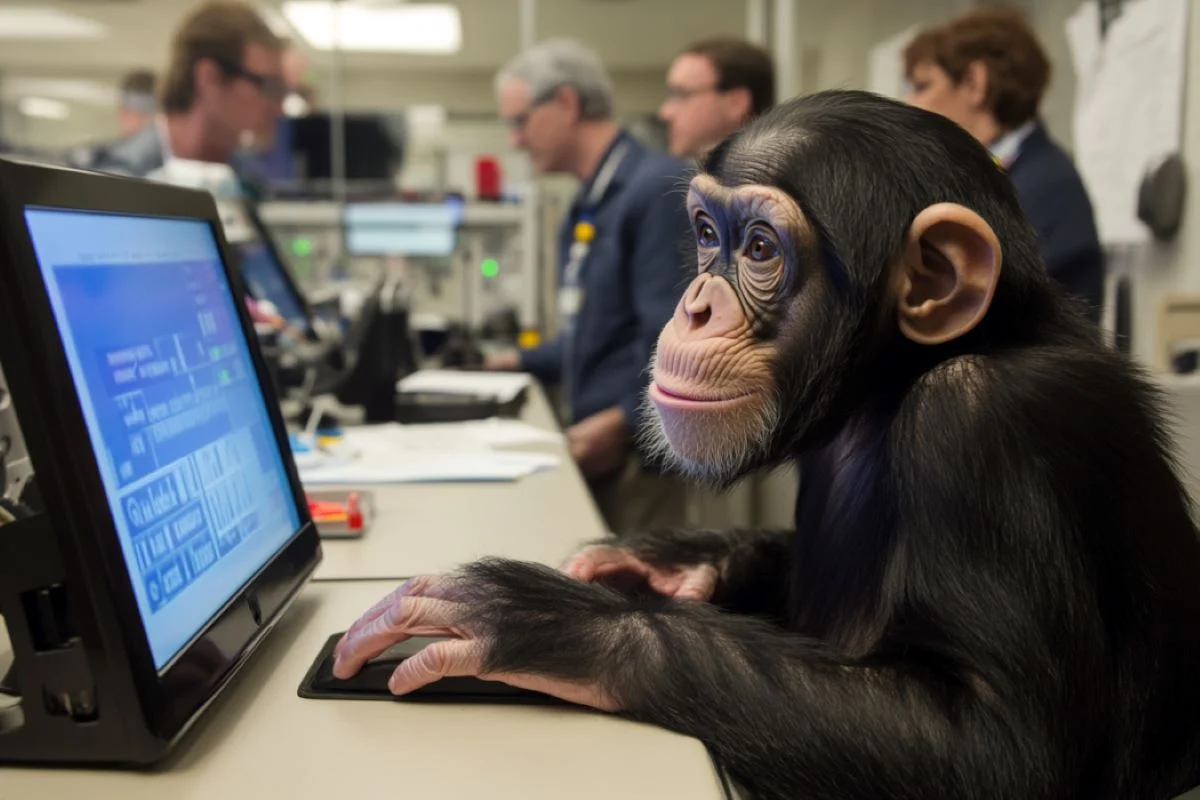
Chimpanzees have demonstrated improved performance on challenging tasks when they are observed by humans, according to a study published in iScience on November 8. Conducted at Kyoto University, the research focused on chimpanzees performing number-based tasks on touchscreens. The study found that their task performance improved with increased task difficulty when a greater number of human observers were present. However, for simpler tasks, chimpanzees performed worse when observed by larger audiences, suggesting that the presence of humans has a complex impact on their behavior and task outcomes.

The study, led by Shinya Yamamoto and Akiho Muramatsu, sought to explore whether chimpanzees experience what is known as an “audience effect,” a phenomenon often associated with humans who modify their behavior based on the presence of others. In this case, the researchers were interested in understanding if chimpanzees, who are regularly exposed to human interaction, would exhibit a similar response. The study’s participants were chimpanzees familiar with touchscreen tasks and accustomed to receiving food rewards for correct answers. The comfortable relationship between the animals and humans allowed the researchers to assess how the presence of an audience might affect the chimpanzees’ performance.

Over six years and thousands of experimental sessions, the researchers measured the chimpanzees’ ability to complete tasks of varying difficulty levels. The results were striking: chimpanzees performed better on more complex tasks when watched by a larger human audience. However, their accuracy declined when performing simpler tasks in the presence of more observers. This nuanced response challenges previous assumptions about animal cognition, suggesting that chimpanzees are capable of some level of social awareness, similar to the audience effects seen in humans.

This finding sheds light on the cognitive abilities of chimpanzees and raises interesting questions about the role of social dynamics in animal behavior. The researchers’ conclusion that chimpanzees may adjust their performance based on the presence of others opens up new avenues for studying animal intelligence and social interaction. The study suggests that, like humans, chimpanzees may be influenced by the social context in which they perform tasks, revealing a more complex and socially-aware animal behavior than previously understood.


Exploring the Digital Assets Platform Under Discussion by the BRICS Group

In October, Russian President Vladimir Putin confirmed that the BRICS nations (Brazil, Russia, India, China, and South Africa) are in the process of discussing a new digital currency platform to help reduce their dependence on Western financial systems. The move is aimed at lessening the influence of the US dollar in global trade and fostering greater financial independence among developing economies. Putin has voiced strong support for the initiative, suggesting that digital currencies could benefit not only BRICS members but also other emerging economies looking to diversify their financial tools.

The proposed platform, which may be called BRICS Pay, will be designed to enable member countries to conduct cross-border transactions more efficiently. According to reports, countries like Iran, Egypt, Ethiopia, and the UAE are also involved in the initiative, expanding the scope of the platform. The goal is to create a system that minimizes the reliance on traditional Western payment networks and promotes the use of digital assets, such as cryptocurrencies and Central Bank Digital Currencies (CBDCs), for international transactions.

The BRICS Pay platform would operate on a blockchain network, allowing for direct peer-to-peer transactions between member nations. One of the primary advantages of this system is that it would eliminate the need for brokers or intermediaries, streamlining the settlement process and reducing the costs associated with cross-border payments. In traditional international transactions, payment facilitators often charge high service fees, but using digital assets can bypass these intermediaries, resulting in lower costs for businesses and consumers alike.

This move aligns with the broader global trend of central banks and financial institutions exploring digital currencies as an alternative to traditional financial systems. While it remains to be seen how quickly BRICS Pay will be implemented, the development signals a significant shift in the financial landscape, with the potential to challenge the dominance of the US dollar and shift power towards a new, decentralized model of global trade and finance.

OnePlus Ace 5 Series Expected to Feature Metal Frame, Ceramic Body, and Up to 24GB RAM

OnePlus is reportedly gearing up for the launch of its OnePlus Ace 5 and OnePlus Ace 5 Pro in China, although no official announcement has been made yet. As rumors continue to swirl, new leaks suggest significant upgrades for the upcoming devices. The OnePlus Ace 5 is expected to feature the latest Snapdragon 8 Gen 3 chipset, offering a notable performance boost over the Snapdragon 8 Gen 2 seen in the OnePlus Ace 3. Additionally, the Ace 5 series is anticipated to sport a premium design with a metal middle frame, setting it apart from previous models in the lineup.

According to tipster Smart Pikachu, the design of the OnePlus Ace 5 series will retain the camera module style of its predecessors, ensuring continuity while incorporating some new enhancements. The most striking feature is the combination of a metal middle frame and a ceramic body, which is likely to provide both durability and a premium aesthetic. This sophisticated design choice is expected to appeal to users looking for a high-end feel in their smartphone.

In terms of performance, the OnePlus Ace 5 series is said to be packed with impressive specifications. The devices will reportedly offer up to 24GB of RAM, which is a significant leap over what we have seen in previous OnePlus models. This vast amount of RAM, combined with the Snapdragon 8 Gen 3 chipset, will likely deliver a smooth and responsive user experience, even with heavy multitasking or demanding applications. For the Ace 5 Pro, there is speculation that it could debut with an even more powerful Snapdragon 8 Elite chipset, promising an even greater boost in speed and efficiency.

These new leaks suggest that OnePlus is focusing on delivering a device that not only improves on performance but also enhances the overall user experience with premium materials and top-tier specifications. As the launch date approaches, more details about the OnePlus Ace 5 series are likely to surface, giving consumers a clearer picture of what to expect from these highly anticipated smartphones.